The Ministry of Science and ICT and the Space Agency announced on the 28th that they will publicly recruit project entities to develop a low Earth orbit satellite communication system based on the 6G international standard.
The low Earth orbit satellite communication development project involves developing one low Earth orbit satellite communication system consisting of two low Earth orbit communication satellites and ground stations and terminal stations. Communication payloads performing communication functions between satellite and ground, and between satellites, as well as satellite integrated systems, will be created.
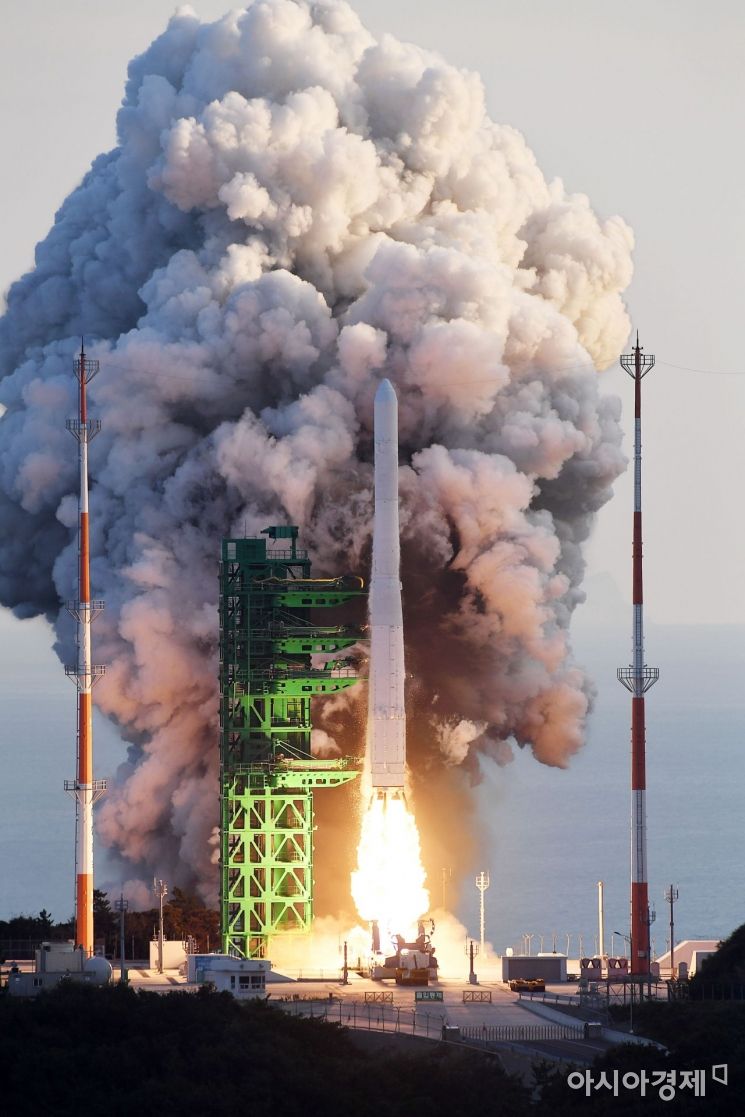 The Korean launch vehicle Nuriho (KSLV-II) is soaring powerfully, emitting flames from the second launch pad at Naro Space Center in Goheung County. Goheung=Photo by Joint Press Corps
Low Earth orbit satellite communication is gaining attention as an effective alternative in disaster situations where ground communication networks are paralyzed due to earthquakes, fires, wars, etc., and its importance is increasing in terms of national safety and security.
However, the satellite communication industry has high technical difficulty, enormous investment costs, and high risk of failure, making it burdensome for domestic companies to invest independently. Therefore, strategic government support is essential to secure competitiveness in the global market.
The Ministry of Science and ICT and the Space Agency plan to support a total of 320 billion KRW (300.4 billion KRW in national funds, 19.6 billion KRW in private funds) over six years from this year for three projects. Eligibility to apply requires having produced and delivered at least one satellite system of practical-grade satellites or higher, main bodies, or components, or being a research institute or company currently developing under contract.
The Ministry of Science and ICT and the Space Agency will form a selection evaluation committee composed of external experts and comprehensively evaluate the low Earth orbit satellite communication execution plans, past development achievements and current development capabilities, localization, commercialization, and technology transfer plans to select the final three lead research and development institutions.
© The Asia Business Daily(www.asiae.co.kr). All rights reserved.

















