Car-Free Street at Mudeung Night Market
Visitor Numbers Up 65%, Sales Rise 27%
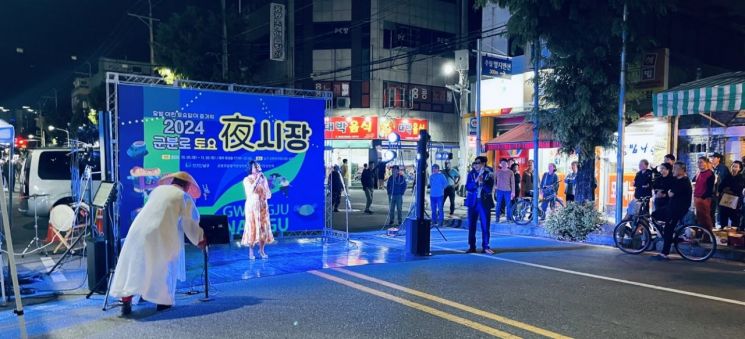
The operation of a "car-free street" in the Gunbun-ro (Mudeung Market) area of Nam-gu, Gwangju from October to November last year resulted in a significant increase in both visitor inflow and sales. Consequently, Gwangju City and its five districts have decided to further promote the "car-free street" initiative to build community consensus toward making Gwangju a "Daeja-bo City."
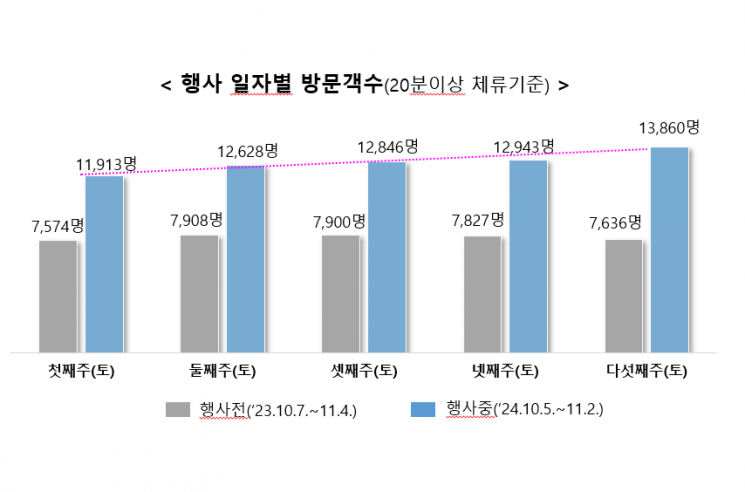
According to Gwangju City on the 27th, a total of approximately 64,190 people (based on a minimum stay of 20 minutes) visited the car-free street and night market held every Saturday from October 5 to November 2 last year in the Gunbun-ro Mudeung Market area. This marks a 65% increase compared to 38,845 visitors during the same period the previous year.
The city analyzed that various events such as performances, hands-on activities, and the Walk-On walking challenge held on the car-free street were key factors in attracting visitors. In particular, the number of visitors continued to rise as the car-free street events were repeated. The Gunbun-ro night market, which previously saw an average of 7,700 visitors per day, surpassed 10,000 visitors with the implementation of the car-free street.
There was also an increase in visitors from neighboring Jeonnam regions and other outlying areas. The largest numbers came from Naju (509 people) and Hwasun (500 people), which are adjacent to Gwangju, followed by Yeosu (222 people) and Mokpo (151 people). By age group, the 50s (22.4%), 60s (21.9%), 40s (16.9%), 30s (13.2%), and 20s (10.5%) all visited the night market in a relatively balanced distribution.
During the operation of the car-free street in October and November last year, total consumer sales in the Gunbun-ro area reached 1,011 million KRW, an increase of 217 million KRW (27.4%) compared to the same period the previous year (794 million KRW). Of this, the food and beverage sector accounted for 531 million KRW, or 52.5% of total sales, a rise of 224 million KRW from the previous year.
The city expects that restricting vehicle traffic on major downtown streets and providing a safe, pedestrian-centered environment through the "car-free street" initiative will revitalize local businesses and serve as an attractive feature for tourists.
To realize the "Daeja-bo City" vision, which focuses on people-centered urban space innovation, the city and its five districts plan to operate car-free streets at Geumnam-ro, Pungam-dong Communication Theme Road, Baegun Square Saturday Night Market, Chonnam National University Back Gate University Road, and Songjeong Station Market. The strategy is to utilize car-free streets as spaces for relaxation and play within the city and to offer experiences that promote carbon neutrality.
Park Hyemi, Director of Data and Informatization, said, "We will continue to analyze the effects of operating car-free streets to expand pedestrian-centered spaces in Gwangju, vitalize local businesses, and lay the foundation for increasing the city's user population."
© The Asia Business Daily(www.asiae.co.kr). All rights reserved.


















