Analysis by Jeong Heecheol of Korea Capital Market Institute
Young Generation's Participation in Capital Market Fails to Offset Downward Trend
A forecast has emerged that from 2034, a decade from now, the scale of household capital market assets such as stocks and funds will sharply decline. Along with the low participation rate of the elderly aged 65 and over in the capital market, the participation rate of the younger generation is also unable to offset the downward trend.
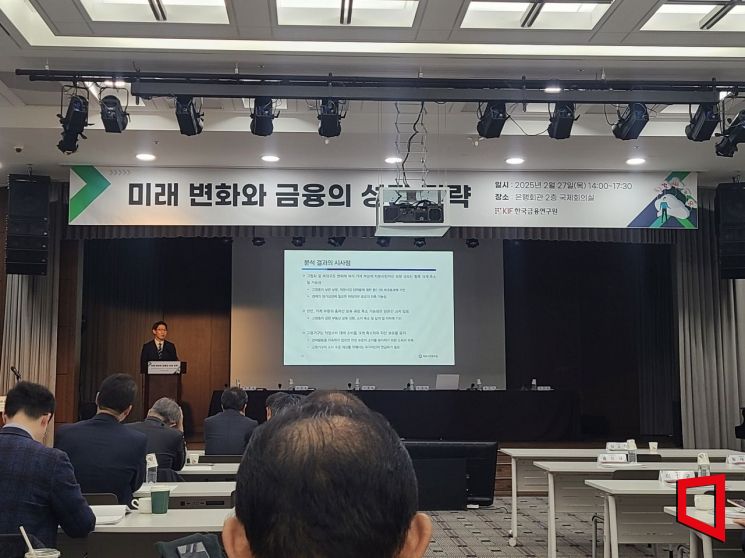 Jeong Hee-cheol, Research Fellow at the Macro-Finance Department of the Korea Capital Market Institute, is giving a keynote presentation at the seminar "Future Changes and Growth Strategies in Finance" on the 27th.
Jeong Hee-cheol, a research fellow at the Macro-Finance Office of the Korea Capital Market Institute, announced this during a keynote presentation at the 'Future Changes and Growth Strategies in Finance' seminar held on the afternoon of the 27th at the Bankers' Hall in Jung-gu, Seoul.
Researcher Jeong said, "Demographic changes are expected to have a significant impact on capital market changes," adding, "Analyzing changes in age and generational structure and the future scale of household assets, it was found that the scale of capital market holdings will sharply decline starting in 2034." He particularly predicted that by 2049, it would fall to the level of 2009. This contrasts with the projection that total assets, including financial assets, will continue to increase until 2049 despite the decrease in the number of households and aging.
Researcher Jeong explained, "This result is due not only to the low participation rate of the elderly in the capital market but also to the fact that the participation rate of the generation born after 1990 has decreased compared to previous generations," adding, "This indirectly suggests that the younger generation may also follow the elderly's asset holding pattern centered on real estate and savings/deposits." He further noted, "When divided into stocks and funds, it was analyzed that the more recent the generation, the higher the stock market participation rate, but fund market participation has significantly decreased."
He also presented an analysis that the elderly need to continue economic activities to maintain appropriate consumption. Researcher Jeong said, "It was found that more than 76% of households in all age groups cannot replace appropriate consumption with pensions, owned assets, or transfer income," adding, "This means continuous economic activity is essential to maintain an appropriate level of consumption."
He stated, "If economic activity is not continued and appropriate consumption is to be maintained, the monetization of real assets such as converting them into pensions is essential," adding, "When both financial assets and real assets including housing are monetized into pensions, this ratio is reduced to 30%."
Researcher Jeong emphasized, "The reduction in the scale of capital market assets means a shrinking supply base of risk capital essential for the economy's long-term growth," and stressed, "It is necessary to encourage young and middle-aged generations to accumulate sufficient retirement assets and to establish efficient allocation plans for elderly financial assets concentrated in savings and deposits." He added, "Ultimately, structural improvement efforts must continue so that the domestic stock market can generate sufficient risk premiums."
To improve the consumption level of the elderly, he said, "It is necessary to increase the utilization of the housing pension system and review ways to expand its sustainability."
 On the afternoon of the 27th, attendees are discussing "Demographic Changes and Finance" at the seminar titled "Future Changes and Growth Strategies in Finance" held at the Korea Federation of Banks Building in Jung-gu, Seoul.
In the subsequent discussion, concerns were raised that as the proportion of elderly borrowers in household loans continues to increase due to aging, the soundness of financial institutions may become vulnerable. Jo Eun-ah, head of the Financial Stability Research Team at the Bank of Korea, analyzed, "The baby boomer generation, now elderly, took out many loans during the period of rapid economic growth while forming assets through real estate," adding, "Many of them have not reduced their loans even after retirement."
Jo said, "With downward pressure on housing prices due to population decline, the proportion of elderly borrowers continues to increase, which may negatively affect the profitability and asset soundness of financial institutions," emphasizing, "If financial institutions mainly helped expand household assets through leverage in the past, going forward, their role should be strengthened to help smooth assets and income over the life cycle in response to demographic changes, such as monetizing real assets into pensions."
Ko Je-heon, policy research team leader at the Housing Finance Research Institute of the Korea Housing Finance Corporation, explained, "It is highly likely that this year, when the elderly classified as the first baby boomers enter age 70, will be the actual point when they start to dispose of assets," adding, "The actual retirement age of the elderly in Korea is 72, the age at which they recognize themselves as elderly, and the average age of joining the housing pension is also 72."
Ko added, "In other words, the method by which many elderly dispose of assets has not yet been observed," and said, "Activation of the method of monetizing housing assets by disposing of them is a primary expectation, and since the willingness to hold housing is strong, there is also a need to consider what kind of housing asset-linked financial methods can socially enhance efficiency."
© The Asia Business Daily(www.asiae.co.kr). All rights reserved.


















