Legal Basis Established for Construction of Permanent Spent Nuclear Fuel Disposal Facilities and More
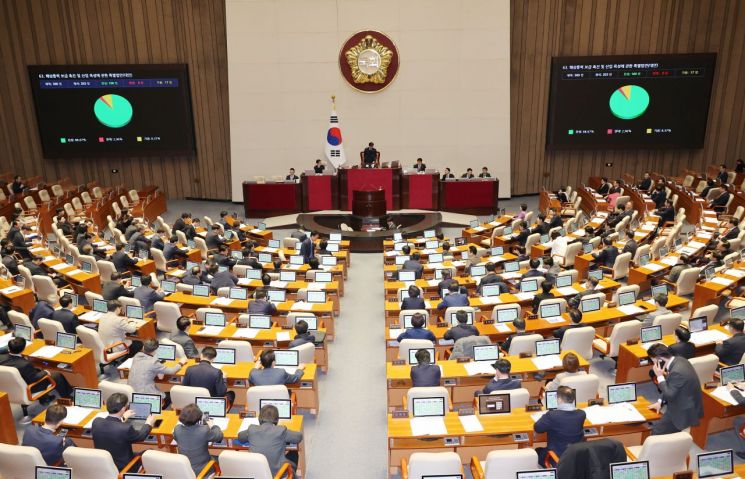
The National Assembly passed the so-called 'Energy 3 Laws'?the High-Level Radioactive Waste Disposal Facility Act, the Power Grid Expansion Act, and the Offshore Wind Power Special Act?at the plenary session on the 27th. The passage of these bills established the legal foundation for energy policies such as the construction of permanent disposal sites for spent nuclear fuel, expansion of the national power grid, and revitalization of the offshore wind power industry.
The National Assembly held a plenary session that day to deliberate and approve the Energy 3 Laws.
First, the High-Level Radioactive Waste Disposal Facility Act (Special Act on the Management of High-Level Radioactive Waste) was passed with 190 votes in favor, 8 against, and 27 abstentions out of 225 members present. This law serves as the legal basis for constructing facilities to process spent nuclear fuel generated from nuclear power plants, enabling the transition from temporary storage to intermediate storage and permanent disposal sites.
Currently, South Korea's temporary storage facilities for spent nuclear fuel at nuclear power plants are expected to reach capacity starting with Hanbit Nuclear Power Plant in 2030, followed by Hanul in 2031, and Kori in 2032. The storage periods for Wolseong (2037), Shin-Wolseong (2042), and Saeul (2066) nuclear power plants are also limited, making it inevitable to halt nuclear power plant operations if permanent disposal facilities are not established. Accordingly, both ruling and opposition parties agreed on the urgent need to secure disposal facilities to ensure the continuous operation of nuclear power plants and support nuclear power exports.
The Power Grid Expansion Act (Special Act on the Expansion of the National Power Grid) was also passed with 191 votes in favor, 5 against, and 19 abstentions out of 215 members present. This law mandates the government to lead the expansion of the national power grid to support the growth of industries requiring large-scale electricity, such as AI and data centers. It also includes provisions allowing regions that produce electricity to have priority in using it.
The Offshore Wind Power Special Act (Special Act on the Promotion and Industrial Development of Offshore Wind Power) was approved with 180 votes in favor, 6 against, and 17 abstentions out of 203 members present. This law aims to promote offshore wind power generation to achieve carbon neutrality and to pursue development that considers the public nature of marine spaces.
Notably, within offshore wind power development zones, preliminary feasibility studies may be exempted if necessary, and public institutions operating coal-fired power plants can receive preferential treatment in project selection when transitioning to offshore wind power projects. Existing offshore wind power project operators with permits can choose to maintain their current projects or be incorporated into the 'Offshore Wind Power Development Zone.'
Acceleration of Energy Transition The passage of the Energy 3 Laws reflects the government and National Assembly's commitment to pursuing balanced policies between nuclear power and renewable energy. South Korea's energy transition policy is expected to enter a full-fledged phase.
© The Asia Business Daily(www.asiae.co.kr). All rights reserved.

















