Government Announces "Measures to Prevent Fall Accidents at Construction Sites"
Aims to Reduce Fatal Fall Accidents by Over 10% Annually
The government will resume the disclosure of the list of construction companies where fatal accidents have occurred to reduce fall accidents, which account for more than half of all deaths at construction sites. The disclosure, which was suspended from the fourth quarter of 2023, will be reinstated to strengthen the responsibility of contractors. Additionally, a safety real-name system will be introduced to encourage visits by CEOs to construction sites and to disclose the names and contact information of contractors and supervisors.
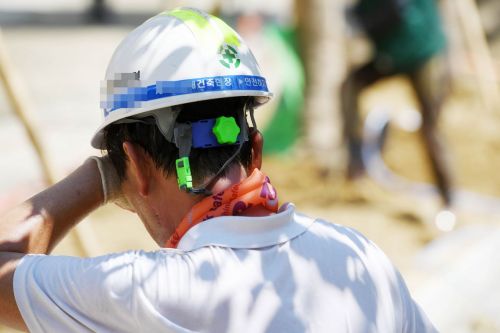
On the 27th, the Ministry of Land, Infrastructure and Transport announced the "Measures to Prevent Fall Accidents at Construction Sites," prepared in collaboration with the Ministry of Employment and Labor, the Korea Construction Association, and the Korean Society of Construction Safety. The government aims to reduce fall-related fatalities at construction sites by more than 10% annually and is committed to creating a safer construction environment.
The government plans to disclose the names of construction companies among the top 100 contractors by construction capability evaluation if fatal accidents occur. These companies account for about 25% of all fatal accidents (based on last year). There are also plans to disclose information about construction sites such as reconstruction projects and order status of companies where fatal accidents have occurred. The status of fall accidents will be reflected in public institution management evaluations and construction company capability assessments, so companies with inadequate safety management will face disadvantages.
Furthermore, a system will be introduced in technical bid evaluations to award additional points for CEOs visiting construction sites. If the CEO personally carries out safety assurance activities at the site, the company will have an advantage in bid competitions. This is based on the judgment that CEO visits effectively raise safety awareness among frontline workers. In fact, Company A’s CEO held the New Year's ceremony at the site this year, and headquarters executives stayed on-site for two weeks emphasizing safety awareness, resulting in zero fatal or injury accidents during that period.
A safety real-name system will be implemented to disclose the names of responsible persons at high-risk workplaces. This applies to work conducted at heights of 2 meters or more, excavation deeper than 1.5 meters, steel structure assembly, elevator installation, and other tasks with high risks of falls or collapses. For such dangerous work, a work plan must be prepared in advance, reported to the construction supervisor (person in charge), reviewed, and approved. Additionally, signboards displaying the contractor and supervisor information (affiliation, name, contact) must be posted for public viewing.
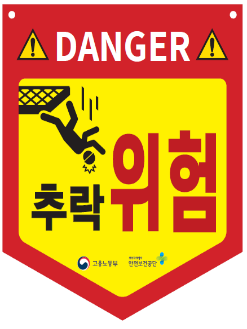 Fall hazard sign. The government plans to distribute fall hazard signs and encourage their installation at sites with fall risks, such as high-altitude work areas, so that workers can easily see them. Provided by the Ministry of Employment and Labor.
When a fall accident occurs, the contractor must directly prepare countermeasures and submit them to the government. At the same time, the construction company’s headquarters must submit self-inspection results for all sites. If the government deems the countermeasures insufficient, it will immediately conduct a special inspection. If an accident occurs in a public construction project, the relevant public institution must prepare additional safety measures for similar sites, report them to the government, and apply them immediately on-site.
To strengthen safety management in small-scale construction projects, the establishment and implementation of safety management plans will be mandatory if hazardous work types are included, and fines will be imposed for non-compliance. Previously, construction could proceed without approval from the ordering agency or licensing authority without penalties, but related laws will be amended to mandate the establishment of plans including safety assurance measures.
In response to criticisms that existing design standards do not adequately reflect site conditions, design standards for fall-vulnerable work types such as scaffolding (temporary work structures), roofs, and skylights will be revised. For example, while previously it was impossible to move directly to structures during high-rise scaffolding work, measures to allow passage installation when safety is ensured are being pursued. New standards for the spacing of work stairs will also be established to enable safe movement of workers.
The design safety review procedure, previously applied only to public construction projects, will be expanded to private projects. This procedure confirms safety during construction and requires design modifications if necessary. Review results will be submitted to and managed by the Ministry of Land, Infrastructure and Transport.
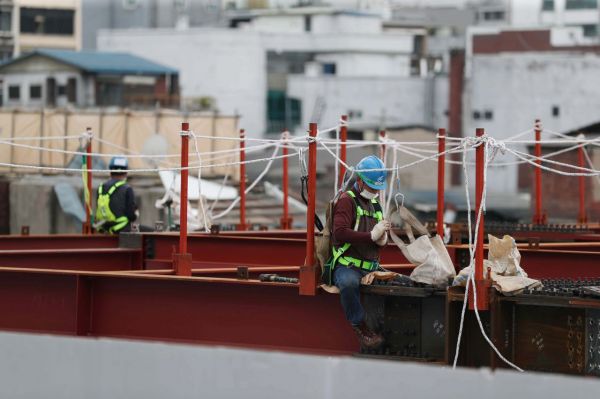
The unit cost standards (required manpower and cost criteria) used for construction cost estimation will be revised to reflect reality. In particular, standards for connecting parts (joints) of scaffolding installation and dismantling work will be detailed, and additional costs will be applied according to the scale of work. Also, tower crane operators will be contractually required to follow the main contractor’s work plan, and penalties will be imposed for unauthorized additional work to enhance safety.
To improve safety management for small and medium-sized construction companies, safety and health system consulting will be expanded from 1,500 to 2,000 companies, and inspections and education for hazardous work sites will be strengthened. Support will be provided for the purchase of smart safety equipment such as smart air vests for small construction companies with fewer than 50 employees (35 billion KRW), and smart safety equipment will be provided free of charge to small sites with budgets under 30 billion KRW (more than 200 sites by 2025).
Safety education will shift from formal methods to experiential learning. Actual CCTV accident footage will be used as educational material, and tailored training will be expanded for foreign workers and tower crane operators. Virtual reality (VR) education will be introduced to enhance accident prevention awareness.
The government plans to operate a dedicated task force for fall accident prevention until June to monitor safety trends at construction sites after the announcement of these measures. Additional measures will be prepared if necessary. Kim Taebyeong, Director of Technical Safety Policy at the Ministry of Land, Infrastructure and Transport, said, "To prevent fall accidents, installing safety facilities and improving workers’ safety awareness are essential. The most effective measure is for construction company CEOs and executives to visit sites directly and inspect worker safety."
© The Asia Business Daily(www.asiae.co.kr). All rights reserved.


















