Raising Sentencing Standards for Animal Abuse... Expanding Animal Registration Obligations
Mandatory Animal Welfare Education to Be Introduced Gradually in Elementary, Middle, and High Schools
The government is preparing a breeding prohibition system that prevents animal abusers from keeping animals for a certain period. Guidelines will be issued to raise sentencing standards related to animal abuse, and fines for animal abandonment will be increased to 5 million won.
On the 27th, the Ministry of Agriculture, Food and Rural Affairs announced the "3rd Comprehensive Animal Welfare Plan (2025?2029)," presenting the vision and direction of animal welfare policies for the next five years. Over 30 meetings and issue-specific consultative bodies were held with stakeholders from animal protection organizations, industry, experts, and academia to evaluate past animal welfare policies and prepare future directions and detailed tasks.
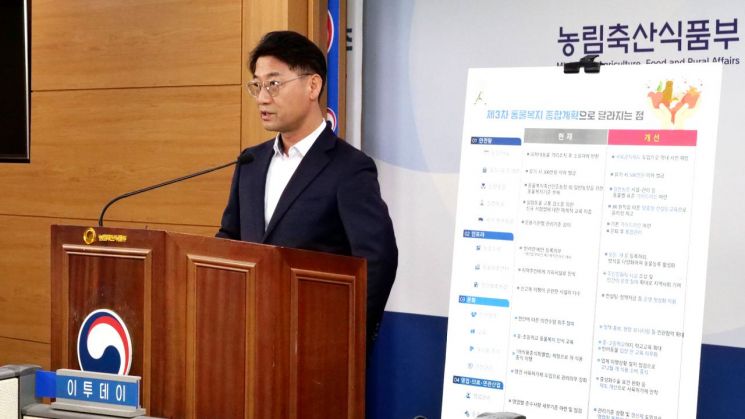 Park Jeong-hoon, Director of Animal Welfare and Environment Policy at the Ministry of Agriculture, Food and Rural Affairs, is announcing the "3rd Comprehensive Animal Welfare Plan (2025-2029)" at the Government Sejong Complex on the 27th. Provided by the Ministry of Agriculture, Food and Rural Affairs
This comprehensive plan includes measures to strengthen the implementation of previously introduced systems such as the animal registration system and local government animal protection centers. It also includes preventive policies such as the breeding prohibition system and mandatory education before adoption. Additionally, by collaborating with private organizations that have field expertise, it aims to create synergy in policy enforcement, and focuses on spreading social consensus on animal welfare through fostering a culture where pet owners, pets, and non-pet owners coexist harmoniously.
Park Jeong-hoon, Director of Animal Welfare and Environment Policy at the Ministry of Agriculture, Food and Rural Affairs, said, "We focused on solidifying the foundations so that the systems introduced so far can function properly in the field." He added, "We will continue to discuss issues that require social consensus, such as restructuring the system based on the Animal Welfare Act and securing resources related to animal welfare," and emphasized, "We will closely communicate with animal protection organizations, related associations, and companies to implement policies that meet the public’s expectations."
Raising Sentencing Standards for Animal Abuse... Expanding Animal Registration Obligations
The Ministry of Agriculture, Food and Rural Affairs is promoting the introduction of a breeding prohibition system to strengthen measures against animal abuse and abandonment/loss, and is revising laws related to abandonment acts. A breeding prohibition standard will be established to prevent individuals who have abused animals from keeping animals for a certain period. Sentencing guidelines will be set to avoid lenient punishments for animal abuse crimes. The fine for abandoning pets will be raised from up to 3 million won to up to 5 million won.
Director Park pointed out, "Because animal abuse has been approached as a minor offense, sentencing in Korea tends to be relatively light." He explained, "Rather than amending the Animal Protection Act regarding animal abuse, we plan to set sentencing guideline standards. If these are established in consultation with the courts, judges will consider social sentiment and other factors, leading to appropriate rulings."
Additionally, since cases occur where pets are left unclaimed after being entrusted to animal hospitals or hotels, or owners move without their pets, the ministry plans to clarify owner actions related to abandonment and strengthen penalties. To manage stray cat populations, a survey will be conducted followed by focused neutering projects in densely populated areas. Furthermore, social consultative bodies involving local governments, cat caretakers (Cat Moms), and local residents will be established to create communication channels and reduce related conflicts.
The ministry will expand the animal registration obligation to all dogs to address issues of abandonment, loss, and illegal sales. The system that exempted registration obligations in towns, townships, and island areas without registration agencies will be phased out. Since local government animal protection centers play a crucial role in rescuing and protecting abandoned and lost animals, guidelines will be revised to encourage the establishment of auxiliary facilities such as dog training and education centers, outdoor playgrounds, and cafes.
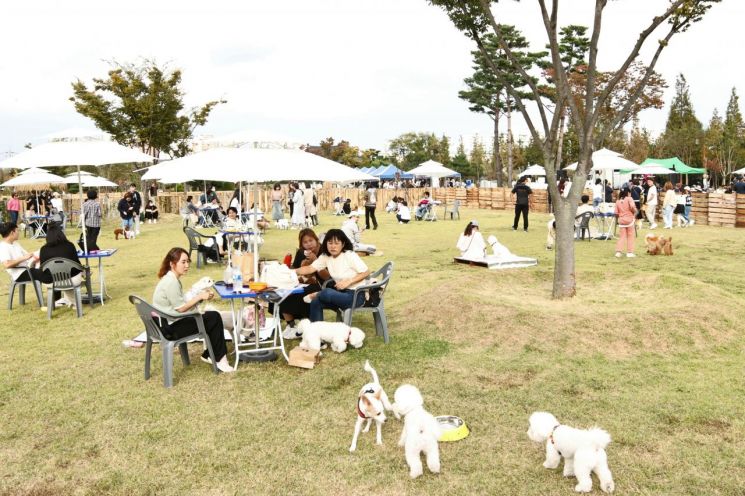
The legally designated "Animal Protection Day," which will be enforced starting this year, will be promoted as an event jointly prepared by the Ministry of Agriculture, Food and Rural Affairs, local governments, and private organizations, with participation from related companies, organizations, and institutions. To spread a culture of responsible care, pre-adoption education for pets will be made mandatory. Starting this year, animal welfare education will be introduced into the curriculum of elementary schools’ Neulbom Schools and middle schools, and from 2026, into high schools as well.
To prevent animal abuse occurring at pet business sites, standards for managing production animals will be raised. A renewal system for production, import, sales, and exhibition businesses will be introduced, and a standard contract for sales will be prepared to prevent transaction disputes. To prevent illegal animal distribution and fraud, parent dogs and puppies in production businesses will be managed with linked identification numbers, and adopters will be provided with detailed information.
To reduce difficulties in choosing animal hospitals, veterinary specialists with expertise in specific medical fields will be trained. While establishing an animal medical system including advanced and specialized hospitals, the ministry plans to announce the "1st Comprehensive Plan for Animal Medical Development and Promotion" in June. To foster related industries such as pet food and pet tech, a "Pet-Related Industry Promotion Act (tentative name)" will be enacted, and separate standards related to pet food will be introduced.
Director Park said, "There are already places in Korea that pursue and promote specialized and advanced hospitals," adding, "Consumers may have doubts about reliability, so the government intends to establish standards." He also noted, "There may be concerns about medical fees, but looking at the current animal hospital system, all equipment is installed, which ultimately shifts costs to hospital fees. Specializing hospitals could reduce such burdens."
© The Asia Business Daily(www.asiae.co.kr). All rights reserved.