At the European Congress of Radiology,
Lunit Presents 15 Latest Research Results on AI-Based Breast Cancer Diagnosis
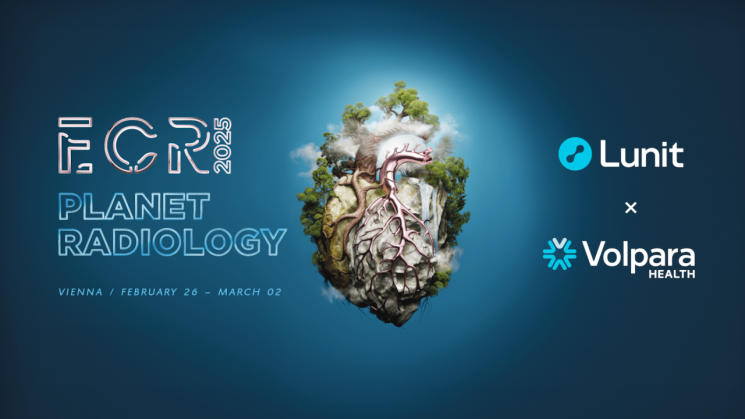
Medical AI company Lunit (CEO Beomseok Seo) announced on the 27th that it presented 15 latest research results in the field of breast cancer diagnosis at the '2025 European Congress of Radiology (ECR 2025)' held in Vienna, Austria, until the 2nd of next month.
At this conference, Lunit showcased 13 oral presentations and 2 poster presentations as major achievements of the congress using its AI imaging analysis solution for mammography, 'Lunit Insight MMG.' In particular, through collaborative research with prestigious European medical institutions, it demonstrated the clinical value of AI-based breast cancer diagnosis.
The most significant study at ECR 2025 was a large-scale research jointly conducted by Lunit and the Cancer Registry of Norway research team. The researchers analyzed over one million mammography data from the Norwegian national breast cancer screening program (BreastScreen Norway) to explore whether 'Lunit Insight MMG' could perform the role of one of the two radiologists in the current double reading system.
The study results showed that when AI judged the probability of breast cancer as 10% or higher, it detected 79.9% of breast cancers actually found during screening, and for a probability of 5% or higher, it detected 75.5% of actual breast cancers. Notably, it additionally identified 5.7% of interval cancers (cancers found between screenings) missed by conventional screening, proving its early detection effectiveness. This empirically demonstrated that AI introduction can significantly reduce the workload of radiologists while maintaining cancer detection rates.
In the next study, Lunit collaborated with the Norwegian Institute of Public Health research team to apply 'Lunit Insight MMG' to mammography data of more than 116,000 women who participated in the Norwegian national breast cancer screening program from 2004 to 2018, evaluating AI's ability for early cancer detection.
As a result, AI detected the risk of future cancer occurrence starting six years before the final cancer diagnosis. Additionally, analyzing cases where breast cancer was detected during screening with AI showed that the cancer risk score rose significantly from 19.2 to 82.7, accurately identifying suspicious breast lesions. Conversely, women without cancer consistently maintained low AI risk scores, and AI smoothly detected early risk increases even in interval cancers.
Beomseok Seo, CEO of Lunit, said, "Through the studies revealed at ECR 2025, we once again proved the high reliability and stability of Lunit AI solutions," adding, "It is meaningful in that it presented solutions to two core challenges: addressing the shortage of specialists and enabling early diagnosis."
© The Asia Business Daily(www.asiae.co.kr). All rights reserved.
![User Who Sold Erroneously Deposited Bitcoins to Repay Debt and Fund Entertainment... What Did the Supreme Court Decide in 2021? [Legal Issue Check]](https://cwcontent.asiae.co.kr/asiaresize/183/2026020910431234020_1770601391.png)