Second Trial Sentencing Scheduled for March 26
Ruling to Come About Ten Days After Yoon's Impeachment Decision
Early Presidential Election Emerging as a Key Variable
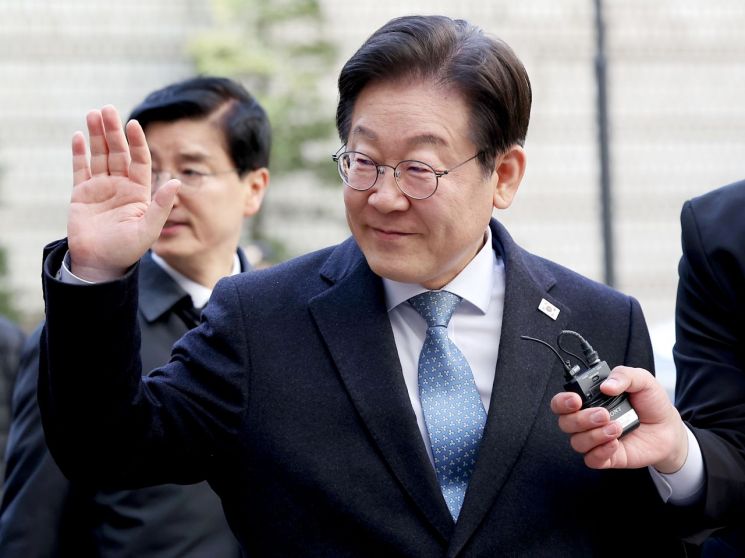
The Seoul High Court Criminal Division 6-4, which is handling the second trial for Lee Jae-myung, leader of the Democratic Party of Korea, on charges of violating the Public Official Election Act, announced that it will hold the sentencing hearing on March 26. Considering that the Constitutional Court’s ruling on President Yoon Seok-yeol’s impeachment trial is scheduled for mid-March, Lee’s second trial sentencing will come about ten days later. The impact on the political situation is expected to be significant.
◆ Lee’s Final Statement: “The Meaning Was That I Was Unaware,” “My Expression Was Insufficient” = At the second trial’s closing arguments held on the afternoon of the 26th, Lee stated that he did not completely deny all relations with Kim Moon-gi, former Head of Development Division 1 at Seongnam Urban Development Corporation. He said, “There was contact, but the meaning was that I was unaware.” Regarding his remarks about Baekhyeon-dong, he explained, “I was angry and spoke, so I made problematic remarks calling it ‘threats’ by the Ministry of Land, Infrastructure and Transport. The Ministry pressured us.” Lee added, “I exaggerated the word ‘threat,’ but I remember that the Ministry said that Seongnam city officials could have problems due to dereliction of duty or negligence, which was an actual fact.” He continued, “It is my fault for not expressing this accurately, but please consider the insufficiency in expression.”
Even if he made statements that were factually incorrect, he claimed he did not have the awareness that they were false, and although there may have been exaggeration in expression, they were not lies. In criminal cases related to false information disclosure charges, whether the statements were knowingly false is a crucial issue in determining guilt or sentencing. Lee’s final statement appears to focus precisely on this point. He also said, “(False information disclosure charges) usually result in a fine, but a two-year prison sentence demand is not a normal exercise of prosecutorial authority.” This statement seems intended to suggest that the prosecution’s exercise of its authority was politically motivated retaliation and to encourage leniency from the court.
Lee was indicted on charges of false information disclosure after stating in a December 2021 broadcast interview, when he was the Democratic Party’s presidential candidate, that he did not know the late Kim Moon-gi, former Head of Development Division 1 at Seongnam Urban Development Corporation, and claimed that the Ministry of Land, Infrastructure and Transport pressured regarding the change of use of the Baekhyeon-dong Korea Food Research Institute site. On November 15 last year, the first trial court sentenced him to one year in prison with a two-year probation, and the prosecution demanded a two-year prison sentence for Lee, the same as in the first trial.
◆ Lee’s Judicial Risks Are Mounting = The timing of Lee’s second trial sentencing and the subsequent Supreme Court confirmation is a major variable in the future political landscape. If the Constitutional Court decides to dismiss President Yoon in mid-March, a presidential election must be held within 60 days, by mid-May, according to Article 68 of the Constitution. However, legal circles believe that even if Lee receives a sentence invalidating his election in the second trial, it is unlikely that the Supreme Court ruling will be issued before the presidential election. The appeal period (7 days), record submission deadline (14 days), and appeal brief submission deadline (20 days) mean it takes about a month before the Supreme Court panel is assigned. Lee is also facing four other trials aside from this case: impersonation of prosecution and perjury coaching, allegations of preferential treatment in Daejang-dong, Baekhyeon-dong, and Wirye developments, illegal remittance to North Korea related to Ssangbangwool, and misuse of corporate cards during his tenure as Governor of Gyeonggi Province. Among these, the perjury coaching case was acquitted in the first trial on November 26 last year. The prosecution appealed, and the first appellate trial preparation hearing is scheduled for the 11th of next month.
© The Asia Business Daily(www.asiae.co.kr). All rights reserved.
![Clutching a Stolen Dior Bag, Saying "I Hate Being Poor but Real"... The Grotesque Con of a "Human Knockoff" [Slate]](https://cwcontent.asiae.co.kr/asiaresize/183/2026021902243444107_1771435474.jpg)
















