AfD triples youth support with TikTok strategy
Left Party, once feared extinct, revived through social media
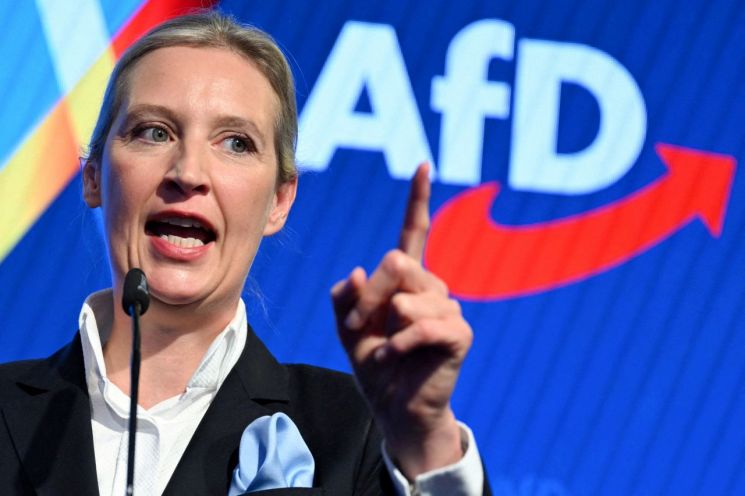 On the 23rd (local time), Alice Weidel, co-leader of the Alternative for Germany (AfD), is giving a speech to supporters after the exit poll announcement. Photo by Reuters and Yonhap News.
For the first time since World War II, the far-right party 'Alternative for Germany (AfD)' has emerged as the second-largest party in Germany. AfD's strategy of focusing on exposing their content on social networking services (SNS), especially TikTok, is credited with resonating with young voters. The German Left Party, which also targeted young voters through TikTok, managed to escape the threat of extinction and more than doubled its support in the general election. Following the U.S. presidential election, the power of SNS was reaffirmed in the German general election, and it is expected that political parties worldwide will increasingly shift their strategic focus from traditional media to SNS at a faster pace.
The Foundation of Far-Right Party AfD's Leap: 'TikTok'
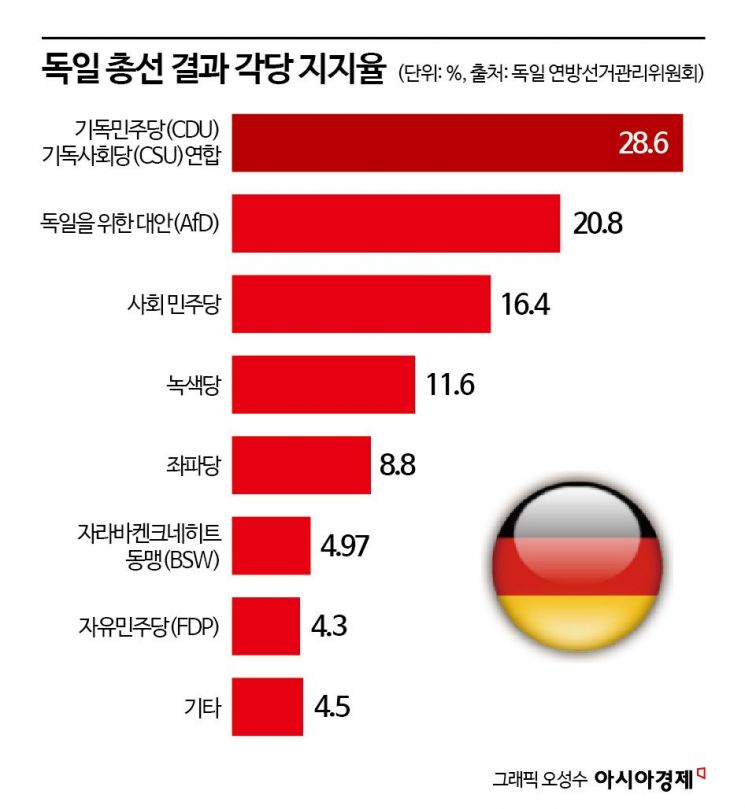
According to The Wall Street Journal (WSJ), in the German general election held on the 23rd of last month, the Christian Democratic Union (CDU) - Christian Social Union (CSU) alliance secured first place with 28.6% of the vote, while AfD came in second with 20.8%. The ruling Social Democratic Party (SPD) fell to third place with 16.4%. AfD, which started as a minor party in 2013, has risen to become the second-largest party in just 12 years.
AfD's support in this election more than doubled compared to the 10.3% it recorded in the 2021 general election. Notably, support among 18-24-year-old voters surged threefold from 7% to 21%. Support among 25-44-year-old voters also doubled to 25%. AfD's election strategy, which concentrated on maximizing SNS exposure to appeal to young voters, proved highly effective.
R?diger Maas of the German think tank Generational Research told WSJ, "If you create a new TikTok account, you have to watch at least 5 to 6 clips of AfD content," adding, "There is up to 400 times more content than that of other parties. Germans who spend more than 90 minutes a day on SNS cannot help but be influenced by AfD's content."
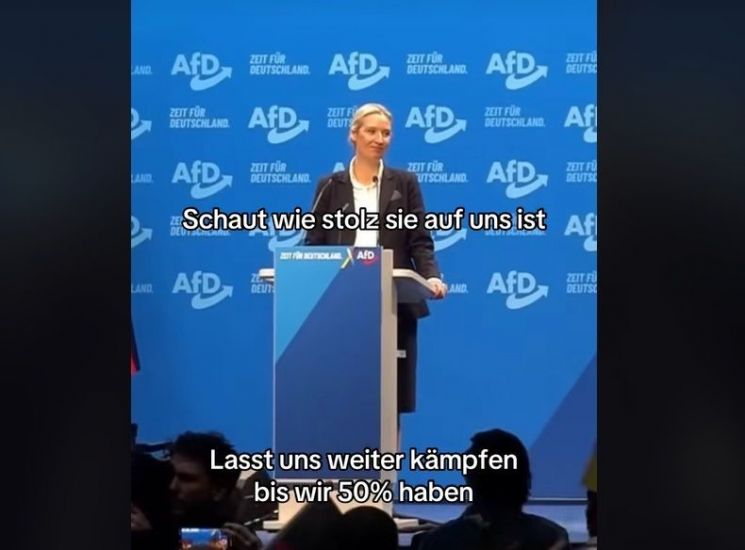 A speech by Alice Weidel, co-chair of the Alternative for Germany (AfD), posted on TikTok. TikTok video capture
AfD particularly focused on content criticizing terrorist attacks by illegal immigrants in Germany. By tapping into anti-immigration sentiment, one of the major issues in this election, they significantly moved conservative voters.
Prior to the election, there were incidents in Germany where an Afghan refugee wielded a weapon causing the death of a 2-year-old boy. Another Afghan refugee drove a vehicle into a protest march, resulting in a child's death. Two days before the election, on the 21st of last month, a Syrian refugee attacked tourists with a weapon at the Berlin Holocaust Memorial, causing serious injuries.
AfD highlighted these incidents extensively on TikTok and other SNS platforms, making anti-immigration policies a key campaign promise. They pledged to completely close the borders, make asylum procedures more stringent, and reject the European Union (EU) refugee agreement. Additionally, they promised to establish detention facilities for deporting refugees and impose economic sanctions and cut development aid to countries that refuse to accept their deported nationals.
WSJ analyzed, "AfD attracted numerous independent political influencers separate from their party who posted countless videos related to anti-immigration policies, garnering millions of views," adding, "Through this, they succeeded in significantly expanding their voter base beyond the working-class men in the former East Germany."
German 'Left Party,' Once Feared to Disappear, Revived Thanks to TikTok
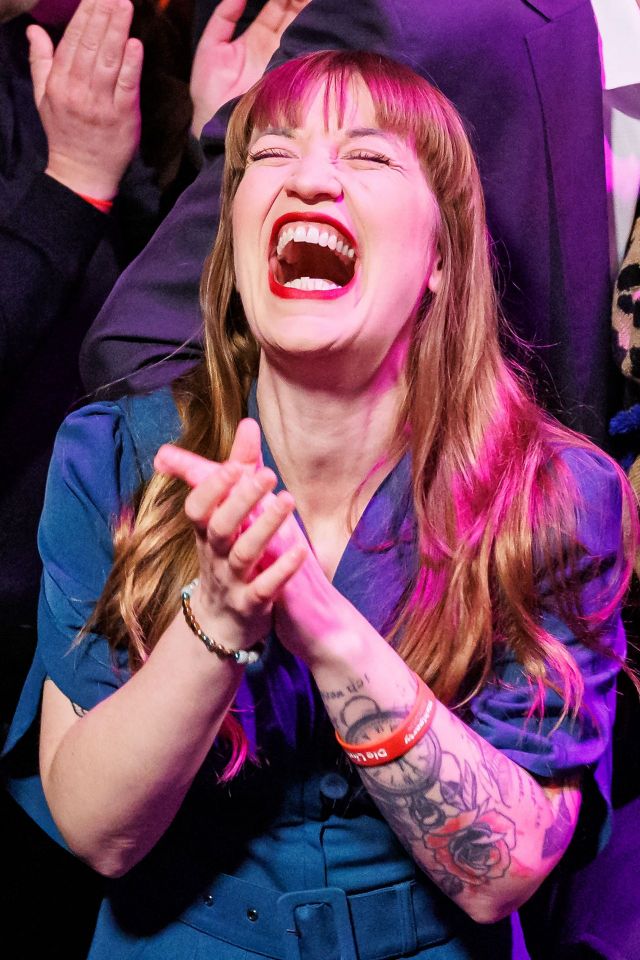 On the 23rd (local time), Heidi Reichneck, co-leader of the German Left Party, is seen celebrating after the announcement of the exit polls for the German general election. Photo by AFP and Yonhap News.
The German Left Party, which also significantly increased its support in this election alongside AfD, is credited with a revival due to its active use of TikTok. The Left Party secured 8.8% of the vote in this election, nearly 4% higher than the 4.9% it received in the previous election.
The Left Party originally succeeded the Socialist Unity Party of Germany (SED), the ruling party of former East Germany, and is a far-left party. Its support plummeted when AfD surged in the former East German region in 2013. In the 2021 general election, its support was halved from 9.2% to 4.9%, putting it at risk of extinction. However, in this election, co-leader Heidi Reicheneck, who has 580,000 TikTok followers, swept the youth vote and led the party to revival. The Left Party recorded 27% support among 18-24-year-olds, receiving the most support from young voters.
Notably, 36-year-old co-leader Reicheneck tattooed the face of 19th-century German socialist revolutionary Rosa Luxemburg on her left arm and focused on SNS promotion, rising as a star in the political arena. One of Reicheneck's anti-immigration policy opposition speeches posted on TikTok surpassed 7 million views and gained great popularity.
© The Asia Business Daily(www.asiae.co.kr). All rights reserved.



















