Discussion on Adjusting the Elderly Age Accelerates
Cases from Japan, Australia, and Europe Suggest Flexible Standards
In major advanced countries with a higher proportion of elderly population than South Korea, discussions on adjusting the elderly age, such as extending the retirement age and raising the pension eligibility age, have already begun, and the perception that the elderly age cannot be uniformly defined is spreading.
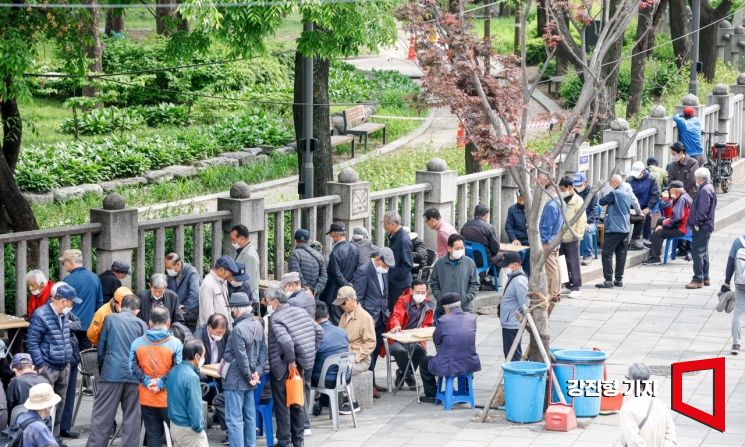 On the 30th, elderly people gathered in small groups near Tapgol Park in Jongno-gu, Seoul. Photo by Jin-Hyung Kang aymsdream@
At the '2nd Elderly Age Expert Meeting' held by the Ministry of Health and Welfare on the 26th, Professor Jeong Sun-dul of Ewha Womans University’s Department of Social Welfare introduced cases from overseas countries that have abolished the statutory retirement age or raised the retirement age standard and delayed the pension eligibility age.
In Australia, which abolished the retirement age, the pension eligibility age was set at 67 from 2023, but recently there have been claims that the pension eligibility age should be raised further. The UK also abolished the retirement age from 2011, except for special occupations such as police officers, firefighters, and pilots, and plans to raise the pension eligibility age to 67 by 2028. Germany plans to extend the retirement age to 67 by 2031 and raise the public pension eligibility age, including statutory pension insurance, from 65 to 67 by 2029. France is promoting a plan to extend the retirement age from the current 62 to 64 by 2030 and correspondingly delay the pension eligibility age to 64.
Professor Jeong said, "In Europe, there is criticism that applying a strict age criterion when distinguishing the elderly does not consider that not everyone begins aging at the same age or progresses at the same rate."
In Japan, the statutory retirement age is 60, but 'employment security measures' allow workers who wish to continue working until 65. According to Dr. Kim Do-hoon of Korea University Institute for Aging Society, in Japan, the Geriatrics Society and the Gerontology Society argued in 2017 that the definition of elderly should be adjusted from 65 to 75 years old, suggesting that those aged 65-74 be called quasi-elderly, 75-89 elderly, and 90 and above super-elderly. Also, the age criteria for referring to the elderly differ across laws: 55 and above in employment security laws, 60 and above in housing security laws, 65 and above in medical security laws, and 70 and above in the Road Traffic Act.
Professor Jeong advised, "The elderly age can be seen as being defined within systems rather than uniformly regulated. We should consider how to proceed with discussions in South Korea by referring to cases like Japan and Australia, where age discussions are actively underway."
Lee Sam-sik, director of Hanyang University Institute for Aging Society, pointed out, "If we raise the elderly standard from the current 65 to 75, some citizens may expect retirement age extension, but others may worry about delayed pension benefits. It is necessary to conduct more comprehensive surveys and analyses on how the 40s and 50s, and even the 20s and 30s generations, think about raising the elderly age."
© The Asia Business Daily(www.asiae.co.kr). All rights reserved.

















