Contributing to Reducing Rice for Cooked Rice Production
and Replacing Demand for Imported Wheat Flour
The government has decided to expand the scale of specialized production complexes for powdered rice to 11,400 hectares this year to increase powdered rice production. Powdered rice features a starch structure that is round and loosely arranged, allowing for dry milling similar to wheat flour, and was introduced to partially replace imported wheat flour usage.
The Ministry of Agriculture, Food and Rural Affairs announced on the 27th that it has selected 151 specialized powdered rice production complexes for 2025.
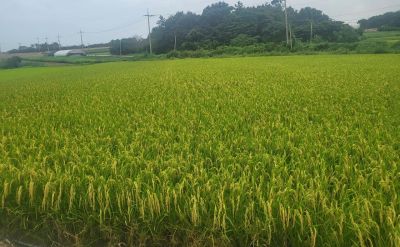
The Ministry is promoting policies to foster the powdered rice industry to stabilize rice supply and enhance food security. As part of this, it has been focusing on nurturing and supporting powdered rice production complexes since 2023. The number and scale of these specialized production complexes have steadily increased. In 2023, when the first complexes were established, there were only 38 sites covering a total of 2,000 hectares, but this increased to 135 sites and 8,400 hectares in 2024. This year, it will further increase to 151 sites and 11,400 hectares. Along with the increase in production complexes, powdered rice production volume also rose from 11,000 tons in 2023 to 38,600 tons in 2024. The Ministry expects 50,000 to 60,000 tons of powdered rice to be produced this year.
An official from the Ministry stated, "Last year, by fostering 135 specialized powdered rice production complexes, we contributed to reducing the production of rice for cooked rice, which was in oversupply, by more than 40,000 tons. Additionally, the high re-participation rate of existing production complexes in 2025 and the continuous expansion of complex sizes indicate that farmers are highly satisfied with powdered rice cultivation and are strongly motivated to participate."
Among this year’s production complexes, many large-scale agricultural corporations with joint farming areas of over 50 hectares are also participating. By region, Jeonnam has 57 sites (4,600 hectares), Jeonbuk 35 sites (2,900 hectares), Chungnam 24 sites (2,000 hectares), Gyeongnam 17 sites (1,100 hectares), Gyeongbuk 10 sites (400 hectares), and others 8 sites (400 hectares).
The Ministry will provide education and consulting for powdered rice cultivation, joint farming, and organization to the selected production complexes. In particular, for 30 production complexes with cultivation areas of 60 hectares or more, selected through expert evaluation, the Ministry will support facilities and equipment necessary for powdered rice production with up to 500 million KRW per complex.
Kim Kyung-eun, head of the Strategic Crop Development Team at the Ministry, said, "Powdered rice contributes to stabilizing the supply and demand of rice, which is in a structural oversupply, and serves as an alternative to replace the demand for imported wheat flour, which has a low self-sufficiency rate. Moving forward, to create new demand for powdered rice, we will support food manufacturing companies in product development, promotion, and marketing, and plan to gradually expand the production area of powdered rice considering productivity improvements and increased consumption."
© The Asia Business Daily(www.asiae.co.kr). All rights reserved.

















