A 'Gold Card' System Five Times More Expensive Than the Existing Program
Opportunity Extended to Russian Emerging Tycoons
Hints at Abolishing the Investment Immigration Visa
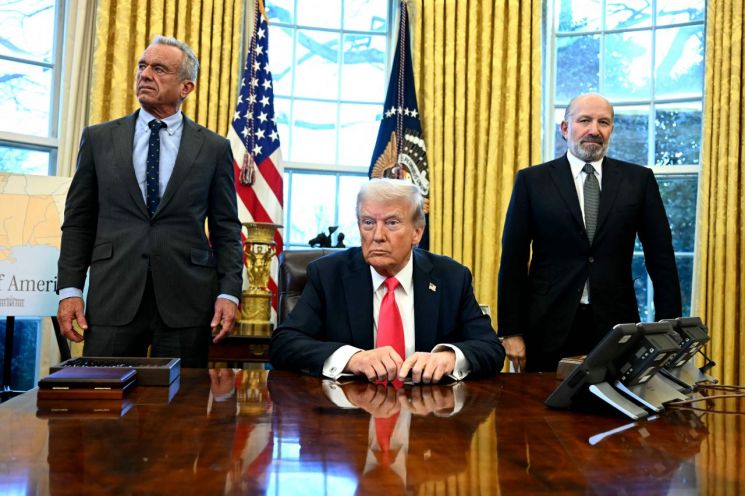 U.S. President Donald Trump holds a press conference after signing an executive order in the White House Oval Office on the 25th (local time). /AFP News Agency·Yonhap News Agency
On the 25th (local time), U.S. President Donald Trump declared that he would grant 'U.S. permanent residency' to Russian emerging tycoons for just $5 million (71.6 billion KRW). This so-called 'Gold Card' policy envisions selling permanent residency at five times the price of the existing investment immigration visa 'EB-5' program, while significantly relaxing the detailed conditions with a 'Fast-track' version.
According to the Wall Street Journal (WSJ) and Bloomberg News, President Trump signed an executive order in the White House Oval Office on the same day, stating, "We will sell Gold Cards," adding, "The card price will be about $5 million, and it will provide the same benefits as permanent residency (Green Card) as well as open the path to citizenship."
President Trump confidently asserted that the system could be established within two weeks without requiring congressional approval. The Gold Card system is expected to replace the existing investment immigration visa 'EB-5' program. The EB-5 program allows immigrant investors to gradually obtain permanent residency by investing a certain amount in businesses within the United States.

In particular, when asked whether Russian emerging tycoons and oligarchs?financial backers of Russian President Vladimir Putin?could also purchase the Gold Card, President Trump answered, "Yes." Oligarchs are political backers who provided financial support to President Putin during the collapse of the Soviet Union.
Howard Lutnick, U.S. Secretary of Commerce, who was present in the Oval Office that day, hinted that this measure could lead to the abolition of the existing EB-5 program. Secretary Lutnick explained, "It was a way to get a Green Card cheaply," adding, "President Trump stated that he would terminate the nonsensical EB-5 system rather than operate it."
The most significant difference between the Gold Card system and the existing EB-5 investment immigration system is the minimum investment threshold. Currently, the EB-5 minimum investment ranges from $800,000 to $1.05 million, which is only one-fifth of the Gold Card's amount. Even the EB-5 minimum investment was raised during the 2022 congressional reauthorization process.
Conversely, the detailed conditions for application are expected to be greatly relaxed. For example, EB-5 requires immigrant investors to create at least 10 full-time jobs. Preferred investment targets are rural areas or so-called employment promotion zones with high unemployment rates. Immigrant applicants must first receive conditional permanent residency and then apply for permanent residency after two years with government approval. There was also uncertainty as final approval could take several years.
In contrast, the newly established Gold Card system plans to eliminate job creation requirements and the phased permanent residency granting process, providing immediate permanent residency. Regarding the operation of the Gold Card, Secretary Lutnick explained, "Applicants will undergo background checks, and we will ensure that those who purchase the Gold Card are excellent global citizens of the highest caliber."
Meanwhile, the second Trump administration is accelerating the deportation of illegal immigrants. Starting from the day after his inauguration on the 21st of last month, President Trump began cracking down on illegal residents nationwide through the Immigration and Customs Enforcement (ICE). According to WSJ, the Trump administration is currently preparing a registry of illegal immigrants. All illegal immigrants aged 14 and older must submit personal information such as fingerprints and addresses without omission. It is reported that regulations are being prepared to impose fines of $5,000 and up to six months imprisonment for violations.
© The Asia Business Daily(www.asiae.co.kr). All rights reserved.


















