Temporary Holiday in January Aimed to Boost Domestic Travel
Lunar New Year Holiday Extended to Nine Days... Surge in Overseas Trips
More Koreans Visiting Japan Than Japanese Traveling Abroad
"If the Domestic Travel Industry Collapses, It Will Threaten the Entire Economy"
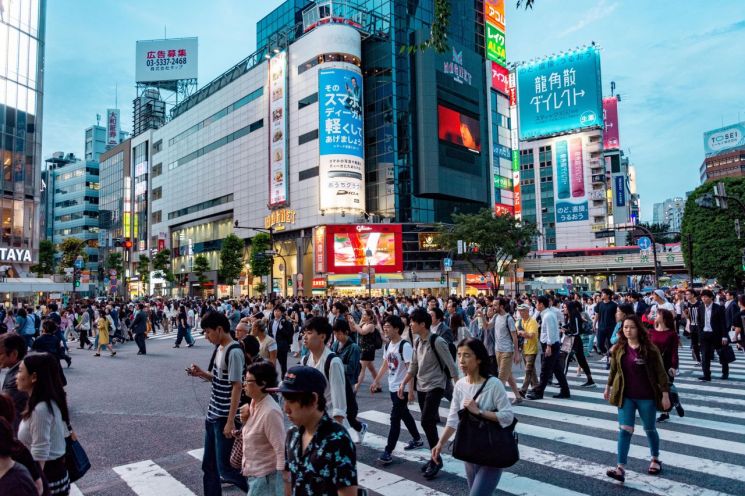
The government’s 'temporary holiday' implemented last January with the aim of 'stimulating domestic demand' has been found to have actually harmed domestic travel and consumption, according to a recent survey. The designation of the temporary holiday extended the Lunar New Year holiday to a maximum of nine days, which led to an increase in demand for overseas travel. There is criticism that the temporary holiday system, introduced to encourage domestic travel and consumption, instead encouraged overseas travel.
According to the results of the 'Weekly Travel Behavior and Plan Survey' released on the 25th by Consumer Insight, a consumer research specialist organization, the decline in domestic travel consumer indicators has deepened this year. In January of this year, consumer interest in domestic travel destinations recorded 80 points, down 10 points compared to the same month last year. The proportion of respondents who said their interest had increased was only 33.2%. Compared to 2022, when overseas travel was restricted due to COVID-19, interest dropped by 33 points, and the proportion who said their interest had increased decreased by 29.4%.
The 'travel plan rate,' which measures plans to travel domestically within the next three months, fell to 93 points, 8 points lower than the same month last year, falling below 100 points. The 'willingness to spend on travel expenses' for domestic travel dropped 34 points from the same period last year to 79 points. Compared to the 135 points recorded in 2022, this represents an almost halving of spending intentions.
Indicators of actual domestic travel also remain cold. The 'travel experience rate,' which asks about domestic travel experiences within the past three months, was 95 points, down 7 points from the previous year. The total domestic travel expenditure per person also decreased by 3 points to 1.13 million KRW, down from 1.16 million KRW last year. The contraction of the domestic travel market is interpreted as being due to overlapping adverse factors such as economic recession, high inflation, and high exchange rates, which have reduced disposable income.
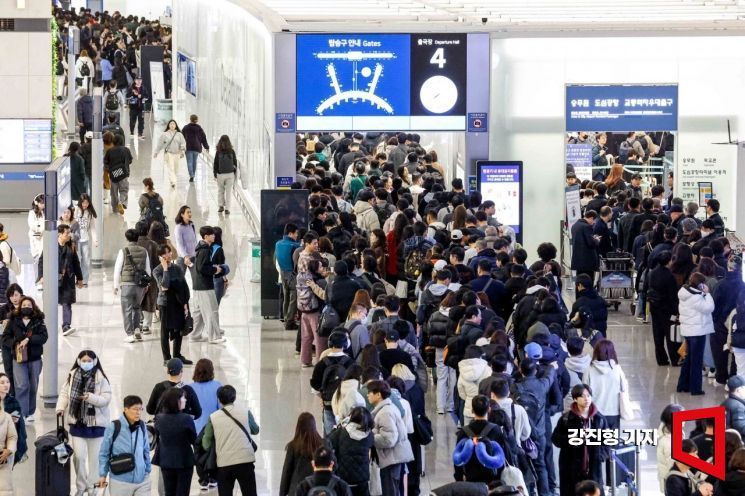 On the 24th of last month, ahead of the Lunar New Year holiday including the temporary public holiday, travelers visiting Incheon International Airport Terminal 1 were lining up to move to the boarding concourse.
Additionally, the growing preference for overseas travel over domestic travel is also problematic. In particular, the 'temporary holiday' implemented to coincide with the Lunar New Year holiday in January this year was confirmed to have had a negative effect on domestic travel.
According to Incheon International Airport Corporation and others, from the 24th of last month to the 2nd of this month, 2,189,778 people departed overseas through Incheon Airport over ten days. This averages 218,978 people per day. This is the highest number of departures recorded during any Lunar New Year holiday since the opening of Incheon International Airport in 2001.
Industry insiders analyzed, "Typically, when holidays last three days or more including weekends, demand for overseas travel increases. During this Lunar New Year holiday, with the designation of the temporary holiday, taking just one day of annual leave created a maximum nine-day holiday, which seems to have further increased overseas travel demand." Consumer Insight also pointed out, "Despite reduced disposable income, the advantage of a six-day long holiday likely made overcoming these economic constraints more difficult rather than easier."
The top overseas travel destination chosen by travelers during the Lunar New Year holiday was Japan. The number of travelers to Japan during the holiday period was 276,237, more than double the 122,778 during last year’s Lunar New Year holiday. Furthermore, the number of Koreans entering Japan in January this year reached 979,042, surpassing 900,000 for the first time and setting a monthly record. This number is about 60,000 more than the 912,325 Japanese who traveled overseas during the same period. In other words, the number of Koreans traveling to Japan exceeds the number of Japanese traveling abroad worldwide.
Consumer Insight expressed concern, saying, "If there is a widespread distorted consumer consciousness where people find it difficult to even consider cost-effectiveness (value for money) in domestic travel due to 'ultra-tight' budgets, yet spend several times more on overseas travel and feel satisfied, there is no solution. If the domestic travel industry collapses, it will pose a significant threat to the entire national economy."
© The Asia Business Daily(www.asiae.co.kr). All rights reserved.
![Clutching a Stolen Dior Bag, Saying "I Hate Being Poor but Real"... The Grotesque Con of a "Human Knockoff" [Slate]](https://cwcontent.asiae.co.kr/asiaresize/183/2026021902243444107_1771435474.jpg)

















