Tug-of-War Over Automatic Adjustment Mechanism
Ruling Party Proposes Conditional Introduction with National Assembly Approval
Opposition Suggests Prior Agreement on Parameter Reform
Acting Prime Minister Choi Stresses "Urgent Need for Bipartisan Cooperation"
The ruling and opposition parties have left open the possibility of agreeing on a pension reform income replacement rate of 44%, but are engaged in a final tug-of-war over whether to prioritize the introduction of an automatic adjustment mechanism.

The People Power Party insists that to accept the 44% income replacement rate, an automatic adjustment mechanism that adjusts insurance premiums and income replacement rates according to demographic and economic conditions must be introduced, even if conditionally approved by the National Assembly. The Democratic Party regards this as a progressive proposal but believes that agreement on fundamental parameter reforms should come first.
On the morning of the 25th, Kim Sang-hoon, the Policy Committee Chair of the People Power Party, stated at a floor strategy meeting at the National Assembly, "The decline in the working-age population directly leads to a sharp decrease in National Pension subscribers and will result in a burden on future generations," adding, "The introduction of an automatic adjustment mechanism for the National Pension is the minimum reform plan."
The People Power Party is refining its response strategy considering the possibility of finding a compromise in the ruling-opposition-government working-level talks on pension reform. They are positioning to push for a package agreement on parameter reforms and the automatic adjustment mechanism. After the talks the previous day, Chair Kim told reporters, "The government does not insist on 42%," and mentioned that if the automatic adjustment mechanism is introduced, the opposition's proposed income replacement rate could be flexibly reviewed. Jin Sung-jun, the Democratic Party Policy Committee Chair, also left room for negotiation by saying, "The conditional introduction of an automatic adjustment mechanism subject to National Assembly approval is a progressive proposal."
On the same day, the People Power Party held a youth forum on pension reform and launched a final public opinion campaign. Kwon Seong-dong, the floor leader of the People Power Party, emphasized, "This is not a trivial debate about whether to raise the income replacement rate to 43% or 44%, but comprehensive structural reform should be carried out in a way that maximizes long-term benefits."
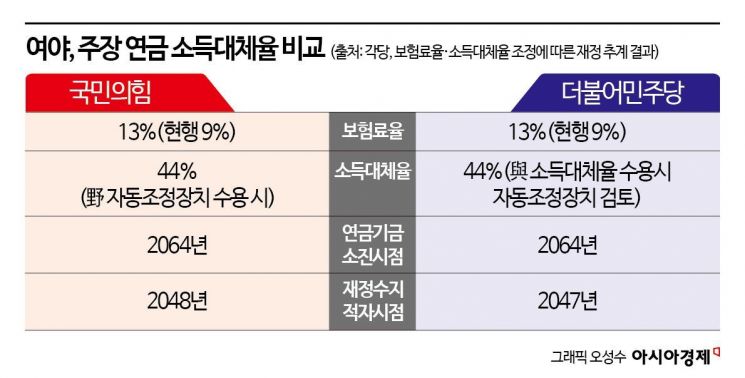
On the other hand, the Democratic Party reiterated its stance to first agree on parameter reforms without conditions such as the automatic adjustment mechanism. Chair Jin said at the floor strategy meeting, "We have consistently opposed the automatic adjustment mechanism, but since the government proposed it subject to National Assembly approval, we will not exclude it from discussions," adding, "But we should not attach various conditions and should first agree on parameter reforms."
Originally, the Democratic Party was reported to have considered conditionally accepting the introduction of the automatic adjustment mechanism on the premise of "National Assembly approval" at the ruling-opposition-government policy council on the 20th, but reversed to a cautious stance the day before due to opposition from civil society groups. Currently, the Democratic Party's proposed National Pension parameter reform plan aligns with the ruling party on a 13% insurance premium rate but maintains the income replacement rate at around 44-45%. Ultimately, separate from discussions on the automatic adjustment mechanism, they have set the negotiation bottom line at 44%. This is because party leader Lee Jae-myung has left a 1 percentage point negotiation margin from the party's official 45% income replacement rate.
Regarding the introduction of the automatic adjustment mechanism, the ruling party's position is that discussions can continue if the Democratic Party accepts the proposed income replacement rate bottom line. The Democratic Party defines the automatic adjustment mechanism as a National Pension "automatic reduction mechanism." The automatic adjustment mechanism is a system that automatically adjusts pension insurance premiums and benefits based on the number of subscribers, inflation rate, and subscribers' life expectancy (benefit expenditure). However, the Democratic Party and labor groups emphasize that this mechanism effectively reduces pension benefits and is difficult to accept.
The government is emphasizing a grand consensus for the fruition of the pension reform, which has remained an unfinished task. On the 25th, Choi Sang-mok, Acting Prime Minister and Minister of Economy and Finance, stated at the Cabinet meeting, "This time, I earnestly hope that a sustainable pension reform plan can be prepared through a grand consensus between the ruling and opposition parties." Acting Prime Minister Choi stressed, "Bipartisan cooperation in the National Assembly is urgently needed."
Attention is also focused on Acting Prime Minister Choi's choice if the ruling and opposition parties fail to reach an agreement and the opposition unilaterally passes the pension reform. There is speculation inside and outside political circles that he may exercise the right to request reconsideration (veto) of the opposition's unilateral pension reform bill. However, considering variables such as the urgency and gravity of pension reform, cautious opinions suggest that this time, various factors will be taken into account in making a judgment.
© The Asia Business Daily(www.asiae.co.kr). All rights reserved.



















