Mobile Phone Market Heats Up Ahead of Device Distribution Act Repeal in July
Galaxy S25, Just One Month After Launch, Comes With Payback at Some Stores
Older Models Offer Even Larger Subsidies, Marking the "Return of the Holy Place"
On the morning of the 22nd, at Sindorim Technomart, a mobile phone dealer I met asked, "How many quotes have you checked so far?" This was in response to my question about whether "chabi" (cash given to customers by the store when they purchase a phone) was possible. When I spread both hands to indicate 100,000 won, Mr. Lee tapped on his calculator for a moment. "I can do that for the Galaxy S25. For last year's model, the S24, I can go up to 200,000 won."
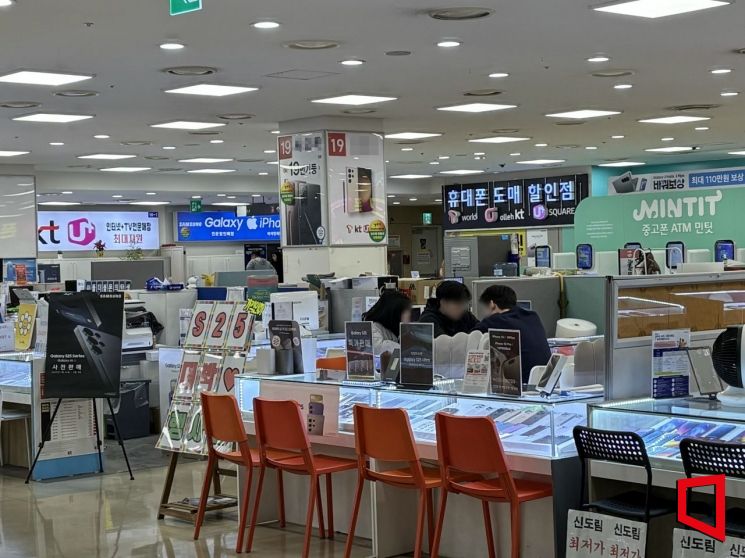
On this day, five months ahead of the abolition of the Mobile Device Distribution Improvement Act (Device Distribution Act), the ninth floor of Technomart was already in a festive mood. The area, filled with mobile phone stores, was adorned with eye-catching advertisements such as "Sindorim's Lowest Price Shocking Discount," "Samsung S24 Device Price 0 Won," and "S25 Huge Discount Only for Today." In front of a large sign reading "Holy Place," salespeople continuously approached customers. In industry jargon, a "holy place" refers to a mobile phone store that offers subsidies far exceeding the official support amount-a practice that is illegal under the Device Distribution Act.
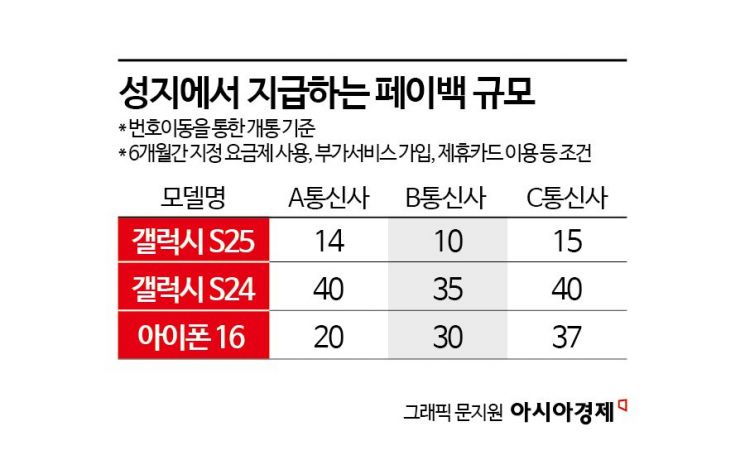
The official subsidy for the Galaxy S25 set by the carrier is up to 245,000 won. Even with an additional 15%, it amounts to about 280,000 won. This is only available if you purchase the most expensive model, the Galaxy S25 Ultra (256GB), and use an expensive plan for two years. However, stores known as "holy places" are offering much more than this. One mobile phone store, which mainly operates through online communities, offered up to nearly 400,000 won in chabi for the basic model of the Galaxy S24. Considering its retail price is 1.15 million won, the total support-combining the official subsidy, additional support, and illegal subsidies-reaches 1.6 million won.
Mr. Lee, the dealer, said, "Prices have started dropping significantly this month due to expectations of the Device Distribution Act being abolished," and added, "Today, the subsidies are good, so I can offer you a great deal." However, there are conditions attached to purchasing a phone. To buy the Galaxy S25, you must use an expensive plan for six months and maintain at least two value-added services for three months. There is also a requirement to spend a certain amount with a credit card affiliated with the carrier.
Although the official abolition of the Device Distribution Act is scheduled for July, mobile phone stores are already in a celebratory mood. This is because a subsidy competition is breaking out in advance, in anticipation of the legal restrictions being lifted. The fact that even the Galaxy S25, released just a month ago, has become a "chabi phone" (a phone that comes with cash when purchased) is a clear sign of this atmosphere. Some stores have even put up signs reading "Device Distribution Act Abolition Maximum Subsidy Store," signaling their intent to capture the post-abolition market early.
This kind of illegal subsidy competition existed even before the Device Distribution Act was introduced. At that time, "holy place" stores offered discounted prices only to select customers in a closed manner, leading to controversy over consumer discrimination, which prompted the introduction of the Device Distribution Act. However, even after the law was enacted, market backlash continued, and there were persistent criticisms that the Device Distribution Act actually restricted price competition, forcing consumers to pay more for mobile phones. As a result, calls for abolishing the Device Distribution Act grew, rendering the law effectively meaningless, and it is now in the process of being officially repealed.
However, some analysts believe that the extreme "holy place chaos" seen in the past is unlikely to reoccur just because the Device Distribution Act is gone. This is because the mobile telecommunications market is already oversaturated, and carriers are avoiding price competition. In particular, the domestic market has become a duopoly between Samsung Electronics (Galaxy) and Apple (iPhone) after LG Electronics and Pantech withdrew from the smartphone market, which has also had an impact. An industry insider said, "It is difficult to predict since the detailed implementation plan after the abolition of the Device Distribution Act has not yet been determined, but the industry does not expect the market to overheat as it did in the past."
The Korea Communications Commission has advised consumers to exercise caution. This is because there may be cases where some stores fail to properly explain discount conditions, do not pay the promised cash, or cut off contact. A representative from the Commission advised, "If a store is offering a phone at a very low price, you must carefully check the discount conditions and any remaining installment payments."
© The Asia Business Daily(www.asiae.co.kr). All rights reserved.


















