Limitations and Future Directions of the Act on Decisions on Life-Sustaining Treatment
A Collection of Papers by Eight Emerging Researchers
Dong-A University (President Lee Hae-woo) announced on the 24th that Professor Kim Jeong-ah of the College of Medicine and others have published 'Is a Dignified Death Possible? - The Limits and Alternatives of the Act on Decisions on Life-Sustaining Treatment' (Beommunsa).
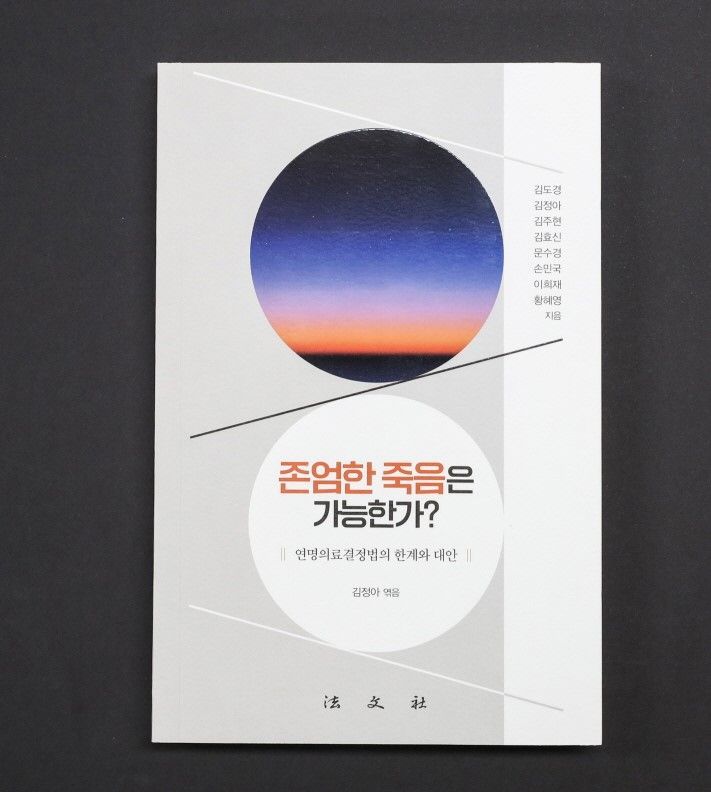 Cover of 'Is a Dignified Death Possible? - Limits and Alternatives of the Life-Sustaining Treatment Decision Act' featuring Professor Kim Jeong-ah of Dong-A University and others.
This book involved eight emerging researchers on the Act on Decisions on Life-Sustaining Treatment, including Dong-A University professors Kim Jeong-ah, Kim Do-gyeong, Son Min-guk, and graduate student Moon Su-gyeong. The authors' fields of expertise are diverse, including medical ethics, medical humanities, medical informatics, health policy, medical history, law, and nursing ethics.
The various authors compiled eight papers from different fields they have researched on the current hospice and palliative care and the Act on Decisions on Life-Sustaining Treatment concerning patients in the dying process, focusing on the limitations of the current law and directions for future development.
In this book, the authors point out the limitations of the current Act on Decisions on Life-Sustaining Treatment, which severely restricts patients' right to refuse treatment, and present these empirically. As an alternative, they urge the establishment of a comprehensive system based on transparent and effective social discussions, including fundamental recognition of the right to refuse treatment.
Editor Professor Kim Jeong-ah stated, “Our society, having entered a multi-death (dasa) society, faces the significant issues of ‘death’ and ‘end-of-life care.’ These matters possess complexities that cannot be captured by a single academic field and involve decisions that connect life and death, where individuals’ perceptions of right and wrong, desirability, and permissibility intersect and conflict.” She added, “Often, there is insufficient accurate understanding of reality to delicately handle such issues, and there is a lack of social resources to promote such understanding,” explaining the background of the book’s publication.
Professor Kim further explained, “By bringing together writings from various research methodologies and academic fields such as medical ethics, law, history, big data statistics, nursing, and policy studies, we aimed to enable readers to achieve an integrated understanding of these issues as much as possible.”
© The Asia Business Daily(www.asiae.co.kr). All rights reserved.
![Clutching a Stolen Dior Bag, Saying "I Hate Being Poor but Real"... The Grotesque Con of a "Human Knockoff" [Slate]](https://cwcontent.asiae.co.kr/asiaresize/183/2026021902243444107_1771435474.jpg)
















