6.06 points... Significantly below the OECD average of 6.69 points
Salaried workers work 157 hours per month and earn 3.55 million KRW
The satisfaction level of Koreans with their lives was found to be among the lowest among the member countries of the Organisation for Economic Co-operation and Development (OECD). While the political efficacy, which reflects citizens' participation and influence in politics, showed improvement, the suicide rate increased and the crime victimization rate reached an all-time high.
6.06 points... Far below the OECD average of 6.69 points
According to the "Quality of Life in the Nation 2024 Report" released by Statistics Korea on the 24th, the average life satisfaction score of Koreans from 2021 to 2023 was 6.06 points, significantly lower than the OECD average of 6.69 points. Among the 38 OECD member countries, Korea ranked 33rd. Countries with lower life satisfaction than Korea included Portugal, Hungary, Greece, Colombia, and Turkiye. Finland had the highest score at 7.74 points. Life satisfaction is an indicator that shows individuals' subjective satisfaction with objective living conditions, measured on a scale from 0 to 10.
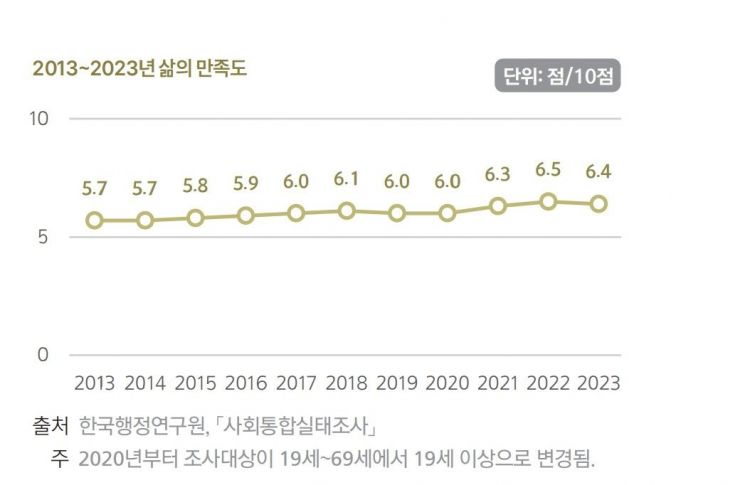
Life satisfaction was lower among those with lower income levels. The life satisfaction score for low-income households earning less than 1 million KRW was 5.7 points, while it was higher at 6.1 points for those earning between 1 million and less than 2 million KRW. For those earning over 5 million KRW, the score was 6.6 points, which is 0.9 points higher than those earning less than 1 million KRW. By occupation, professionals and office workers both scored 6.7 points, while those in agriculture, forestry, and fisheries scored 6.1 points, and manual laborers scored 6.3 points.
Among the 11 overall areas, indicators related to the environment showed clear improvement. Satisfaction with air quality increased by 0.5 percentage points to 42.8% in 2024 compared to 2022. During the same period, the per capita urban park area increased by 0.3 square meters to 12.6㎡.
The per capita urban park area has shown an increasing trend from 5.3㎡ in 2001 to 10.3㎡ in 2008. After decreasing to 8.1㎡ in 2009, it maintained a similar area in the high 8㎡ range until 2015, then entered the 9㎡ range from 2016 onward and has been increasing since.
The political efficacy, which reflects citizens' belief that their actions can influence the political process, rose by 2.4 percentage points to 17.6% in 2023 compared to the previous year.
On the other hand, unemployment and suicide rates increased. Last year, the unemployment rate was 2.8%, up 0.1 percentage points from the previous year. By gender, the unemployment rate was 2.8% for men and 2.9% for women, with women slightly higher, and both genders experienced an increase compared to the previous year.
By age group, the unemployment rate was highest at 7.2% for those aged 15-19, followed by 5.8% for those aged 20-29, indicating a high unemployment rate among young people in their prime working age.
The suicide rate in 2023 was 27.3 per 100,000 people, an increase of 2.1 from the previous year. The suicide rate peaked at 31.7 in 2011 and had been declining but has shown a slight upward trend since 2017.
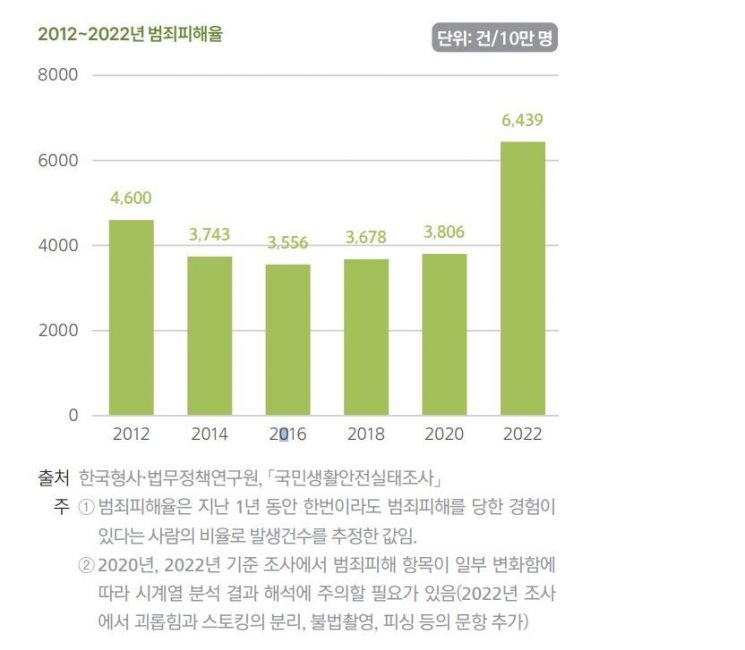
The issue of crime victimization also worsened. The crime victimization rate was 6,439 cases per 100,000 people in 2022, a sharp increase from 3,806 cases in 2020. This was the largest increase since the related statistics began to be compiled. Statistics Korea analyzed that "the increase in crime victimization rate in the 2022 survey appears to be influenced by the separation of bullying and stalking categories and the addition of illegal filming and voice phishing categories."
Salaried workers work 157 hours a month and earn 3.55 million KRW
The average monthly wage of workers in Korea in 2023 was 3.555 million KRW, and the total monthly working hours were 157.6 hours, with wages decreasing and working hours increasing compared to a year ago.
The real average monthly wage, adjusted for the consumer price index for wage earners, was 3.554 million KRW, down 38,000 KRW from the previous year. The average monthly wage had steadily increased since 2011 but recently turned to a downward trend. It slightly decreased from 3.599 million KRW in 2021 to 3.592 million KRW in 2022, and further decreased by 38,000 KRW to 3.554 million KRW in 2023 compared to the previous year.
During the same period, working hours increased by 2.7 hours to 157.6 hours. Working hours had been decreasing from 193.4 hours in 2006 to 152.4 hours in 2019, then slightly increased to 163-164 hours during the COVID-19 pandemic period between 2020 and 2021, but decreased again to 154.9 hours in 2022.
A Statistics Korea official explained, "Working hours are usually affected by the number of working days during the survey period. In June 2020 and 2021, the number of working days was 22 days, which is 3 days more than the previous year, while in 2022 and 2023, it was 20 and 21 days respectively, showing a similar trend in working days and hours. Although working hours fluctuate depending on the number of working days, the overall trend is a decrease."
© The Asia Business Daily(www.asiae.co.kr). All rights reserved.



















