Due to the recent deterioration of domestic and international economic conditions leading to poor business performance, concerns are rising over an increase in audit-related issues, making it necessary to be cautious of unfair trading. During the earnings season, a large amount of important information such as the business performance and audit opinions of listed companies is typically generated, increasing the likelihood of unfair trading activities related to this information.
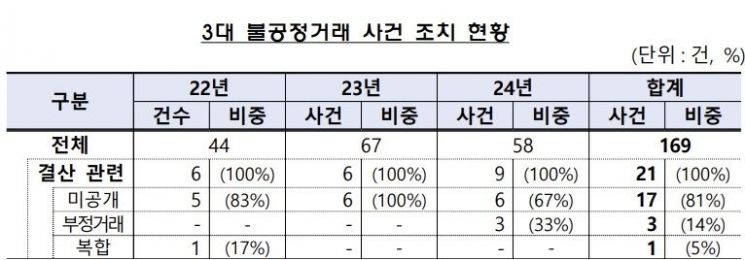
On the 24th, the Financial Supervisory Service (FSS) announced that among 169 cases of the three major unfair trading acts related to earnings settlements (insider trading, market manipulation, and fraudulent trading) over the past three years, 21 cases (involving 18 companies) were related to earnings information. The number increased from 6 cases in 2022 to 6 cases in 2023, and 9 cases last year.
Among these, insider trading cases accounted for the majority with 17 cases (81%). The earnings-related information used in insider trading mostly (82%) consisted of negative information such as adverse audit opinions and deteriorating business performance. Additionally, there were 3 cases (14%) of fraudulent trading and 1 case (5%) of combined cases (insider trading and fraudulent trading).
Most suspects in insider trading cases were insiders. Of the 66 suspects, 43 (65%) were insiders of the respective companies (major shareholders, executives, employees), including 14 major shareholders and 25 executives.
The companies involved in earnings-related unfair trading (18 companies) tended to have small capital sizes. The average capital of these 18 companies was 17.6 billion KRW, with 11 companies having capital under 20 billion KRW. They also continued to experience poor performance. Over the past three years, they consistently recorded cumulative net losses. As of 2023, their average debt ratio was 216.1%, nearly double the average of listed companies (108%). Furthermore, many received adverse audit opinions or delayed submission of audit reports.
Notably, these companies continued to raise funds. Among the companies involved in earnings-related unfair trading, 12 issued a total of 324.3 billion KRW in privately placed convertible bonds (CBs) under the pretext of improving financial structure. Seven companies conducted third-party allotment capital increases totaling 181.6 billion KRW.
Another characteristic of companies caught for unfair trading is the low shareholding ratio of the largest shareholder, leading to frequent changes in the largest shareholder. At the end of 2023, the average largest shareholder stake in these 18 companies was 26.9%, which is 16.2 percentage points lower than the average largest shareholder stake (43.1%) of other listed companies. Among the 18 companies, 13 changed their largest shareholder within the past three years. Additionally, 10 of these companies changed their company names to conceal poor business performance or adverse audit opinions.
The FSS emphasized, "Employees of listed companies should be aware that trading financial investment products using earnings-related information may constitute insider trading," and stressed the need to strengthen internal controls to prevent unfair trading in advance.
It also advised, "Investors should be cautious of false disclosures or rumors that may mislead during the earnings season, such as new business initiatives or external fund raising by listed companies," and warned, "Trading stocks or passing on information heard from others may result in punishment for insider trading or market order disruption."
© The Asia Business Daily(www.asiae.co.kr). All rights reserved.