Market Reacts Even Before Announcement
Benefits Limited to Gangnam, Widening Polarization
Some Experts Expect Stabilization After Short-Term Rise
"The expectation was high due to the lifting of the Land Transaction Permission System, so some increase was anticipated. However, in the long term, there is no mechanism for further price rises. The volume of transactions made easier accounts for two-thirds of the total (38,205 households), which is not enough to significantly impact the market." (Lee Chang-moo, Professor at Hanyang University)
"The timing of the lifting was wrong. I told a senior official in Seoul City that it should not be lifted, but it was eventually lifted. They say the research report showed no impact, so they lifted it, but I think it's 'crazy'." (Real estate expert requesting anonymity)
Experts' views diverged regarding the price fluctuations of apartments in areas such as Songpa-gu, Seoul, which were removed from the Land Transaction Permission Zone (Toheo Zone). The recent rise in housing prices in Gangnam is largely attributed to Seoul Mayor Oh Se-hoon's public remarks made one month before lifting the Toheo system. Areas likely to be removed from the Toheo system had time to prepare mentally, and after the lifting, sellers quickly withdrew listings or raised asking prices, creating momentum for rapid movement. However, while some analysts believe there is no mechanism for sustained price increases, others predict the trend could spread to other areas, stimulating a broader market movement.
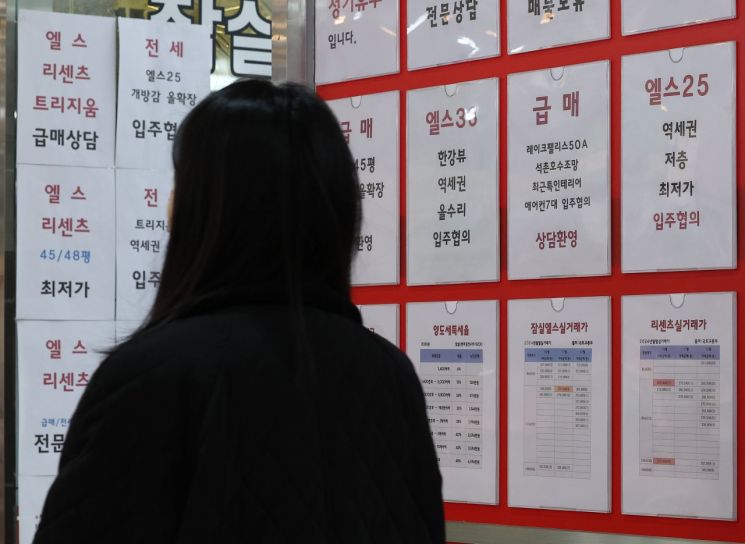 Amid an overall downturn in the real estate market, Seoul City lifted the designation of land transaction permission zones in Jamsil-dong, Songpa-gu, and the areas of Samseong, Daechi, and Cheongdam-dong in Gangnam-gu, where apartment demand is concentrated, on the 12th. The day after the lifting, a real estate sales notice was posted at a real estate office in Songpa-gu, Seoul. Photo by Yonhap News
◆Housing Prices Rise in Songpa After Toheo System Lifted= According to the weekly apartment price trends released by the Korea Real Estate Board, Songpa-gu, where the lifted zones are concentrated, saw a 0.36% increase in the week of February 17-23 alone, and a cumulative 0.8% rise since the beginning of the year. This contrasts with the nationwide and metropolitan area trends, which have continued to decline since last year. This rise occurred within a week after Seoul City lifted the Land Transaction Permission System on some areas on February 12.
Experts analyzed that Mayor Oh's remarks a month earlier prepared the market for an immediate reaction. However, opinions differed on whether this dramatic movement would continue.
Real estate agencies in the area, observing direct increases in transactions and actual prices, predicted further rises. A real estate office in Jamsil-dong said, "After the lifting, a flood of listings appeared, with prices for 84㎡ units reaching 3 billion KRW, and the most expensive going up to 3.2 billion KRW." Another nearby agency noted, "Demand has emerged to sell apartments like Jamsil Liscence, Els, and Trizium and move to planned reconstruction apartments, causing prices to rise even in areas where regulations remain."
Yoon Soo-min, a specialist at NH Nonghyup Bank, said, "Prices were already rising before the lifting, but the announcement amplified the increase and shortened the time of the rise. If asking prices go up and transactions increase one by one, prices may hold steady while asking prices in Gangnam, Hannam, and even other areas like Mapo, Yongsan, and Seongdong could also rise."
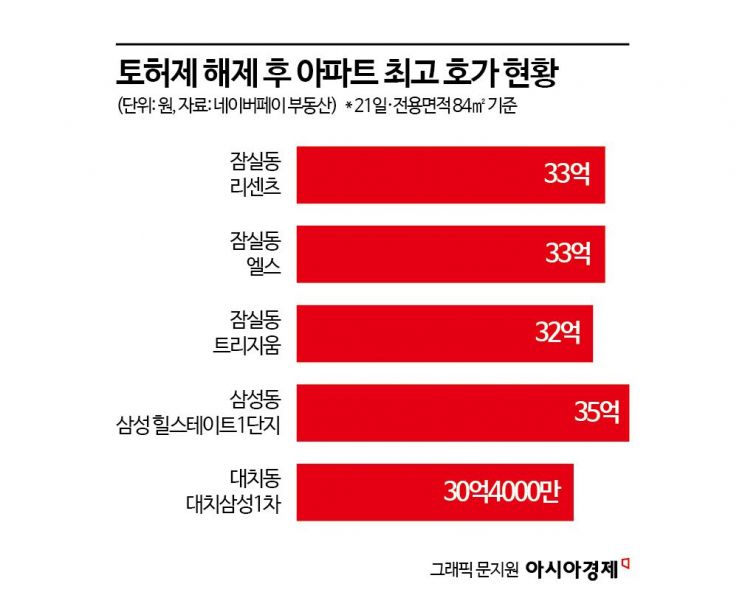
◆"Possibility of Stabilization After Early-Year Rise"= The city expects some market movement initially after the lifting but believes it will stabilize later. Since prices were rising even when the Toheo system was in place, maintaining it would not necessarily have a stabilizing effect. Considering grievances from homeowners who were unfairly restricted by the system, the city judged that lifting the system like in other areas was appropriate.
A Seoul city official said, "Although transaction volumes decreased under the Toheo system, prices steadily trended upward. With the upcoming implementation of the third stage of the Debt Service Ratio (DSR) regulation in July, it is uncertain whether the upward trend will continue."
Professor Lee Chang-moo, who has been reviewing the effects of the Toheo system since last year on behalf of Seoul City, said, "In both the year before last and last year, the actual transaction price index rose from January but declined toward the end of the year. This is just an early-year upward trend, and it will enter a stabilization phase over time."
◆"Concerns Over Sharp Price Rise Due to Interest Rate Cuts and Presidential Election"= There is also analysis that the lifting of the Toheo system could stimulate housing prices amid falling interest rates and the upcoming presidential election, suggesting the timing was inappropriate.
Recently in Seoul, only areas along the Han River or around Gangnam have seen price increases, while other regions have remained unchanged or even declined, highlighting a polarization of location preferences. The highly favored Gangnam area lacks alternatives and still attracts speculative demand, which could deepen this polarization.
Ko Jong-wan, President of the Korea Asset Management Research Institute, said, "Due to supply shortages relative to demand and speculative inflows, Gangnam housing prices were steadily rising even before the lifting. The rise spreading to areas like Yeouido and Mok-dong during the moving season could act as a market destabilizing factor." He added, "To judge that prices have stabilized, at least six months to a year of close observation is needed. Judging a four-month adjustment period is premature. The lifting benefits only Gangnam, and given the imminent presidential election, it seems like a populist policy aimed at winning votes in that area."
A real estate expert who wished to remain anonymous said, "There is a high possibility of interest rate cuts this year, and if the presidential election is held early, housing prices could surge after the election. Lifting the system before the Yeongdong-daero development is completed was a wrong decision." The areas lifted this time were designated as Toheo zones in 2020 by the late Mayor Park Won-soon to prevent speculation during the Yeongdong-daero development.
© The Asia Business Daily(www.asiae.co.kr). All rights reserved.
![Clutching a Stolen Dior Bag, Saying "I Hate Being Poor but Real"... The Grotesque Con of a "Human Knockoff" [Slate]](https://cwcontent.asiae.co.kr/asiaresize/183/2026021902243444107_1771435474.jpg)












