Merz Expected to Become New German Chancellor
Far-Right Party Surges to Second Place
Chancellor Scholz Fails in Re-Election Bid
In the German federal parliamentary election held on the 23rd (local time), exit polls indicated that the center-right Christian Democratic Union (CDU) and Christian Social Union (CSU) alliance would secure the position of the largest party, surpassing Chancellor Olaf Scholz's Social Democratic Party (SPD) and the far-right Alternative for Germany (AfD).
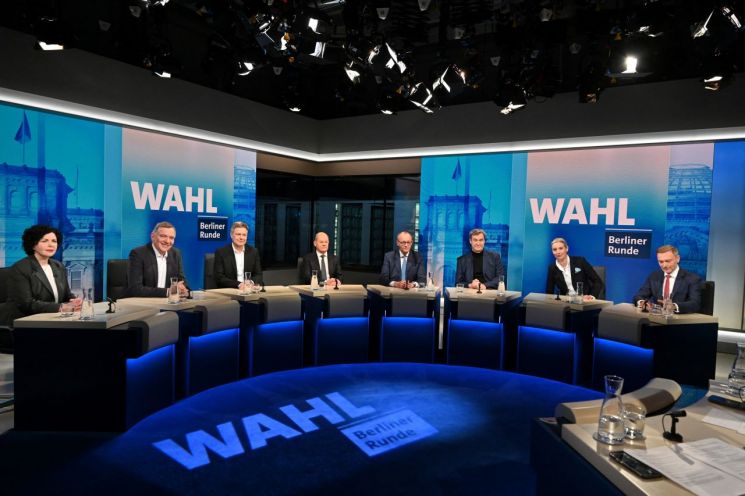
According to the Financial Times (FT), in the survey released at 6 p.m. by the public broadcaster ARD, the CDU·CSU alliance was projected to receive 29.0% of the vote, significantly ahead of AfD with 19.5% and SPD with 16.0%. The Green Party followed with 13.5%, and The Left Party with 8.5%.
Friedrich Merz, the 70-year-old CDU leader, declared to supporters gathered at the Berlin party headquarters, "We have won." Alice Weidel, the 46-year-old co-leader of AfD, which was predicted to come in second, praised the party by saying, "We have doubled our votes compared to the last election. This is a historic result." Meanwhile, SPD Chancellor Olaf Scholz, expected to fall to third place behind AfD, admitted, "We must acknowledge a bitter defeat."
The pro-business Free Democratic Party (FDP) was estimated to receive 4.9%, and the populist Sahra Wagenknecht Alliance (BSW) 4.7%, making it unlikely for them to enter the parliament. According to German election law, a party must either surpass 5% of the party vote or win at least three constituency seats out of 299 to gain seats in the Bundestag. FT predicted that the form of Germany's ruling coalition would depend on whether small parties, including the pro-business FDP, meet the vote threshold to enter the federal parliament.
These exit poll results closely align with the party support rates shown in pre-election opinion polls. In a poll conducted on the 22nd of last month, the parties recorded support rates of 30.0% for the CDU·CSU alliance, 20.2% for AfD, 15.5% for SPD, 13.1% for the Green Party, and 4.2% for the FDP.
Unless the final vote shares for the top three parties change significantly in the official count, a regime change led by the CDU·CSU is considered certain. If a coalition is successfully formed, Merz is expected to become Chancellor. This would mark the return of a center-right government in Germany just over three years after former CDU Chancellor Angela Merkel stepped down in December 2021.
Immediately after the exit poll results were announced, Merz stated, "I am aware of the heavy responsibility now before me," declaring victory. He also said, "The world will not wait for us," and although he did not specify which party he would partner with, he expressed a desire to form a government swiftly.
As of 7 p.m. on the same day, ARD projected that out of the total 630 seats, the CDU·CSU alliance would hold 210 seats, AfD 145 seats, SPD 118 seats, the Green Party 94 seats, and The Left Party 62 seats.
The rapidly growing AfD is expected to become the second-largest party in the Bundestag with nearly double the 10.4% vote share it received in the 2021 election. However, even if AfD secures second place in actual votes, it is expected to be excluded from coalition formation. Established parties likely to lead coalition talks are thoroughly avoiding AfD. German parties reject all cooperation with AfD, including coalition formation, citing that AfD undermines democracy.
© The Asia Business Daily(www.asiae.co.kr). All rights reserved.

















