"Claims of 'Insult to Hinduism'...
Ganges River Water Safe to Drink, Officials Insist"
The water quality of the Ganges River, known as the 'Sacred River' in India and where countless pilgrims immerse themselves, has been revealed to be in a serious condition.
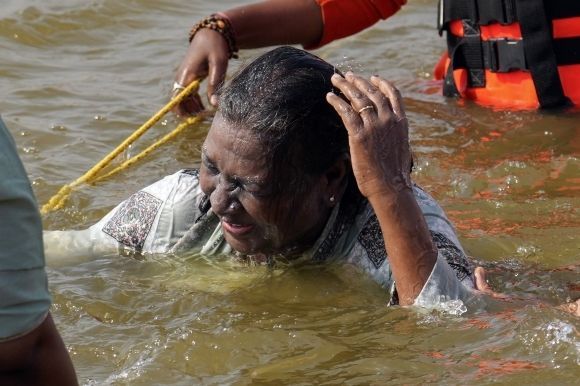 During the Maha Kumbh festival in India, considered one of the world's largest religious gatherings, Indians are bathing at the confluence of the Ganges River, Yamuna River, and Saraswati River (a mythical river that does not actually exist). Photo by AP Yonhap News
On the 23rd, India's Times of India and the UK's BBC reported that the Central Pollution Control Board (CPCB), under the Ministry of Environment, Forest and Climate Change of India, released a report on the 20th stating that the water quality of major rivers including the Ganges does not meet government standards. The report was based on water quality investigations conducted in the Prayagraj region of Uttar Pradesh in northern India during the Hindu festival 'Kumbh Mela' (January 13 to February 26), considered the world's largest religious event.
The area is the confluence of the Ganges, Yamuna, and Saraswati rivers (the latter being a mythical river that does not actually exist), and bathing at the junction of these three rivers is regarded as a core ritual of the festival. During this year's Kumbh Mela, it was estimated that 570 million people bathed there. However, the E. coli levels in this area greatly exceeded the safety standard (2,500 units per 100 ml). This poses a serious health risk to those performing the 'sacred bath.'
After the main bathing rituals, the fecal coliform E. coli levels in the Ganges River near Shastri Bridge surged to 11,000 units per 100 ml, and at Sangam to 7,900 units, which is more than four times the safety standard of 2,500 units.
Fecal coliform E. coli is a bacterium naturally found in the intestines of humans and animals, but its detection in water is considered a warning sign of the presence of harmful pathogens such as viruses, parasites, and bacteria that cause various diseases originating from fecal matter. The Times of India pointed out, "Exposure to contaminated river water can lead to diseases such as gastrointestinal infections, skin rashes, typhoid, hepatitis A, and respiratory infections," adding that "the deterioration of pilgrims' health as well as the daily lives of local residents who use the river water for drinking and cooking will be threatened."
However, Yogi Adityanath, Chief Minister of Uttar Pradesh, responded by saying, "The state government is monitoring the water condition," and insisted, "This river water is suitable not only for bathing but also for drinking." He even raised suspicions that "false results were produced to insult the Hindu festival."
Dr. Adma Kumar Shankar, a distinguished scientist who received the Padma Shri cultural award in India, countered based on his own experiments, stating, "It has been proven that the Ganges River water maintains excellent self-purification ability in every aspect," and added, "It is as clean as alkaline drinking water. The fact that not a single one among 570 million people fell ill proves this."
© The Asia Business Daily(www.asiae.co.kr). All rights reserved.

















