Seoul Mayor Oh Se-hoon criticized the inheritance tax reform plan promoted by the Democratic Party of Korea as a mere stopgap measure aimed at winning middle-class votes. He emphasized that not only a simple increase in deductions but also a structural reform is necessary.
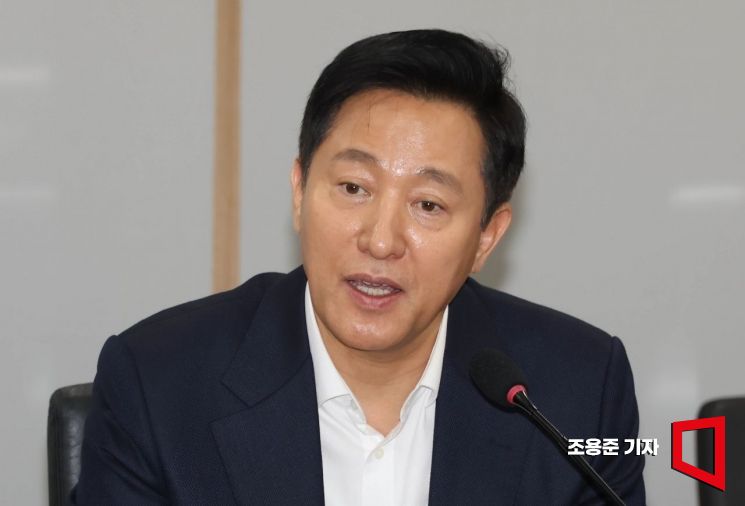 On February 13, 2025, Oh Se-hoon, Mayor of Seoul, attended and spoke at the report meeting on the abolition of regulations for investment and funded institutions held at the Seoul City Hall in Jung-gu, Seoul. Photo by Jo Yong-jun
On the 23rd, Mayor Oh stated on his social media service (SNS), "It is fortunate that the Democratic Party belatedly recognized the burden of inheritance tax," but added, "This is not enough." He continued, "If the Democratic Party truly wants to reform the inheritance tax for the middle class, simply expanding deductions is insufficient," and argued, "It should not be a stopgap measure targeting the votes of middle-class households owning one house in Seoul, but a fundamental reform reflecting the realities of the Korean economy and changes in asset accumulation structures." On the 18th, the Democratic Party proposed increasing the spousal deduction from 500 million won to 1 billion won and the blanket deduction from 500 million won to 800 million won as part of expanding inheritance tax deduction limits.
Mayor Oh explained, "The burden of inheritance tax in our country is already increasing at the fastest rate globally," adding, "In 2001, only 0.9% of heirs paid inheritance tax, but by 2022, this rose to 4.5%. The ratio of inheritance and gift tax burden to GDP is the highest except for France."
He pointed out, "The inheritance tax system has been neglected for 25 years, and a tax originally targeting a very small number of ultra-high-income earners is now squeezing the middle class," and said, "To solve this problem, a sophisticated reform is needed, not just a simple increase in deductions." This is interpreted as criticism of the Democratic Party's proposal to expand inheritance tax deduction limits.
Mayor Oh proposed raising the child deduction from 50 million won to 500 million won and establishing a new grandchild deduction of 500 million won. He also argued that, like Japan, gift tax deductions for childcare and education expenses from elementary school through university should be introduced, and gift tax deductions for start-ups and marriage should be expanded.
He stated, "Expanding these pre-gift deductions will promote the intergenerational transfer of assets and contribute to their use in productive sectors," and emphasized, "Furthermore, the method of inheritance tax assessment must be reformed. Currently, the inheritance tax law includes assets given to heirs within 10 years before the decedent’s death in the tax calculation, but this period should be reduced to 5 years."
Additionally, Mayor Oh proposed shortening the gift tax assessment period from the current 10 years to 5 years and transitioning from the current estate tax system, which taxes the entire inherited estate, to an inheritance acquisition tax system that taxes based on the actual assets received by each individual heir.
© The Asia Business Daily(www.asiae.co.kr). All rights reserved.