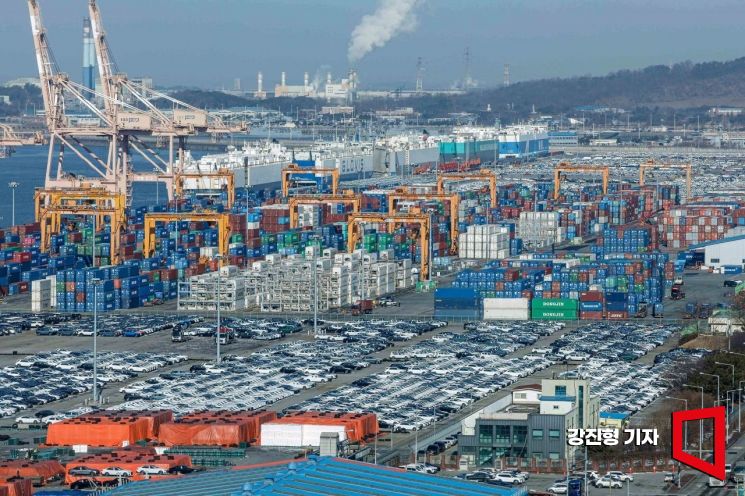
 President Donald Trump signed a proclamation imposing a 25% tariff without exceptions on steel and aluminum products imported into the United States, and stated that tariffs on automobiles and semiconductors are also under consideration. Meanwhile, export vehicles are waiting to be loaded at Pyeongtaek Port, Gyeonggi Province on February 13, 2025. Photo by Kang Jin-hyung
The U.S. government has detailed measures to curb China's expanding influence in the global shipbuilding and shipping markets.
On the 21st (local time), the U.S. Trade Representative (USTR) announced in a notice that, considering China's dominance in the maritime, logistics, and shipbuilding industries, it plans to impose fees on international maritime transport services related to Chinese shipping companies and Chinese-made vessels.
The USTR's proposed measures include imposing fees of up to $1 million (approximately 1.4 billion KRW) per vessel or up to $1,000 (approximately 1.44 million KRW) per ton of vessel capacity each time a specific Chinese shipping company's vessel enters a U.S. port.
Additionally, for shipping companies operating multiple vessels, including Chinese-made ships, a fee of up to $1.5 million (approximately 2.15 billion KRW) may be imposed depending on the number of Chinese-made vessels entering U.S. ports.
Furthermore, the USTR has also prepared regulatory proposals to promote the use of U.S.-made products on U.S. vessels.
Once implemented, at least 1% of U.S. products shipped by sea must be exported via U.S.-flagged vessels operated by U.S. shipping companies. This ratio is set to gradually increase to 3% after two years, 5% after three years, and 15% after seven years. Ultimately, the plan is to ensure that maritime exports of U.S. products are carried out through U.S.-flagged, U.S.-made vessels.
These measures follow an investigation into China's industrial practices conducted during the previous Joe Biden administration.
During the Biden administration, the USTR pointed out in an investigative report released four days before President Trump's inauguration that China had employed various unfair means to dominate the global shipbuilding and shipping markets, emphasizing the need for "urgent measures" in response.
According to the report, China increased its global shipbuilding industry market share from about 5% in 2000 to over 50% in 2023 through preferential treatment and subsidies. While South Korea and Japan ranked second and third respectively, the U.S., which once led the global shipbuilding market, saw its market share fall below 1%.
Bloomberg News forecasted that if the USTR's measures raise transportation costs for Chinese vessels, it could present opportunities for the shipbuilding industries in South Korea and Japan.
However, it also noted that increased transportation costs might be passed on to consumer prices, ultimately burdening Americans. Considering that U.S. shipbuilding capabilities have declined despite previous protective measures for the shipbuilding and shipping industries, it remains uncertain whether this policy will be effective.
The proposed measures are based on Section 301 of the Trade Act of 1974. This law grants the U.S. government the authority to respond when foreign governments are found to engage in discriminatory trade practices.
Meanwhile, the measures will be finalized after a public comment period initiated on the same day and a public hearing scheduled for the 24th of next month.
© The Asia Business Daily(www.asiae.co.kr). All rights reserved.

















