At Least Six Months Needed to Set Up Required Facilities... Effectiveness in Question
Justifying Move as a Boost for Travel Industry, but True Motives Differ
Power Struggle Over Key Issues Like Military Airport Relocation
Residents Disappointed by Infighting Without a Vision for Regional Development
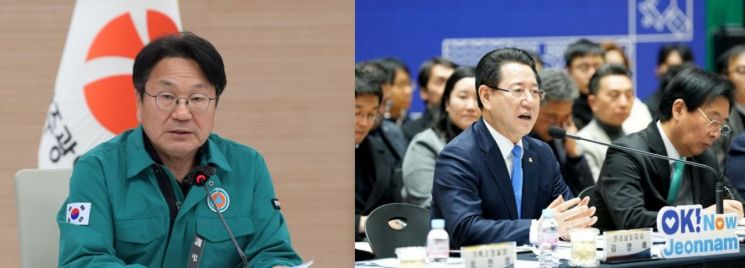
As Jeonnam Province recently shifted to a 'positive mode' after having opposed Gwangju City's persistent request to temporarily relocate international flights from Muan Airport to Gwangju Airport for a certain period, debates are continuing.
Some observers note that while it appears Jeonnam Province has yielded to Gwangju City, which has been aggressively pushing for economic stimulus measures such as supporting the travel industry, in reality, Jeonnam may have cleverly sidestepped Gwangju's unrealistic slogans and found a new way forward.
Regardless of the current situation, there are also cynical remarks that this marks the second round of the so-called "aviation war," following the ongoing issue of relocating the military airport from Gwangju to Muan over the past few years.
The endless conflict structure between Gwangju City and Jeonnam Province, who seize every opportunity to clash, is causing extreme fatigue among local residents.
On the afternoon of the 18th, Gwangju Mayor Kang Gijung met with local reporters in the Gwangju City Hall briefing room in Seo-gu, Gwangju, and announced, "We will officially request the Ministry of Land, Infrastructure and Transport to allow temporary international flights at Gwangju Airport." He also claimed, "It can be done in two months (including preparing international flight facilities)."
This statement echoes the complaints of the travel industry, which has been hit hard by reservation cancellations and other aftereffects following the Jeju Air disaster. The travel industry claims that, based on typical reservation rates and sales figures for the peak season (January-February), tangible and intangible damages since the disaster amount to about 30 billion KRW. They argue that if international flights at Muan Airport are further delayed, the losses will only increase.
Officially, Jeonnam Province has tentatively set October as the resumption date for international flights at Muan Airport. Mayor Kang has taken up the travel industry's request to allow temporary international flights from Gwangju Airport as a justification.
Even before his official statement, Mayor Kang had sent positive signals about relocating international flights to Gwangju Airport. For Gwangju City, operating international flights from Gwangju Airport is highly desirable, not only for the clear reason of revitalizing the local economy but also for the smooth hosting of the World Archery Championships in September.
Negative public sentiment within the region has formed against Jeonnam Province, which had opposed the temporary operation of international flights at Gwangju Airport, while failing to provide a clear solution for the travel industry's problems. This situation does not harm Gwangju City.
Furthermore, the ongoing issue of relocating both civilian and military airports to Muan remains unresolved, so this debate over international flights at Gwangju Airport could serve as a new card for Gwangju City to shift the situation. It could even outline the "Plan B" that Mayor Kang has repeatedly mentioned.
However, as Jeonnam Governor Kim Youngrok recently expressed support for the temporary relocation of international flights to Gwangju Airport, cracks are appearing in Gwangju City's plans. From Jeonnam's perspective, Gwangju City's repeated demands for international flights, representing the travel industry, have been quite unpleasant.
In an unusual move, Moon Ingi, head of the Construction and Transportation Bureau of Jeonnam Province, even issued a statement on the 6th, detailing the reasons why a temporary relocation of international flights to Gwangju Airport would be difficult.
In reality, operating international flights requires customs, immigration, quarantine systems, and related facilities. It is known that installing these systems takes at least six months and up to one or two years. If the existing facilities at Muan Airport were to be moved, considering the sunk costs and other additional factors, it would not be economically feasible at all.
Gwangju Airport also faces safety issues, such as the need to upgrade the localizer on the runway. The World Archery Championships do not even meet the requirements for hosting international flights under the International Sports Event Support Act.
Additionally, the October resumption date for Muan Airport was set due to the regional atmosphere of mourning and the need to uncover the truth about the disaster. Internally, however, some in Jeonnam Province believe that flights could resume as early as August, depending on future developments. In other words, Gwangju City's claim to relocate international flights to Gwangju Airport is virtually impossible both in reality and under relevant regulations. Even the Ministry of Land, Infrastructure and Transport is skeptical about the possibility of operating international flights from Gwangju Airport this time.
Governor Kim's recent shift to support the temporary relocation of international flights to Gwangju Airport is seen as a clever move that could both quell negative public opinion toward Jeonnam Province and shift responsibility for raising unrealistic expectations onto Gwangju City?a win-win strategy.
In a recent public opinion poll conducted by a media outlet, 8 out of 10 residents of Gwangju and Jeonnam supported the relocation of international flights to Gwangju Airport. If, despite high expectations, the plan for temporary international flights at Gwangju Airport ultimately falls through, there is a high likelihood that the blame will fall on Gwangju City.
However, the repeated re-enactment of this long-standing conflict between the two local governments is causing significant fatigue for residents. After dozens of disputes over the military airport relocation issue over the past seven years, the two governments are now bickering again over a similar matter, which is seen as distasteful. While they outwardly call for unity, there is disappointment that they are prioritizing local interests over regional development.
Especially with the local elections (scheduled for June 3, 2026) just over a year away, there is criticism that both sides are merely trying to highlight their own presence, making the current situation even more unseemly.
One Jeonnam resident commented, "It hasn't been long since the Jeju Air disaster, yet Gwangju City and Jeonnam Province, who should be working together for regional development, are at odds again. With the economic downturn, many residents are struggling to make ends meet. The two governments should be moving in a direction that helps, but instead, they are constantly at each other's throats. It's truly disappointing."
© The Asia Business Daily(www.asiae.co.kr). All rights reserved.
![Clutching a Stolen Dior Bag, Saying "I Hate Being Poor but Real"... The Grotesque Con of a "Human Knockoff" [Slate]](https://cwcontent.asiae.co.kr/asiaresize/183/2026021902243444107_1771435474.jpg)











