Cooperation for Assessing the Impact of Marine Microplastics on Aquatic Organisms
and Developing Reduction Technologies
Busan National University (President Choi Jae-won) G-LAMP (LAMP) Project Group signed an MOU on the 20th at the university's Biological Hall to promote joint research with the National Institute of Fisheries Science for the impact of marine microplastics on aquatic organisms and the development of management technologies.
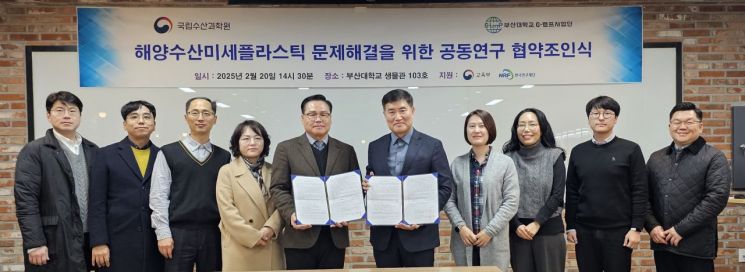 Busan National University G-Lamp Project Group and the National Institute of Fisheries Science are signing an MOU for joint research on marine microplastics. Photo by Busan National University
Marine microplastics are tiny plastic particles ranging from 1㎛ to less than 5㎜, either intentionally produced or formed by the weathering of plastic waste, threatening the aquatic production environment.
This joint research follows the MOU signed last September for collaborative research in climate change and marine environment fields, and plans to conduct △analysis of the impact of marine microplastics on cultured organisms in coastal fish farms △development of marine microplastic reduction technologies in aquaculture farms using various coagulation and adsorption materials.
Accordingly, Busan National University G-LAMP (LAMP) Project Group will conduct research on the physiological impact analysis of marine microplastics and microplastic reduction technology using adsorption material-based 3D structures. The National Institute of Fisheries Science will investigate the distribution characteristics of microplastics in major aquatic products (25 species from coastal and offshore waters, 4 cultured species), secure seawater fish such as flounder, support aquaculture technology, and produce microplastic samples necessary for research.
At the signing ceremony, Jeong Jae-hoon (Professor of Molecular Biology) head of the Busan National University G-LAMP (LAMP) Project Group said, “Microplastic research is becoming an essential social issue to solve for practical environmental protection and human health beyond simple academic interest,” and added, “Starting with this joint research, we expect to inject growth momentum into the research of both institutions and that this research will bring significant changes in various fields.”
Busan National University G-LAMP (LAMP) Project Group has actively promoted mutual exchanges through agreements with domestic companies and research institutes related to earth, marine, and atmospheric sciences such as Fishcare, GenLife, Humanoid Olfactory Display Center, and the National Institute of Fisheries Science, as well as overseas institutions including the University of Tokyo Atmospheric and Oceanic Research Institute, Chiang Mai University Faculty of Science in Thailand, and the U.S. National Institute of Standards and Technology (NIST). Going forward, it plans to further expand exchanges and cooperation with major domestic and international institutions related to earth, marine, and atmospheric sciences to build international research infrastructure and achieve excellent outcomes.
© The Asia Business Daily(www.asiae.co.kr). All rights reserved.

















