Task Force Meeting... 28 Projects Finalized Including Communication and Publicity
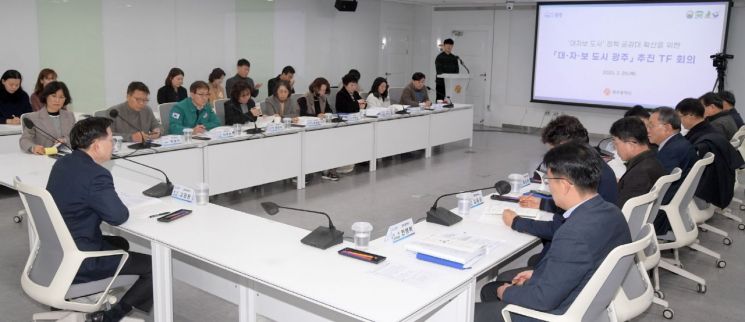 Kwangwan Ko, Deputy Mayor of Gwangju, attended the 'Da-Ja-Bo City Gwangju Promotion Task Force (TF) Meeting' held on the 20th in the city hall small conference room, where he shared strategies to expand consensus on the Da-Ja-Bo city policy and discussed collaboration plans among related organizations. Provided by Gwangju City
Gwangju City is accelerating the spread of community consensus and citizen participation campaigns to become a “Daejabo City” centered on public transportation, bicycles, and walking.
The city plans to actively promote its urban policy direction for responding to the climate crisis and ensuring prosperity for future generations, aiming to boost citizen engagement and interest, following its first steps towards a “Daejabo City” with initiatives such as the Gwangju G-Pass, the opening of Cheongchun Bitpocha Square, and the Gwangcheon area transportation measures.
Gwangju City announced on the 21st that it held a “Daejabo City Gwangju Task Force (TF) Meeting” in the small conference room at City Hall on the 20th, led by Vice Mayor for Administrative Affairs Ko Gwangwan.
The “Daejabo City Gwangju Task Force” serves as the main body for promoting and implementing the policies of “Daejabo City Gwangju,” and is composed of Gwangju City, Gwangju Transportation Corporation, Gwangju Institute, Gwangju Climate and Energy Promotion Agency, Gwangju Urban Regeneration Community Center, Gwangju Transportation Culture Training Center, five district offices, Gwangju Metropolitan Police Agency, Gwangju Metropolitan Office of Education, and Gwangju Sustainable Development Council, among others.
At this year’s first TF meeting, strategies for expanding consensus on the Daejabo City policy were shared, and cooperation methods among related organizations were discussed. The city is carrying out various projects to shift its transportation policy focus from private cars to public transportation, bicycles, and walking. Following efforts such as the Gwangju G-Pass, Cheongchun Bitpocha Square, and Gwangcheon area transportation measures, the city plans to make a significant leap as a Daejabo City by completely reorganizing city bus routes in conjunction with the opening of Phase 1 of Urban Railway Line 2 in 2026.
Additionally, the city is promoting the normalization of bicycle use by creating dedicated bicycle lanes along Phase 1 of Urban Railway Line 2, the Gwangjucheon Bicycle Road, and the nation’s first pilot bicycle living zone in the Cheomdan District area. Furthermore, the city is developing the “Cultural Center Obang-gil for Walking,” which includes the section from Dong-gu District Office to Chodae Intersection centered on the National Asia Culture Center (ACC), the expansion of Seoseok-ro sidewalks, Geumnam-ro car-free street, Munhwajeondang-ro (Gwangsan-gil), and Pureungil.
During the meeting, it was agreed that the key to realizing a “Daejabo City” lies in building citizen consensus and action, and that communication and publicity would be strengthened to verify the effects of the Daejabo City policy and encourage citizen participation.
To this end, the city will focus on 15 projects, including the “Byeolbyeol Daejabo Challenge,” development and dissemination of the Daejabo City policy brand and promotional content, promotion of Daejabo City policies such as the Gwangju G-Pass, and enhancing publicity and practical capabilities through educational programs. Related public institutions will lead 13 projects, including expanding consensus and practical campaigns for Daejabo, developing educational content for Daejabo practice, operating Daejabo City transition training courses for transportation workers, and forming and operating Daejabo Citizen Practice Groups, to foster citizen consensus and policy participation.
The city plans to produce Daejabo-related educational materials to be incorporated into training for transportation workers and elementary, middle, and high school students, and to create booklets and videos for promotional events linked to citizen participation, making information about “Daejabo City Gwangju” easily accessible throughout Gwangju.
Vice Mayor Ko Gwangwan emphasized, “Expanding citizen consensus is the most important factor for the success of the ‘Daejabo City Gwangju Project,’” and urged, “Please actively communicate so that the policies can be effectively conveyed to citizens.”
© The Asia Business Daily(www.asiae.co.kr). All rights reserved.

















