Hyundai Construction Signs Agreement with KIND and K?inga Ora
to Collaborate on Housing Development in New Zealand
Hyundai Construction recently announced on the 21st that it has signed a comprehensive business agreement with the Korea Overseas Infrastructure & Urban Development Corporation (KIND) and K?inga Ora (KO), the New Zealand housing corporation equivalent, to collaborate in the local housing development sector.
This agreement was established to strengthen the strategic cooperative relationship between the two countries and contribute to building sustainable cities. The company explained that the goal is to seek investment opportunities in large-scale housing development projects in New Zealand while establishing a cooperative framework between the governments and private enterprises of both countries.
They decided to proceed with projects using sustainable development methods to meet housing demand while ensuring public interest. Hyundai Construction plans to propose solutions utilizing eco-friendly and smart technologies and review financial and technical support measures. KIND will review information to devise cooperation and financial plans, and KO will provide project-related data and assist with permits.
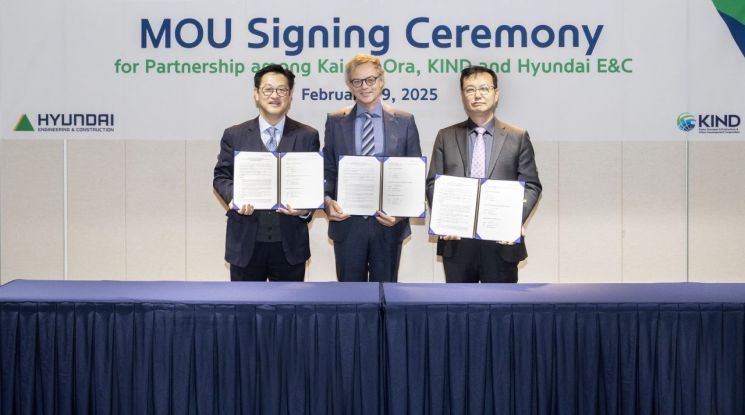 Kim Kyung-soo, Head of Global Business Division at Hyundai Engineering & Construction, Mark Fraser, Head of Kaingaora Urban Development Project, and Won Byung-chul, Head of Business Development Division at KIND, are taking a commemorative photo at the business agreement ceremony held at Hyundai Engineering & Construction headquarters on the 19th. Photo by Hyundai Engineering & Construction
According to the company, New Zealand’s real estate market continues to experience demand exceeding supply, centered around its largest city, Auckland, with the government taking the lead in promoting housing construction. While small to medium-sized, low-rise housing predominates, large-scale mid-rise (five stories or more) developments are gradually increasing.
Hyundai Construction plans to participate from the master plan stage in local housing development projects and incorporate Korean-style residential culture. By utilizing self-developed eco-friendly and smart technologies such as electric vehicle charging stations, solar panels, and specialized communal facilities for residents, they aim to create a differentiated residential environment. The company stated, "This agreement will serve as a catalyst for global urban development cooperation."
© The Asia Business Daily(www.asiae.co.kr). All rights reserved.

















