Natural Monuments "Chamsuri" and "Huinnakkisuri" Spotted Hunting
Recognizing Favorable Habitats, Need to Monitor Duration of Stay
Ulsan City announced that on December 12 and 15 last year, and on January 30 and February 13 this year, citizen biologists and bird enthusiasts captured images of the “Chamsuri” (Eastern Imperial Eagle) and “Huinnakkisuri” (White-tailed Eagle) in the hills and reservoirs located in Cheongnyang-eup, Ulju-gun.
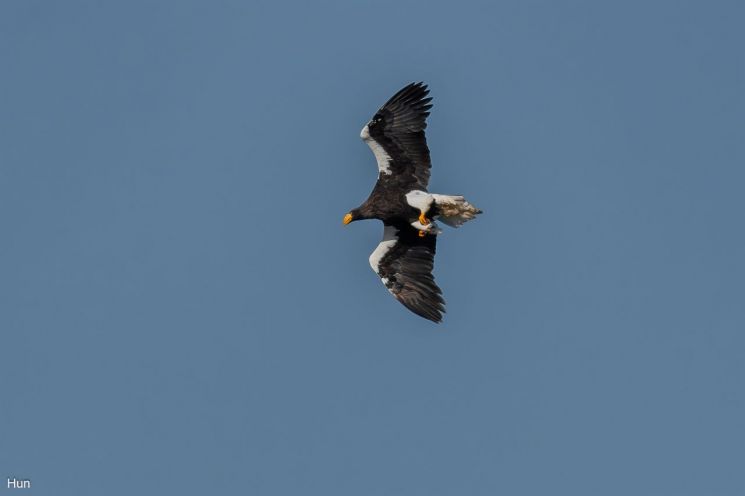
The first observation began on December 12 and 15 last year, when Hong Seung-min, CEO of Jjaekjjaek Rest Area, recorded one individual Chamsuri and two juvenile Huinnakkisuri on a hill in Cheongnyang-eup.
Then, on January 30 this year, bird enthusiasts Kim Tae-hoon (resident of Nam-gu) and Lee Jae-ho (resident of Ulju-gun) spotted Huinnakkisuri and “Mulsuri” (Osprey) at a reservoir in Cheongnyang-eup, and also observed two fully grown Chamsuri and one juvenile.
On February 13, citizen biologist and photographer Yoon Ki-deuk (resident of Nam-gu) captured images of juvenile Huinnakkisuri near a reservoir in Ungchon-myeon, Ulju-gun.
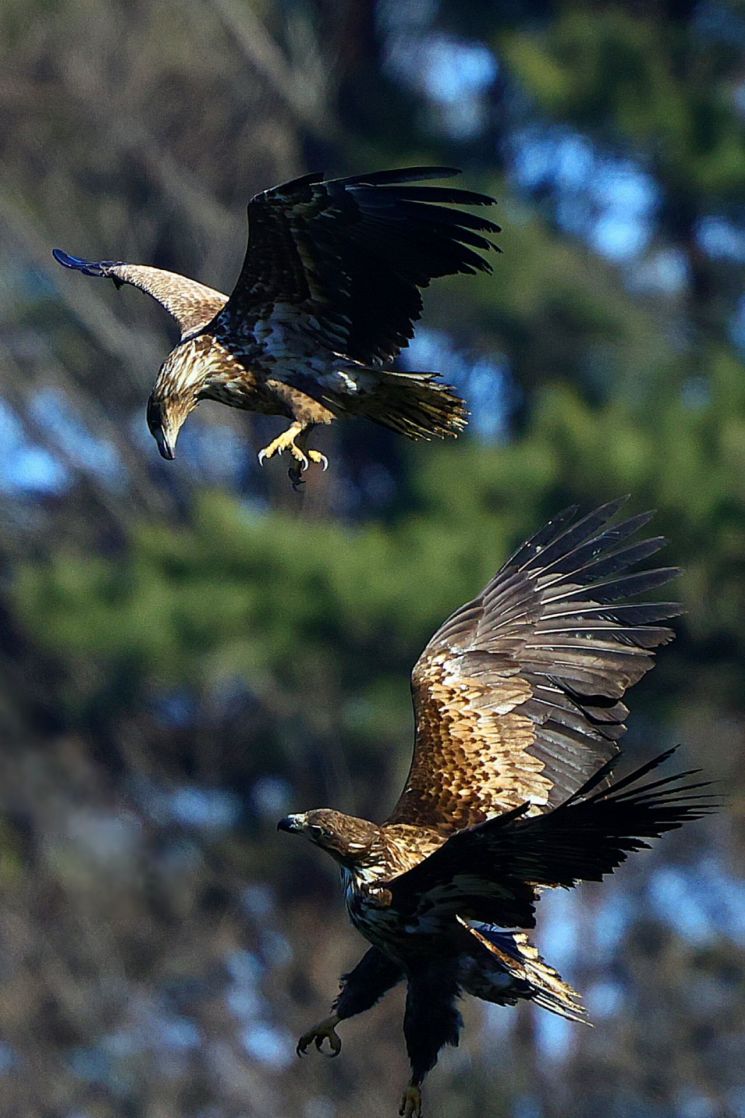 White-tailed eagle juvenile territorial fight. Photo by Yoon Gi-deuk (citizen biologist and photographer), February 13.
The Chamsuri is a winter migratory bird that winters in very small numbers along coastal rivers and estuaries, feeding on fish and animal carcasses. It is designated as a Natural Monument, a Class I endangered wild species by the Ministry of Environment, and an internationally protected species by the International Union for Conservation of Nature (IUCN).
In January last year, two juvenile Chamsuri were also recorded at Hoeya Wetland in Ulju-gun.
The Huinnakkisuri is also a Natural Monument and a Class I endangered wild species, and is a rare winter migratory bird that visits coastal estuaries and rivers.
When fully grown, the Chamsuri can be distinguished from the Huinnakkisuri by its larger, more robust beak and wedge-shaped tail. In contrast, the Huinnakkisuri has a lower, black beak and a yellowish-brown area in front of its eyes.
Additionally, the Chamsuri is entirely black with a tail that appears soiled white, while the Huinnakkisuri is overall brown with a white tail.
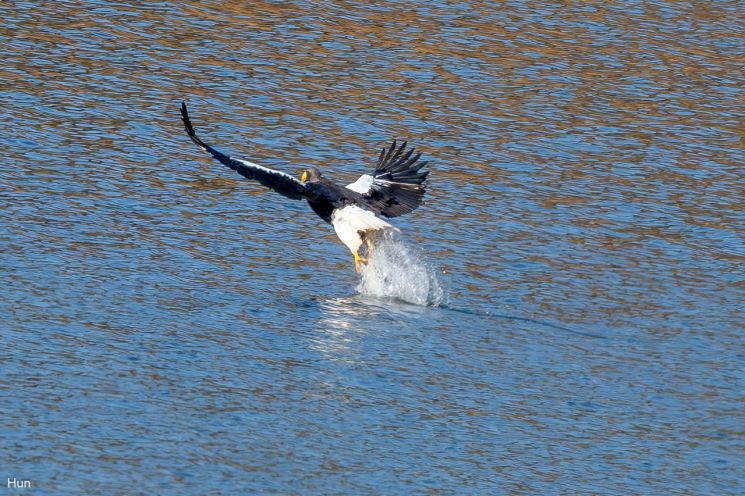
Han Sang-hoon, director of the Korean Peninsula Wildlife Research Institute, said, “About 20 to 30 Chamsuri and Huinnakkisuri visit the Korean Peninsula each year to winter, hunting for food in places with lakes and valleys, and are mainly observed around lagoons on the East Coast.” He added, “The fact that they are observed annually in Ulsan suggests that it is a safe place with sufficient food and visibility, so there is a high possibility they will return every year. Monitoring their duration of stay is now necessary.”
An official from Ulsan City stated, “After observing two juvenile Mulsuri in February last year, we are delighted to hear they have returned this year. We will strive to maintain an environment that allows them to come again next year.” The official emphasized, “Many endangered wild birds visit, and through ‘Bird Safari, the Dream City Ulsan,’ everyone should take an interest so that birds and people can coexist.”
© The Asia Business Daily(www.asiae.co.kr). All rights reserved.



















