Safety Inspections of Vulnerable Facilities Including Construction Sites, Steep Slopes, Retaining Walls, and Aging Buildings from February 17 to March 28
Rapid Response to Risk Factors...
Joint Public-Private Safety Inspections of Apartment Retaining Walls and Steep Slopes from February 24 to March 6, Alongside Campaigns and Facility Manager Training
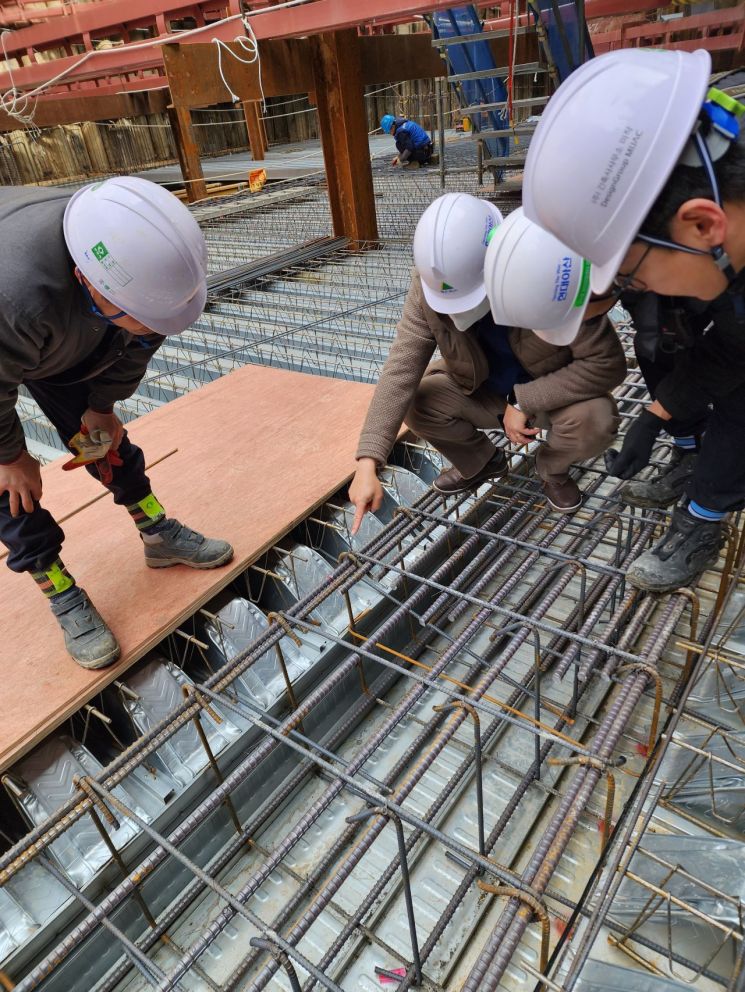
Seongdong-gu (Mayor Jung Won-oh) announced that from February 17 to March 28, it will conduct safety inspections on 194 facilities, including construction sites prone to ground weakening or structural cracks, steep slopes, retaining walls and stone walls, and aging buildings, where the risk of damage is high during the thawing season.
The thawing season (February to April) poses a high risk of safety accidents such as facility collapse, toppling, and falling rocks due to the melting of frozen ground during winter. Especially with temperatures expected to rise sharply in March, accident prevention against rapid temperature changes is necessary.
Accordingly, the district will thoroughly inspect and manage 194 vulnerable facilities closely related to residents' daily lives. First, inspection items by facility type will be identified in advance, and inspection plans will be established based on safety checklists. A joint inspection team composed of responsible officials and safety management advisors in civil engineering and architecture will be formed to conduct effective inspections.
Key inspection items include ground subsidence at construction sites, cracks in pillars and walls of aging buildings, drainage conditions of road facilities, and soil erosion on steep slopes. Minor issues found during inspections will be immediately addressed, while serious defects or hazards will receive emergency measures followed by prompt repair and reinforcement.
A joint public-private safety inspection will also be conducted on retaining walls and steep slopes of apartment complexes during the thawing season. This inspection, conducted from February 24 to March 6, involves responsible officials and private experts in architecture and safety checking ground subsidence, slope cracks, and collapse according to the Korea Land and Housing Safety Management Agency's checklist. Facilities requiring action will be notified to the respective apartment complexes for remedial measures under administrative guidance.
Additionally, the district will actively promote the thawing season safety management campaign to encourage residents to promptly report any abnormal signs via the Safety Report app for quick action. Education on inspection methods and response procedures will also be provided to facility managers during on-site inspections. Jung Won-oh, Mayor of Seongdong-gu, stated, “We will protect residents' safe daily lives through thorough inspections and swift actions on safety-vulnerable facilities during the thawing season,” adding, “We will continue to make meticulous efforts to create a safe city Seongdong where residents can feel secure from various disasters.”
Gwangjin-gu Enhances Safety and Urban Aesthetics with Spring Tree Maintenance in Children's and Small Parks
Tree maintenance conducted in 11 children's and small parks
Efforts to prevent resident inconvenience and safety accidents, improve aesthetics, and create a healthy growth environment
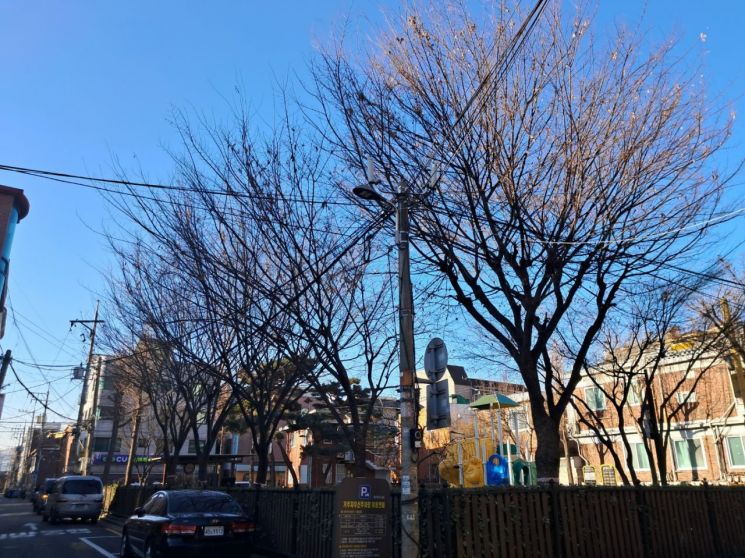
Gwangjin-gu (Mayor Kim Kyung-ho) is conducting pruning of trees in children's parks and small parks.
While trees play an important role in air purification and urban aesthetics, excessive growth can cause safety hazards such as interference with high-voltage lines and obstruct signs in residential and commercial areas, causing inconvenience to residents.
Accordingly, the district is maintaining a total of 172 trees across 9 children's parks including Mugunghwa Park, Forsythia Park, Magnolia Park, and 2 small parks.
This maintenance regulates the density of dense branches to improve ventilation, preventing drying, overgrowth, and pest infestations. It also increases sunlight exposure to shrubs and herbaceous plants, promoting their growth. Removing poor branches improves park aesthetics and provides a healthy growth environment.
The district also conducted maintenance on roadside trees during the winter dormancy period. From February, pruning was performed on 289 street trees along major roads such as Achasan-ro, Gwangnaru-ro, and Dongil-ro to improve tree shape and growth, managing them as safe and healthy street trees. Kim Kyung-ho, Mayor of Gwangjin-gu, said, “Although trees provide us with clean air and greenery, they require systematic management as they can cause inconvenience and safety accidents. We will create a pleasant and green Gwangjin through regular care and attention.”
Gwanak-gu Transforms into a Premier Healing City Harmonized with Nature
Expanding healing and leisure cultural infrastructure for residents' happiness, filled with joy, health, and relaxation content
This year’s highlights include the opening of ‘Nakseongdae Football Stadium,’ expansion of 24 neighborhood parks, and creation of Gwanak Park Golf Course, enhancing sports and leisure infrastructure
The need for healing spaces where people can easily access nature amid busy urban life is growing. In modern society, parks and gardens are valued not just as green spaces but as complex areas for leisure and rest.
Gwanak-gu (Mayor Park Jun-hee) is fully committed to creating a ‘healing city where flowers, trees, and flowing water can be seen from windows’ to promote residents' health and happiness.
Gwanak-gu boasts natural resources such as the famous Gwanak Mountain and two urban streams, Byeolbitnaerincheon and Bongcheoncheon, connecting to the Han River.
In response to the increasing demand for recreation and forest activities, the district established the ‘Park and Leisure Bureau’ last year and is expanding healing and leisure cultural infrastructure utilizing natural resources.
Last year, the district restored Byeolbitnaerincheon as an ecological stream, completing the ecological corridor from Gwanak Mountain to the Han River.
Construction began in 2020, and in September last year, the restoration of the last covered 1.35 km upstream section was completed, finishing the project in about 4 years and 5 months.
The district is transforming Byeolbitnaerincheon into a ‘living stream space where people want to stay’ by investing 3.3 billion KRW to create waterfront spaces around the Sinlim Line station, providing residents with comfortable and enjoyable rest areas.
To promote Byeolbitnaerincheon as a landmark, the district holds the ‘Gwanak Byeolbit Walk (Starlight Festival),’ a local cultural festival linked with nearby commercial areas, and is developing distinctive spaces at key points along the stream to differentiate from other regions.
Additionally, Gwanak Mountain, known as the most visited hiking spot, saw the creation of ‘Gwanak Mountain Prime Park,’ a plaza-type park opened last September, offering hikers a pleasant resting environment.
With the opening of the Sinlim Line, the restoration of Byeolbitnaerincheon, and the proximity of Gwanak Art Hall near Gwanak Mountain Prime Park, the district expects to establish a comprehensive healing space where residents can enjoy health and cultural arts events nearby.
Recognizing that health directly affects quality of life, the district also focuses on healing and health infrastructure in nature.
Eleven locations within the district feature ‘loess trails’ for barefoot walking, known for their grounding effects and health benefits. The largest, located in the Sinlim Valley area of Gwanak Mountain, spans 180 meters in length and 520 square meters in area, offering hikers a unique experience amid fresh air and nature.
This year, with the completion ceremony of the ‘Nakseongdae Football Stadium’ in February, the district will further expand 365-day sports participation.
The district is also prioritizing the ‘Gwanak Mountain Park 24 Project,’ aiming to create 24 neighborhood parks and the Gwanak Park Golf Course, allowing residents to enjoy nature and leisure close to home anytime. The park golf course will be a mountain-type course utilizing natural terrain, covering 11,285 square meters with 9 holes, and will include rest areas and walking paths for families to enjoy nature and leisure together.
Furthermore, the district plans to create three themed ‘specialized parks’ in Nanwoo District, Nanhyang Forest Path District, and Nakseongdae District along the Gwanak Mountain foothills, and one ‘hub park’ in Namhyeon-dong Gwaneumsa District, providing green comfort and rest spaces within the city.
Various natural content such as the ‘Healing Garden’ outdoor playground with hydrangea gardens and rose tunnels in Nakseongdae Park, the ‘Four Seasons Vivid Garden’ utilizing idle land on Nangok-ro, and the creation of Gwanak Mountain Natural Recreation Forest will continue to be developed. Mayor Park Jun-hee said, “Parks and gardens are vital for creating ecological environments and improving residents' quality of life. We will continuously develop leisure and cultural content linked to green infrastructure to build a happy healing and garden city, Gwanak.”
Jungnang-gu Distributes Pear Trees at Bonghwasan Nature Experience Park
Applications accepted from February 26 to March 18... 225 pear trees distributed to local kindergartens and daycare centers
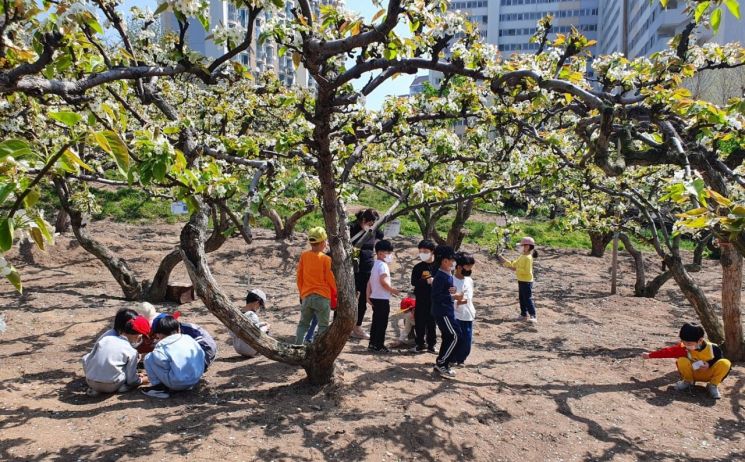
Jungnang-gu (Mayor Ryu Kyung-gi) is distributing pear trees at Bonghwasan Nature Experience Park to local kindergartens and daycare centers. The initiative aims to allow children to cultivate pear trees and experience the growing process in nature, promoting healthy growth and emotional development.
This year, 225 pear trees will be distributed on a 3,600㎡ site at Bonghwasan (San 127-9, Sinnae-dong). Eligible participants include 31 kindergartens and 165 daycare centers in the area, totaling 196 institutions, with each institution generally allocated one tree. Institutions with more than 30 students may apply for additional trees at a rate of one tree per 30 students.
Applications are accepted online via the Jungnang-gu website from February 26 to March 18. The price per tree is set at 100,000 KRW, lower than private market rates to encourage participation. Selected institutions will be announced on March 19, and on March 21, they will select their trees and attach name tags. If applications exceed available trees, allocations will be adjusted considering institution size.
Additionally, a fruit orchard experience program will be offered to institutions receiving trees. Operating five days a week from April to November under expert guidance, children will experience the process from flowering to harvest. Interested institutions can apply on a first-come, first-served basis via the Jungnang-gu website. Mayor Ryu Kyung-gi said, “This pear tree distribution project provides children with a special learning experience in nature and enhances the use of urban parks. We will continue to expand various experiential opportunities for children to grow with nature.”
Admission Strategy Briefings and Special Lectures for Examinees and 10th Graders
March 5: First 2026 University Admission Briefing for Examinees and Parents
March 27: Special Lecture for 10th Graders and Parents on 2028 University Admission Reform
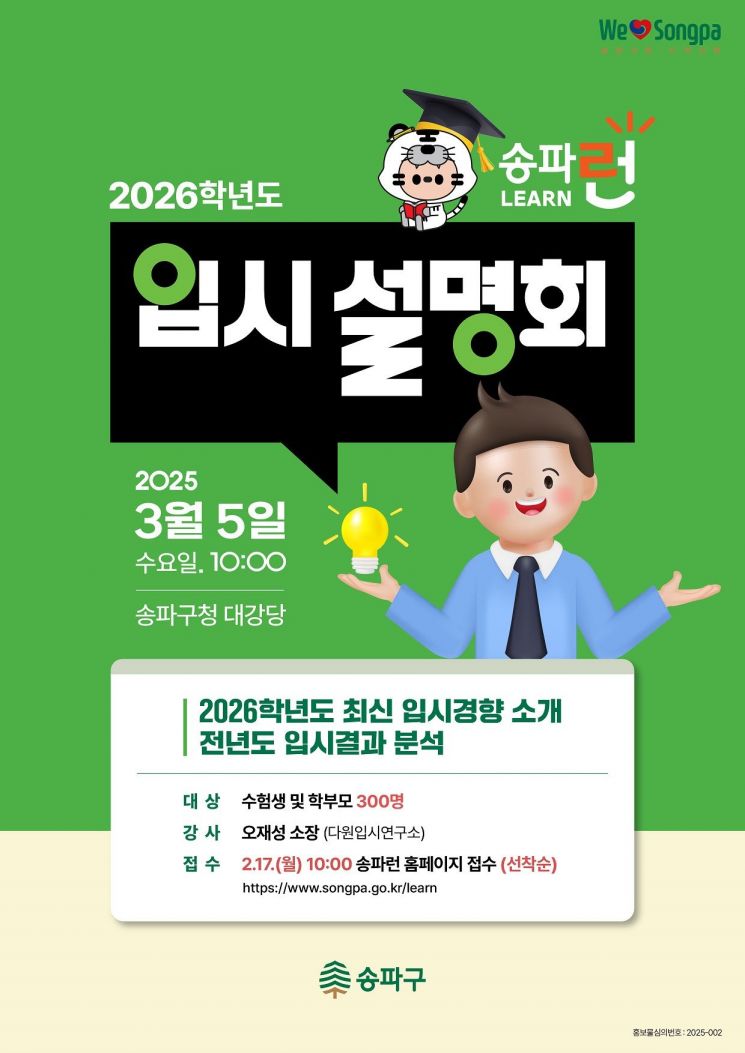
Songpa-gu (Mayor Seo Gang-seok) announced it will hold ‘University Admission Briefings’ and ‘Special Lectures’ to alleviate concerns and support successful admission strategies for examinees and parents.
First, on March 5 at 10 a.m., the district will hold the first ‘University Admission Briefing’ of 2026 at the Songpa-gu Office auditorium.
The briefing will feature Oh Jae-sung, director of Dawon Admission Research Institute and a top admission expert, who will analyze last year’s admission results and discuss the latest trends for the 2026 academic year over two hours.
The briefing is free and open to all examinees and parents, with 300 participants accepted on a first-come, first-served basis via the Songpa-run website. After the event, the lecture video will be posted on the Songpa-run website and YouTube.
On March 27 at 5 p.m., a ‘Special Lecture’ tailored for 10th graders and parents will be held at Songpa Academy to design customized admission strategies.
Reflecting parents’ requests for detailed strategies by admission type and grade level, the district will provide segmented admission information starting this year. This first special lecture is designed to help 10th graders prepare for the 2028 admission reform by explaining changes and guiding systematic strategy planning.
The lecturer will be Yoon Young-rin, a current teacher at Jamsil Girls’ High School, who will present new admission strategies covering 2028 changes, subject selection, and admission understanding.
Applications for the special lecture are limited to 50 participants on a first-come, first-served basis via the Songpa-run website.
Additionally, the district plans to hold a total of five university admission briefings throughout 2026 to provide timely information for each admission period. Six special lectures will be held annually covering strategies by grade, specialized high schools and arts/sports fields, essay and interview preparation, and more. Mayor Seo Gang-seok said, “This program is designed to support high school students and parents facing rapidly changing admission environments. We hope to reduce their burden and help them establish successful strategies, and we will prepare thoroughly for upcoming briefings and lectures.”
‘Mapo Anyone Sports Center Hapjeong’ Attracts Strong Interest Even Before Official Opening
Excellent accessibility, media art specialized facilities, and professional programs receive positive reviews
Program user recruitment until February 24, with many applicants prompting consideration of capacity expansion
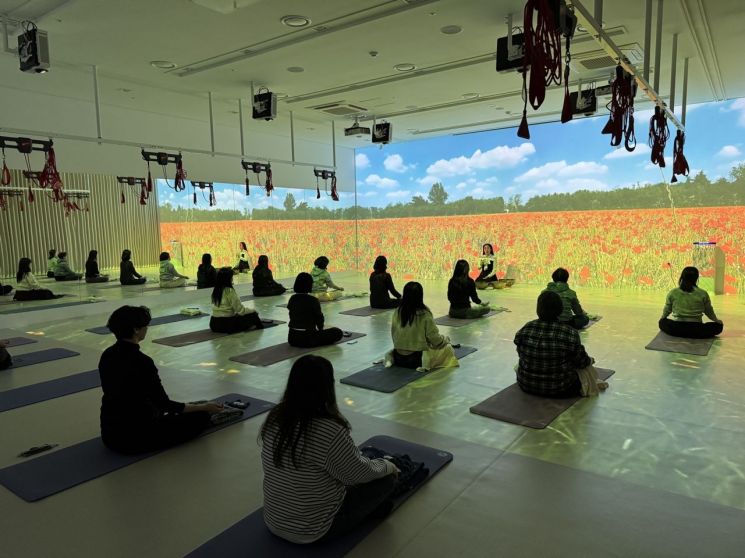
Mapo-gu (Mayor Park Kang-soo)’s ‘Mapo Anyone Sports Center Hapjeong’ is gaining buzz among residents ahead of its official opening on March 4.
The ‘Mapo Anyone Sports Center’ is an integrated sports facility unique to Mapo-gu, designed for use by both disabled and non-disabled individuals, and was ranked first among Mapo-gu’s top 10 policies for 2024 as a representative inclusive welfare project.
Following the first center opened in April 2024 at Gongdeok, the Hapjeong branch is the second facility, receiving high expectations for its excellent accessibility, cutting-edge media art specialized facilities, and professional programs.
While the Gongdeok center specializes in supporting vulnerable groups using digital content equipment and special sports experts, the Hapjeong center features programs using media art for physical and mental care and group exercise.
Since recruitment began on February 12, 209 residents had applied by February 19, exceeding the initial capacity of 178 within one week. Some programs received over three times the number of applicants compared to capacity. Therefore, Mapo-gu is considering expanding capacity to allow more residents to participate. Programs at Hapjeong include exercise classes for seniors, disabled individuals, and youth with developmental disabilities, as well as classes open to all.
The ‘Anyone Line Dance’ for seniors involves repeating basic dance moves to music, greatly aiding healthy aging.
Other programs include ‘Developmental Disability Sports Class Ssaksseuri’ for youth with developmental disabilities, ‘Table Tennis Class’ for adult wheelchair users, and ‘Sling, Slim Exercise’ for adult slow learners. General programs open to all ages include GX gymnastics, GX Zumba, and K-POP dance.
User recruitment continues until February 24. Program fees range from 2,000 to 4,000 KRW per session, with free access for Mapo residents aged 65 and older.
Interested residents can apply by visiting the ‘Mapo Anyone Sports Center Hapjeong’ or via QR codes or application links posted on the Mapo-gu website. Users will be selected based on internal criteria and random draws among ties. The center also offers free exercise and group rental options.
For detailed program and application information, or rental inquiries, contact the Mapo Disabled Family Support Center (070-4238-8141), the operating agency of the center. Mayor Park Kang-soo said, “Following the Gongdeok center, we expect the Hapjeong center to become a health promotion facility embracing all local residents. Mapo-gu will continue expanding the Anyone Sports Center to support healthy living without discrimination.”
Geumcheon-gu to Reopen Newly Renovated Geumbit Fitness Center on March 4
Pre-registered users for March can use the center free of charge until February 28
Old interior replaced; equipped with body composition analyzer and state-of-the-art golf screen
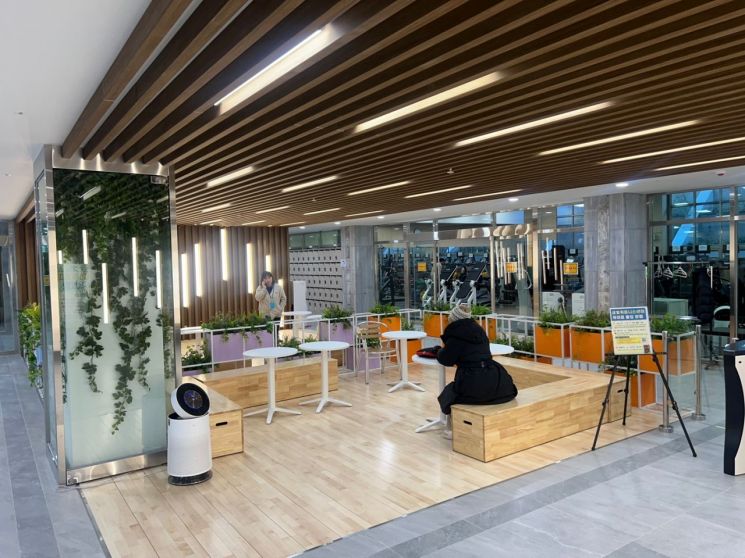
Geumcheon-gu (Mayor Yoo Sung-hoon) announced that the Geumbit Fitness Center in Geumbit Park will reopen on March 4 after facility upgrades.
Located at 668 Geumha-ro, basement level 1, the center has been operating since March 2006. It closed in July 2023 for interior renovations and replacement of aging equipment including gym machines and golf driving range booths, completing renovations this year.
The reopened center offers a gym, golf practice range, and multipurpose room. The gym is equipped with 27 cardio machines, 29 strength training machines, and 8 massage devices, all state-of-the-art. It also features the latest body composition analyzers, posture analyzers, and blood pressure monitors for members to check their physical condition.
The golf practice range includes a high-resolution camera sensor (GDR) screen, AI-based swing analyzers, and putting practice areas, providing a convenient environment for golf enthusiasts.
The multipurpose room is equipped with advanced lighting and sound systems, as well as various small equipment such as gym balls, Pilates bands, and dumbbells. Group exercise programs like Zumba, yoga, and Pilates will be offered after reopening.
During the trial operation period until February 28, the center is open weekdays from 9 a.m. to 6 p.m. From March 4, hours will be weekdays 6 a.m. to 10 p.m. and Saturdays 9 a.m. to 6 p.m.
Registration has changed from rolling admission to monthly enrollment. Geumcheon residents can register from the 22nd to the end of each month, while non-residents can register from the 26th to the end of each month.
The center is currently accepting pre-registrations for March use. Applicants can visit the center between 7:30 a.m. and 7:30 p.m. to apply. Pre-registered users can use the center free of charge during the trial period.
The district plans to collect user feedback on automatic doors, smart lockers, and other systems during the trial period for further improvements. Mayor Yoo Sung-hoon said, “We hope the renovated Geumbit Fitness Center will become a space supporting healthy lives for residents alongside Geumbit Park. We will do our best to support residents' healthy leisure activities.”

Illegal Dumping Monitored 24/7!... Yeongdeungpo-gu CCTV Control Center in Operation
55 vulnerable sites monitored 24 hours... Immediate response with warning broadcasts and on-site enforcement if necessary
Nighttime illegal dumping captured with infrared camera function
“This area is under illegal dumping surveillance. If you do not collect the trash you just dumped, you may be fined up to 1 million KRW.”
Yeongdeungpo-gu (Mayor Choi Ho-kwon) held an opening ceremony for its Illegal Dumping CCTV Control Center on the 20th, establishing a monitoring system to eradicate illegal dumping.
Control center operators monitor 55 vulnerable illegal dumping sites across the district in real time via closed-circuit television (CCTV), enabling immediate response.
When illegal dumping occurs, a warning broadcast is immediately issued as a first measure. If dumping continues despite warnings, enforcement officers are dispatched to the scene to impose fines.
The CCTV system provides 24-hour real-time monitoring and recording, allowing review of past illegal dumping incidents. Infrared filming automatically activates at night, enabling identification of dumpers even in dark alleys without lighting.
At the opening ceremony on the 20th, Mayor Choi personally issued warning broadcasts and inspected control center operations, discussing efficient enforcement strategies.
The district is strengthening administrative support and expanding resident participation to resolve illegal dumping issues in Daerim-dong. Collaborating with local organizations in Daerim 1, 2, and 3-dong, the district encourages voluntary resident involvement and produces multilingual notices for foreign residents to promote proper waste disposal culture. Mayor Choi Ho-kwon said, “We hope residents will practice proper waste disposal and help create a clean city. We will do our best to solve illegal dumping problems through continuous attention and practical prevention measures.”
Nowon’s ‘Child-Friendly Taxi’ Continues Safe Operation This Year
Expanded long-distance hospital rides reflecting resident feedback... 8 additional major hospitals beyond 8 km supported
Additional 10 rides per year provided to households with disabled children, totaling 20 rides
Achieved 70% usage rate last year, rising to 79% in the second half, with high satisfaction
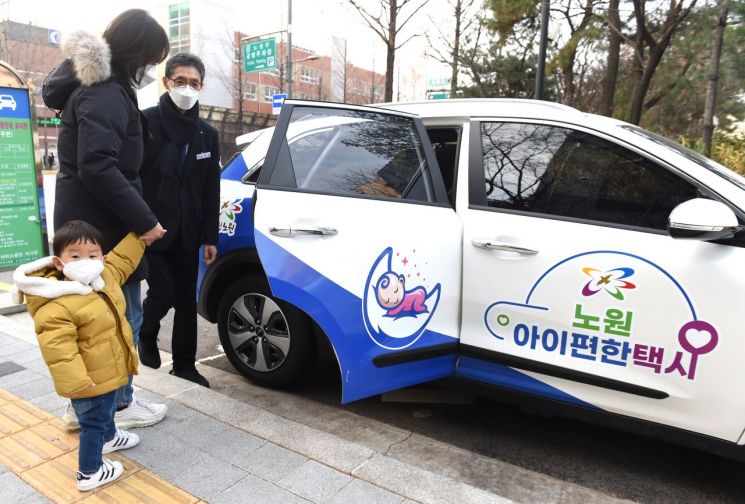
Nowon-gu (Mayor Oh Seung-rok) announced the expansion of the ‘Nowon Child-Friendly Taxi’ service this year to include long-distance rides to major hospitals.
The Child-Friendly Taxi service provides dedicated vehicles for children under 36 months and infertile couples residing in Nowon-gu to visit hospitals and childcare facilities. The service is operated by dedicated drivers from Nowon Senior Happiness Co., Ltd., established by the district, and vehicles are equipped with child safety seats for safe transportation.
Since its launch in 2021, the service has conducted annual user surveys to improve operations. Last year, the age limit for infants was extended from 24 to 36 months, and this year, further improvements are being implemented.
Responding to frequent requests for long-distance hospital transport, the service area has expanded from within 8 km to include major hospitals located farther away. Eight major hospitals outside the 8 km radius, including Seoul National University Children’s Hospital, have been designated for one-way rides.
Additionally, households with disabled children will receive 10 extra ride vouchers annually, doubling the previous 10 rides to 20, to reduce inconvenience and provide stable medical and childcare environments.
Families with children under 24 months can also use the ‘Seoul Mom and Dad Taxi’ program, which provides 100,000 KRW support annually, in conjunction with this service.
Last year, the Child-Friendly Taxi operated 5,456 rides, with 900 of 1,534 registered members using the service. Usage rates increased from 61% in the first half to 79% in the second half, averaging 70% annually, reflecting growing demand and high satisfaction among residents. Mayor Oh Seung-rok said, “We will listen to users and continuously improve the service to provide practical support for childbirth and childcare policies. We aim to make Nowon a city where children and parents can be happy.”
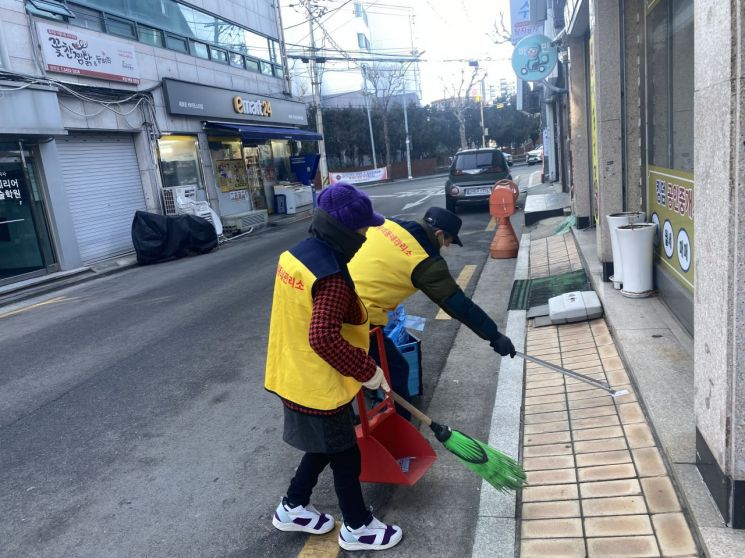 The manager of Dobong-gu Our Neighborhood Management Office is carrying out environmental maintenance work in the area.
Dobong-gu Begins Pilot Operation of ‘Our Neighborhood Management Office’ This Month
Target area: Multi-family housing dense area around Banghak 1-dong
Supports residential environment improvement through cleaning and safety patrols
Dobong-gu (Mayor Oh Eon-seok) started pilot operation of the ‘Our Neighborhood Management Office’ this month.
The office is a facility established by the district to provide life-oriented services to residents in low-rise residential areas.
An official said, “Low-rise residential areas like villas face difficulties in alley cleaning due to lack of managers. The management office will serve as a catalyst to solve local problems and revitalize the community.”
Key services include environmental maintenance, safety patrols, and parking guidance. The staff consists of one office worker and four managers. The office worker is stationed from 9 a.m. to 4 p.m. to handle complaints, while the four managers work in two groups of two during morning and afternoon shifts to address on-site issues.
The pilot area is the multi-family housing dense area around Banghak 1-dong, selected considering housing aging and project effectiveness. The office is located on the 3rd floor at 118 Dobong-ro.
The district plans to conduct regular satisfaction surveys during the pilot to gather resident feedback and improve the project. Once established, the management office model will be gradually expanded. Mayor Oh Eon-seok said, “We expect the management office to become a new model solving local issues. We will continue to strive to ensure residents have no inconveniences living in the area.”
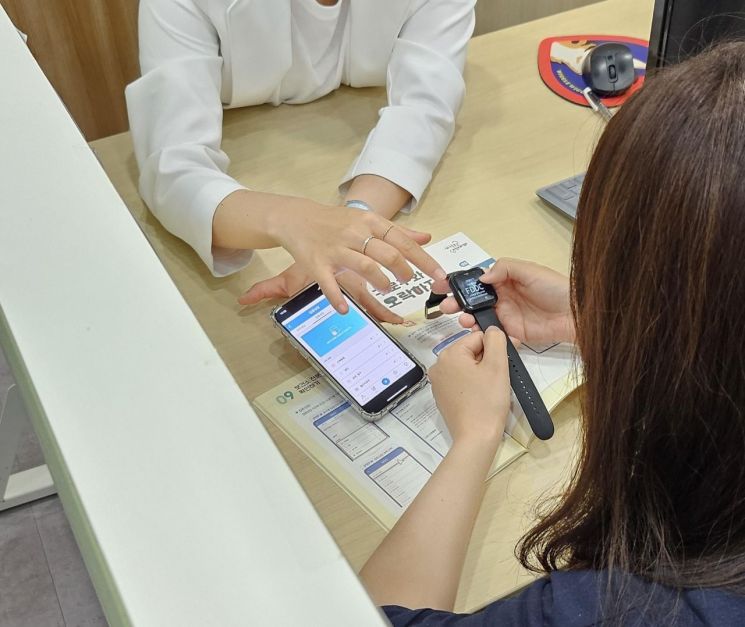
Guro-gu Recruiting Participants for ‘2025 Mobile Healthcare Project’
130 participants accepted on a first-come, first-served basis starting from the 24th
Mobile health management service provided via app and activity tracker (smartband) integration
Guro-gu will recruit 130 participants starting from the 24th to enhance residents’ self-health management skills through the ‘2025 Mobile Healthcare Project’.
‘Mobile healthcare’ is a non-face-to-face personalized health management service that links a mobile app with a wrist-worn activity tracker (smartband), allowing easy expert health consultations without time and space constraints to prevent chronic diseases.
Residents and workers aged 19 or older in Guro-gu will receive expert consultations on health, nutrition, and exercise remotely for six months. However, those diagnosed or treated for any of five health risk factors (blood pressure, fasting blood sugar, waist circumference, triglycerides, high-density cholesterol) are excluded. Participation is also limited if the mobile app cannot link with the participant’s smartphone model.
Participants will install and register on the ‘Chaeum Health’ app and receive a linked smartband free of charge. They will receive health management services in areas such as health, nutrition, and exercise for six months. Both remote and face-to-face services are provided, with three visits to the health center (initial, midterm, final) for metabolic syndrome screening and rewards based on task performance.
After completing the program, participants will receive an additional six months of self-management service via the app.
Those interested can apply by phone or visit the Health Management Center on the first floor of Guro-gu Health Center. Applications are accepted on a first-come, first-served basis. A health center official said, “Providing mobile-based public health management services will help improve residents’ health management capabilities. We will continue to support residents to live healthy lives.”
Dongdaemun-gu Conducts Intensive Hygiene Inspections on Delivery Food from March to May
Inspects hygiene management, expiration date compliance, origin labeling, etc.
Incentives include publishing kitchen photos on health center website and providing hygiene supplies to excellent restaurants
Dongdaemun-gu (Mayor Lee Pil-hyung) will conduct intensive hygiene inspections on delivery-only restaurants from March to May to ensure residents can enjoy delivery food safely.
The inspections respond to increased demand for delivery food by checking hygiene and safety management levels to provide safer food to consumers.
Targets include 240 small-scale delivery-only restaurants with business areas under 33㎡. Key inspection items are hygiene of cooking and storage facilities, compliance with expiration dates and storage conditions, adherence to refrigeration and freezing standards, prohibition of food reuse, proper origin labeling, and employee personal hygiene. Compliance with the Food Sanitation Act and the Act on Labeling of Origin of Agricultural and Fishery Products will be strictly verified.
Restaurants with excellent hygiene will have their kitchen photos published on the district health center website with owner consent and receive hygiene supplies and promotional opportunities through newsletters twice a year. Mayor Lee Pil-hyung said, “We will continue inspections to create a safe delivery food culture residents can trust. We will also regularly inspect vulnerable businesses and those with seasonal demand surges to ensure food safety.”
© The Asia Business Daily(www.asiae.co.kr). All rights reserved.
![Clutching a Stolen Dior Bag, Saying "I Hate Being Poor but Real"... The Grotesque Con of a "Human Knockoff" [Slate]](https://cwcontent.asiae.co.kr/asiaresize/183/2026021902243444107_1771435474.jpg)


















