Lee Bok-hyun, Governor of the Financial Supervisory Service (FSS), stated ahead of the planned resumption of short selling at the end of next month that "the problematic cases of naked short selling in the past can be blocked by nearly 99% through the new system." Regarding the scope of the short selling resumption, he emphasized a non-restrictive approach, saying, "It is necessary to resume short selling across various stocks."
On the 20th, after attending the 'Open Discussion on Stock Market Infrastructure Improvement' held at the Korea Exchange in Yeouido, Governor Lee responded to reporters' questions about whether temporary bans or other measures might be reintroduced if illegal activities become severe after the resumption of short selling. He said, "At least the type of naked short selling that triggered the previous suspension can be detected and blocked."
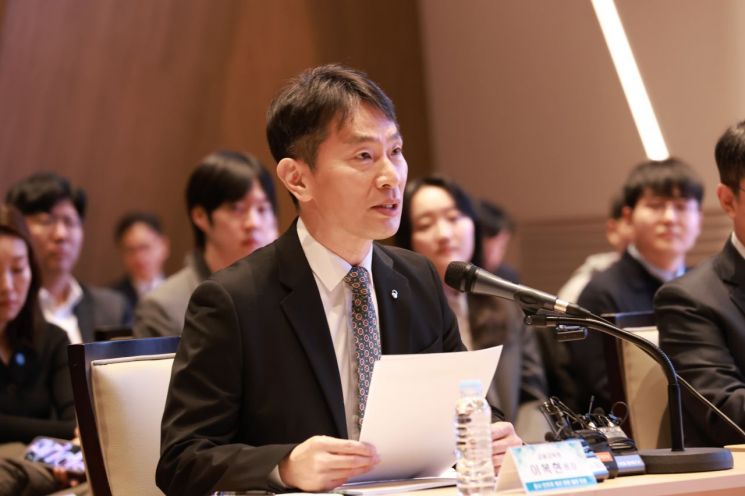
He explained, "Unless there is a separate decision at the Financial Services Commission's regular meeting, short selling will resume on March 31," adding, "The FSS will report to the FSC next month on whether the exchange's preparations are adequate so that the FSC can decide on any additional short selling bans." He also confirmed that the ongoing inspections of past naked short selling cases will be completed before the resumption next month.
Regarding the scope of the short selling resumption, Governor Lee stated that while the decision depends on the FSC, "Personally, I believe it is necessary to resume short selling across a variety of stocks." This remark suggests an expansion of the scope beyond the 350 stocks included in the KOSPI 200 and KOSDAQ 150 indices, which were the only stocks allowed for short selling before the ban in November 2023.
He acknowledged concerns that "with the inadequate delisting and evaluation system in our stock market, the full resumption of short selling on some relatively lower-quality companies might be burdensome," but added, "We need to find ways to reduce volatility while gaining trust in the Korean market from overseas and individual investors."
Regarding concerns that high-frequency trading might increase with the launch of Korea's first alternative trading system on the 4th of next month, he admitted, "As the trading environment becomes more complex, various illegal and circumvention activities may occur. Both the resumption of short selling and high-frequency trading can naturally increase downward pressure and volatility in the stock market." However, he also noted, "They have a positive aspect in that they secure liquidity and enrich the market base."
Governor Lee emphasized, "No matter how much we build walls or ban short selling, the stock market performed well in the first half of last year when foreign investors trusted and participated in our market, and struggled in the second half when they lost confidence and withdrew. Simply building walls is not the solution; a practical approach is to monitor the downsides of high-frequency trading while benefiting from its liquidity-enhancing effects."
Additionally, regarding the Financial Services Commission's decision the previous day to lower the penalty severity compared to the FSS's original proposal for nine securities firms involved in so-called 'bond rolling' through bond-type wrap accounts and specific money trusts (wraps and trusts), Governor Lee pointed out, "The FSC's press release states that such leniency will not be considered in the future."
He explained, "(The FSC's easing decision) was a concession made to reduce market risk during the turmoil in the funding market at the end of 2022," adding, "If similar violations are found at the end of 2023 or in 2024, stricter penalties than yesterday's conclusion could be imposed." He also mentioned, "This will be included in this year's regular and thematic inspections by the FSS."
Furthermore, Governor Lee reaffirmed his previous stance on the prolonged management dispute between Korea Zinc and MBK·Youngpoong, stating, "We intend to avoid intervention as much as possible unless there are unfair trade practices, other illegal acts, or issues with investor-related information disclosure." He acknowledged industry concerns, saying, "We are well aware of the worries that a prolonged dispute in a key period industry could create instability or worsen relationships with business partners," and added, "It is important how shareholders decide at the regular general meeting, and it is difficult for us to comment before then. After the meeting, we will observe various situations and intervene if necessary."
© The Asia Business Daily(www.asiae.co.kr). All rights reserved.

















