Microsoft (MS) has unveiled a quantum computing chip it developed using 'topological superconductors.'
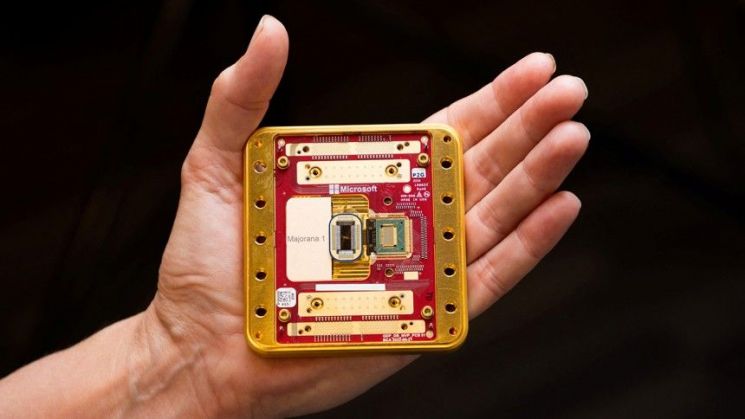
On the 19th (local time), MS announced that it had developed its first self-developed quantum computing chip, 'Majorana 1.'
Prior to this, Google revealed its self-developed quantum chip 'Willow' last year. At that time, Google explained that the quantum computer equipped with Willow outperformed the fastest existing supercomputer, Frontier, in performance tests. While Frontier would take 10 septillion (10 to the 24th power) years, or 10 trillion years, to solve a problem, the quantum computer equipped with Willow solved it in just 5 minutes.
The 'Majorana 1' developed by MS this time is palm-sized and, unlike typical quantum computing chips that use superconducting qubits, it was developed using 'topological qubits.' These qubits have the characteristic that their essence does not change even if their shape changes, making them considered next-generation superconducting qubits.
Unlike classical computers that process information in bits of 0 or 1, quantum computers utilize qubits in superposition and entanglement states where 0 and 1 exist simultaneously. Therefore, quantum computers can process massive amounts of information quickly, which is why they are regarded as one of the future innovative technologies. However, due to the drawback that quantum states can be easily disturbed by external environmental changes such as temperature, causing errors, commercialization has been expected to take decades.
MS stated that its topological superconductor was implemented using indium arsenide and aluminum, which prevents damage to quantum information and enables automatic control of error detection and correction.
The more qubits a quantum chip has, the more powerful its computational ability. 'Majorana 1' is equipped with 8 qubits and is designed to accommodate more than one million qubits.
MS said, "Equipping more than one million qubits marks the beginning of 'quantum computer commercialization,'" and predicted, "With this chip development, the era of quantum computers could be realized within a few years," although there are still many challenges to overcome.
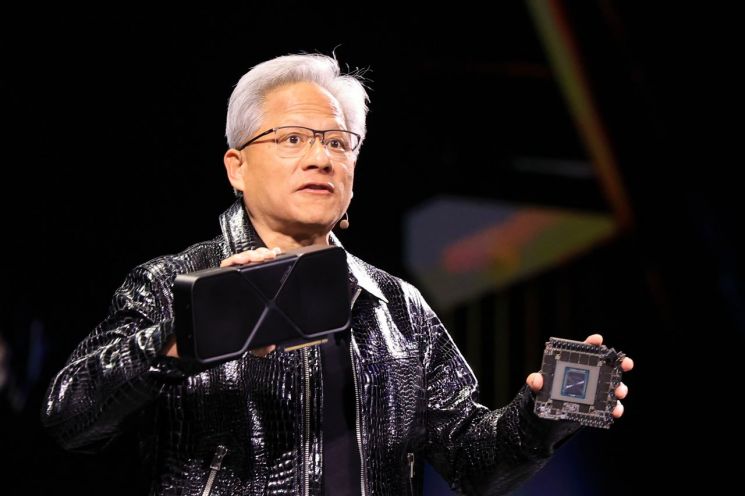
Jensen Huang, CEO of NVIDIA, said last month, "It will take 20 years for quantum computers to be commercialized." Quantum computers are expected to solve humanity's challenges that existing supercomputers could not, such as in medicine and energy, prompting global companies to pursue technology development. Following Google and MS, IBM aims to develop error-correctable quantum computers by 2029.
© The Asia Business Daily(www.asiae.co.kr). All rights reserved.


















