National Assembly: "Should Be Dismissed for Condoning and Aiding Martial Law"
Han's Side: "Had No Prior Knowledge... Failed to Persuade"
Debate Over 'Impeachment Quorum' Also Concludes in Hearing
The impeachment motion against Prime Minister Han Duck-soo, which passed the National Assembly plenary session on December 27 last year, held its formal hearing 54 days later but concluded within 90 minutes. The National Assembly side argued, "Prime Minister Han should be dismissed for condoning and aiding President Yoon Suk-yeol's declaration of martial law." On the other hand, Prime Minister Han's side rebutted, "He had no prior knowledge of the plan, persuaded the president to reconsider, and was not involved in any military mobilization." The Constitutional Court concluded the hearing that day and will designate the date for the verdict later.
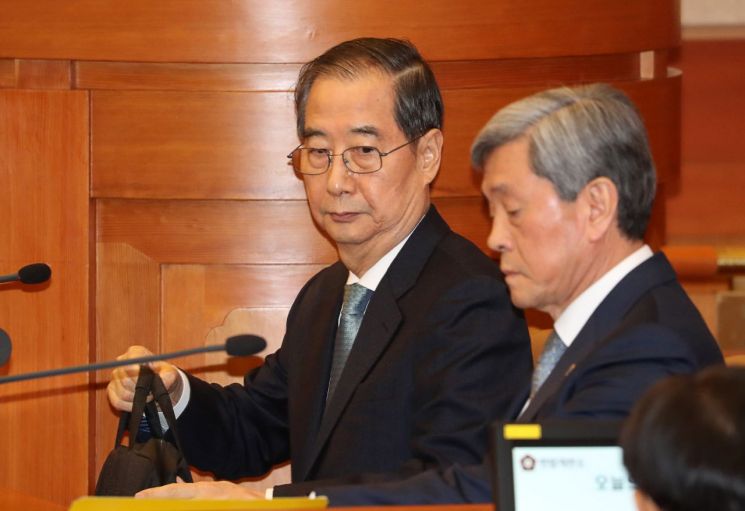 Prime Minister Han Duck-soo is attending the first hearing of the impeachment trial held at the Constitutional Court in Seoul on the 19th. Photo by Yonhap News
On the 19th at 2 p.m., the Constitutional Court held the first hearing of the impeachment trial against Prime Minister Han in the Grand Benchroom of the Constitutional Court in Jongno-gu, Seoul. Prime Minister Han refuted the impeachment grounds presented by the National Assembly point by point. Regarding condoning and aiding the declaration of martial law, he said, "Amid extreme confrontation between the ruling and opposition parties, I tried to overcome the difficult situation by coordinating administrative departments and assisting the president, but I failed to persuade the president to make a different choice." Regarding the refusal to appoint constitutional court justice candidates, he stated, "I deeply considered that appointing justices without substantial agreement between the ruling and opposition parties was unprecedented in constitutional history," adding, "I promised immediate appointments upon agreement, but the National Assembly responded with impeachment."
On the other hand, Jeong Cheong-rae, chairman of the National Assembly's Legislation and Judiciary Committee, argued that "if Prime Minister Han had not been impeached, the Constitutional Court would still be operating with six justices, causing great instability and increasing public anxiety and confusion," and insisted that Prime Minister Han should be dismissed. The National Assembly's grounds for impeachment are fivefold: ▲ condoning and aiding the declaration of martial law ▲ refusal to appoint constitutional court justices ▲ exercising veto power against the special prosecutor law for the Kim Geon-hee and Chae Sang-byeong cases ▲ attempting a joint state administration system with former People Power Party leader Han Dong-hoon ▲ failure to appoint a permanent special prosecutor for the internal rebellion case.
That day, the Constitutional Court also held the first hearing of the dispute over authority filed by 108 People Power Party lawmakers against Speaker Woo Won-shik. The ruling party argued that since Prime Minister Han is the acting president, the same standards as presidential impeachment (two-thirds of the total members, 200 seats) should apply. Since Prime Minister Han became the acting president, who is both the head of state and head of the executive branch, the quorum for resolution should be interpreted as requiring more than 200 seats. They also cited the 'Annotated Constitutional Court Act,' a legal commentary published by the Constitutional Court Research Institute in 2015, as a basis.
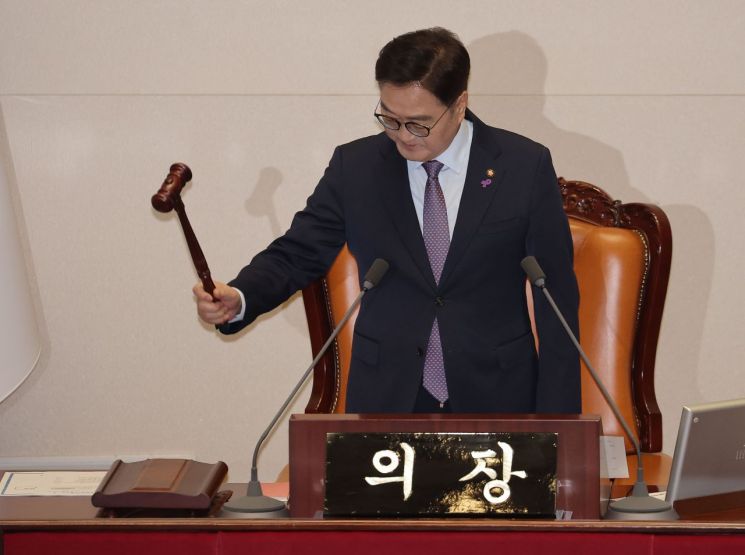
On the other hand, Speaker Woo's side argued that applying the standard for cabinet members (majority, 151 members) to Prime Minister Han's impeachment is appropriate. Unlike other public officials, the president is subject to a 'heightened quorum (200 seats)' standard due to democratic legitimacy conferred by the sovereign's election, but the prime minister, although appointed with the consent of the National Assembly, is an appointed official and should be treated differently. Furthermore, they dismissed the interpretation of the 'Annotated Constitutional Court Act' cited by the ruling party as "the author's personal opinion, not the official view of the Constitutional Court."
In the midst of the quorum debate, questions arose from the justices about why the Speaker of the National Assembly did not decide the number of quorum members by a vote in the National Assembly. Justice Jeong Hyung-sik asked Speaker Woo's side, "At that time, there was controversy over whether the quorum was two-thirds or a majority," adding, "This is an important situation where approval or rejection depends on the quorum, so why was it not handled as an agenda item first?" The implication was that if it had been discussed in advance, the dispute over authority might not have arisen. In response, Speaker Woo's lawyer Noh Hee-beom said, "We received answers from several places that the prime minister is subject to impeachment by a majority of the total members, excluding the president, according to the constitution," and "In a politically turbulent situation, there was no environment to discuss it as a subject of dispute."
© The Asia Business Daily(www.asiae.co.kr). All rights reserved.


















