Lee Hints at Need for Reform: "Isn't This a Problem to Fix?"
Analysis: A Direct Response to 'Fake Rightward Shift' Criticism
Yang Kidae: "Democratic Party Is Closer to Progressives Embracing the Center"
Lee Jae-myung, leader of the Democratic Party of Korea, which has proclaimed itself as a 'centrist conservative' party, has announced plans to revise income tax reform following the easing of inheritance tax. This move is interpreted as a choice to directly confront criticism that his 'fake right-wing shift' is aimed at courting centrist voters ahead of the early presidential election.
According to political circles on the 19th, Lee stated on his social media (SNS) the previous night, "In 2024, earned income tax is expected to reach 61 trillion won, accounting for 18% of total taxes, marking the highest level ever. Meanwhile, due to the economic downturn, corporate tax revenue has shrunk to 62.5 trillion won, a scale similar to earned income tax."
Lee's hint at income tax reform is noteworthy as it has been one of the taboo topics within the Democratic Party. The party has long argued that income tax reform would increase tax benefits for high-income earners. Since most of the tax-exempt are ordinary citizens, the direct connection to income tax reduction benefits is limited. However, since Lee mentioned that "this might be a problem that needs fixing," there is a high possibility that discussions will accelerate.
The background for Lee's strengthened rightward shift under the banner of 'centrist conservatism' is closely related to the fact that centrist and undecided voters are considered the casting vote that will determine the outcome of the early presidential election. In particular, the non-partisan and ideologically centrist voters in Busan-Gyeongbuk (PK) have a high level of rejection toward Lee. According to a poll conducted by Gallup Korea from the 11th to the 13th among 1,004 men and women aged 18 and over nationwide, Lee's approval rating in the PK region was 23%, significantly lower than in Seoul (38%), Gyeonggi-Incheon (35%), and Daejeon-Sejong-Chungcheong (35%).
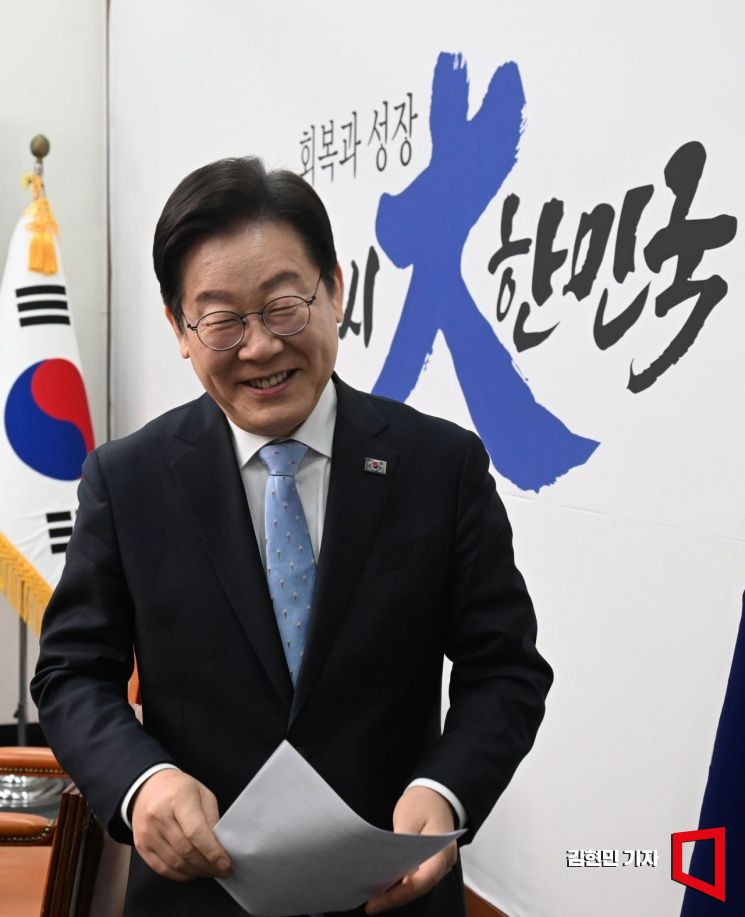 Lee Jae-myung, leader of the Democratic Party of Korea, is leaving after finishing his remarks at the Supreme Council meeting held at the National Assembly on the 19th. 2025.2.19 Photo by Kim Hyun-min
Especially in PK, the rate of 'strong opposition' to Lee was high. Lee has launched income tax and inheritance tax reforms that these voters can feel as a decisive move to secure centrist votes. (The response rate was 16.1%, with a margin of error of ±3.1 percentage points at a 95% confidence level. For more detailed information about the survey, please refer to the Central Election Poll Deliberation Commission website.)
Lee's rightward shift has also sparked growing opposition from the opposition parties and the anti-Lee faction within his party. Cha Gyu-geun, policy committee chairman of the Innovation Party for Justice, said in a phone interview, "I find it hard to agree with the claim that easing the inheritance tax deduction criteria, as Lee advocates, would reduce the burden on the middle class," adding, "Can someone owning an 1.8 billion won house be considered middle class? That is deceptive."
Yang Ki-dae, former Democratic Party lawmaker and secretary of the non-parliamentary anti-Lee group 'Choilhoe,' said in a phone interview with Asia Economy, "The Democratic Party has been a party for ordinary and middle-class people, and that meaning was closer to progressives encompassing the center," adding, "Lee's remark that the Democratic Party is a centrist conservative party seems to reveal his own political identity regarding the Democratic Party."
© The Asia Business Daily(www.asiae.co.kr). All rights reserved.

















