Automakers Request Government to Expand Imports of U.S.-Produced LNG
U.S. Trade Deficit Grows Due to Korean Car Exports
Aiming to Address Trade Imbalance Between the Two Countries
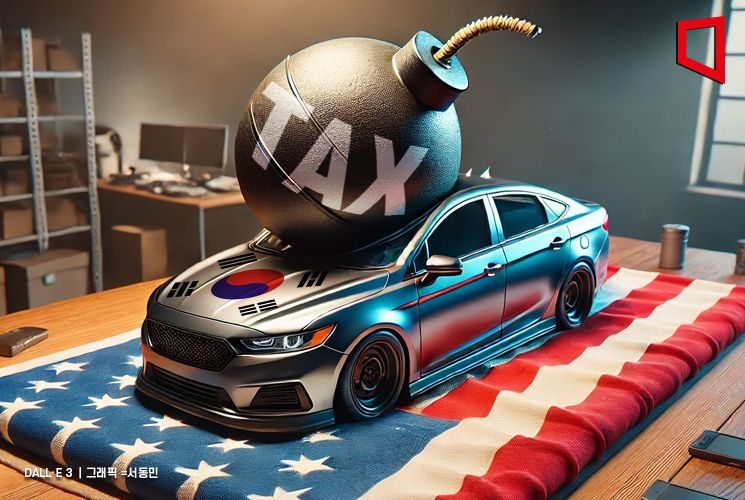
When U.S. President Donald Trump mentioned a 25% tariff on imported cars into the United States, domestic automakers requested that our government expand imports of U.S.-produced liquefied natural gas (LNG). Expanding LNG imports has long been considered a countermeasure for us, but it is unusual for other industries to make such a request. Since automobiles are the biggest factor in the Korea-U.S. trade deficit, the calculation is that increasing LNG imports to reduce the deficit could lower the possibility of a tariff bomb.
According to the industry on the 19th, domestic automakers requested the government to expand imports of U.S.-produced LNG. A senior industry official said, "The automobile industry requested the government to expand imports of U.S. LNG," adding, "We understand the government is also positively reviewing this."
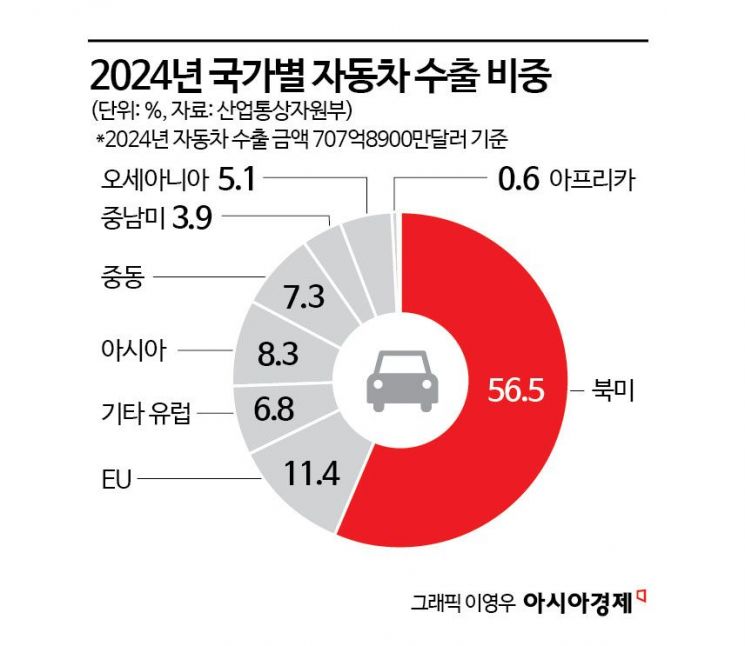
The automobile industry accounts for a large portion of our country's exports, with more than half headed to the U.S. As of last year, automobiles ranked second in exports by single item after semiconductors ($70.8 billion), with 56.5% of that exported to the North American region.
Domestic automakers are appealing for government support, saying that a '25% tariff' is an excessive level that cannot be sustained given our export structure. They also suggested that the government devise measures to resolve the trade imbalance between the two countries from a macro perspective.
If, as Trump declared, a 25% tariff is imposed on imported cars into the U.S., domestic automakers with a high export ratio to the U.S. will inevitably have to adjust their global production map. Hyundai Motor and Kia have decided to increase the production capacity of their Georgia electric vehicle-only plant (HMGMA) from 300,000 units annually to 500,000 units depending on the situation. However, if U.S. production increases, domestic plants will have to bear production gaps. Labor union opposition to this is another variable.
Korea GM, which exports 85% of its production to the U.S., will be directly hit by the tariff imposition. In the case of a general tariff of around 10%, the Korean subsidiary could respond by reducing profits, improving production efficiency, or raising U.S. sales prices. But if tariffs rise to 25%, it will be difficult to endure.
The Trax crossover and Trailblazer made by Korea GM at its Changwon and Bupyeong plants ranked first and third in the U.S. small sport utility vehicle (SUV) market last year. This was because, amid tightening greenhouse gas regulations, General Motors (GM) headquarters had to increase the sales proportion of fuel-efficient small SUVs. With high product quality, price competitiveness, and headquarters support, market share rapidly increased.
After the launch of Trump's second term government, if greenhouse gas regulations are relaxed, GM could increase sales of its main internal combustion large SUVs again. If tariffs rise, there is also a possibility of shifting production locations to the U.S. to maintain competitiveness of price-sensitive small SUVs.
A senior industry official said, "If tariffs reach 25%, it will be difficult for individual companies to respond," adding, "The government can only repeatedly emphasize the advantages of Korean production and U.S. exports."
© The Asia Business Daily(www.asiae.co.kr). All rights reserved.


















