The Korea Atomic Energy Research Institute (KAERI) announced on the 19th that it will start the 'Iron (Fe) Ion Beam Irradiation Service' for nuclear and fusion materials research for the first time in Korea from next month.
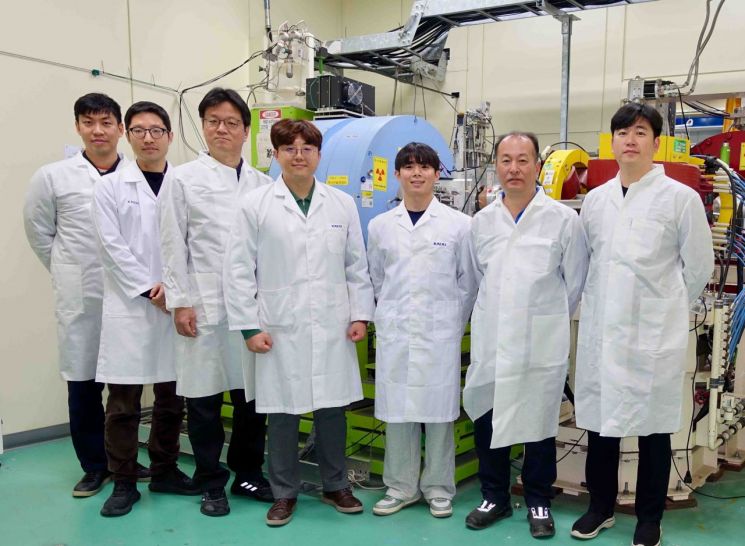 The Nuclear Physics Application Research Division at the Korea Atomic Energy Research Institute has succeeded in the "Iron Ion Beam Irradiation Study" using the heavy ion beam irradiation facility and will begin full-scale irradiation services starting next month. (From left) Seongryeol Heo, Senior Researcher; Sangbin Lee, Postdoctoral Researcher; Daesik Jang, Senior Researcher; Seunghyun Lee, Senior Researcher; Hyunjung Lee, Intern Researcher; Seokgwan Lee, Researcher; Gihyun Lee, Senior Researcher. Provided by Korea Atomic Energy Research Institute.
High-energy neutrons emitted from nuclear reactors and fusion reactors can cause damage to key components such as nuclear fuel cladding tubes and structural materials, making related research essential to prevent such damage.
In research, it is necessary to evaluate the extent of material damage. However, tests involving direct neutron irradiation using research reactors or neutron generators require considerable time and cost, presenting practical limitations. To complement this, overseas research is actively conducted using ions with physical properties similar to neutrons for irradiation.
Ions are charged particles formed when atoms lose or gain electrons; they are generated by vaporizing atoms at high temperatures and then using electric fields. When accelerated ions irradiate materials, results similar to neutron irradiation damage can be obtained.
Considering that heavier ions can induce damage more rapidly, KAERI established the Heavy-ion Beam Irradiation Facility (KAERI Heavy-ion Irradiation Facility·KAHIF) in 2019. Since 2022, it has been providing medium-ion beam irradiation services such as argon (Ar) and helium (He) ion beams.
In particular, iron ion beam irradiation is an effective method for rapidly and precisely evaluating damage to steel materials and is widely used in operating nuclear power plants, next-generation reactors, fusion reactors, and applied industries.
When irradiating with iron ion beams identical to steel materials, unnecessary physical and chemical reactions that occur with other ion beams are avoided, enabling pure evaluation of irradiation damage effects.
Due to these advantages, demand for iron ion beams in the nuclear and fusion fields has steadily increased. However, iron is difficult to convert into gas, and ion extraction is challenging, making technology implementation difficult.
In response, KAERI established metal ion source equipment capable of ionizing and accelerating metallic elements, securing the iron ion beam acceleration and irradiation technology for the first time in Korea. They also succeeded in extracting and irradiating 100 billion iron ions (Fe13+) per second using a dipole electromagnet that can selectively filter desired ions in an electromagnetic field after ionizing solid-state iron compounds into gas.
Based on the secured iron ion beam irradiation technology, KAERI plans to build a comparative database (DB) of neutron irradiation and ion beam irradiation data to contribute to the development of key materials for currently operating nuclear power plants as well as next-generation reactors such as SMR, MSR, SFR, and fusion reactors. Applications for the iron ion beam irradiation service can be made through the KAERI website starting next month.
Lee Dong-won, head of the Nuclear Physics Application Research Division, said, "This research will be a kind of oasis for domestic researchers who have had to rely on overseas facilities so far," adding, "KAERI will strive to provide world-class ion beam irradiation services by additionally establishing high-difficulty ion sources such as nickel and securing high-temperature test environments in the future."
Meanwhile, this research has been conducted since 2022 through the Ministry of Science and ICT's 'Fusion Leading Center (R&D)' project.
© The Asia Business Daily(www.asiae.co.kr). All rights reserved.

















