"15 to 20 Trillion Won Is Appropriate," Governor Lee Reaffirms Stance
Targeted Support for Vulnerable Groups More Effective Than Universal Aid
Korea's 2024 Growth Forecast at 1.6-1.7%... "Under Review Again"
Lee Changyong, Governor of the Bank of Korea, reaffirmed his previous stance regarding the supplementary budget (extra budget) currently being discussed in the National Assembly, stating that "a scale of 15 to 20 trillion won is desirable." He pointed out that a larger supplementary budget could cause side effects similar to "overusing painkillers."

At the plenary session of the Planning and Finance Committee of the National Assembly on the 18th, Governor Lee stated, "Even under the current circumstances, we believe that a supplementary budget of 15 to 20 trillion won is appropriate." He added, "When I previously mentioned that a supplementary budget of this size was necessary, I had already taken into account the current level of political uncertainty. We believe a supplementary budget of around 15 to 20 trillion won would be suitable for responding to the economic situation, as it would raise the economic growth rate by 0.2 percentage points."
Regarding the Democratic Party of Korea's argument that a supplementary budget of 30 to 35 trillion won is needed to provide a 250,000 won consumption coupon per person, he said, "While such a measure could have a temporary effect, if the supplementary budget does not exceed 35 trillion won again next year, it will have a negative impact on the growth rate." He emphasized, "These factors must be considered together when making a decision." He explained that rapidly boosting the growth rate by injecting a large amount of fiscal resources is akin to "overusing painkillers" for immediate effects.
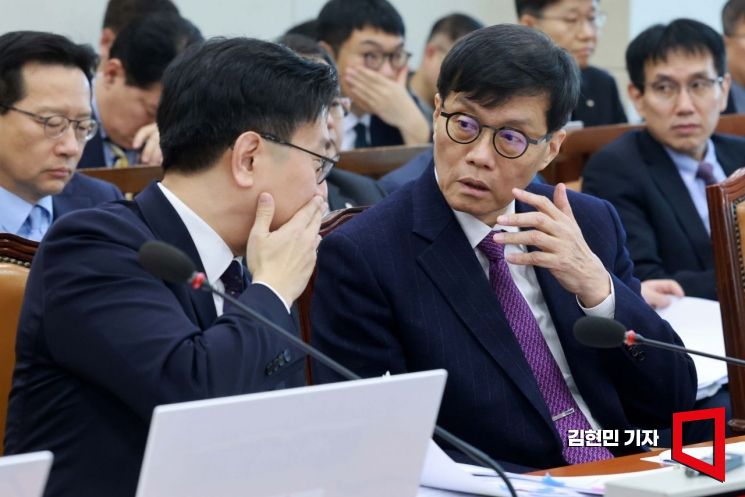 Bank of Korea Governor Lee Changyong (right in the photo) and First Vice Minister of Strategy and Finance Kim Beomseok are attending and conversing at the plenary meeting of the Planning and Finance Committee held at the National Assembly on the 18th.
Governor Lee also reiterated his existing position that "targeted support" focusing on vulnerable groups is more effective than universal support. He stated, "In the past, the economics community viewed cash handouts very negatively," adding, "Generally, distributing cash is a method used when administrative costs are very high due to a lack of a well-established digital infrastructure." He explained that in cases where such limitations do not exist, providing tailored support is generally considered more desirable by the academic community. Governor Lee emphasized, "Providing an amount several times greater than 250,000 won to struggling small business owners would be more effective."
Regarding this year's real GDP growth outlook for Korea, he said, "We are reviewing it again." Last month, before the Bank of Korea's regular economic outlook in February, the growth forecast was unusually revised to 1.6 to 1.7 percent, reflecting the aftermath of the emergency martial law. The previous economic outlook, presented in November last year, had forecast a growth rate of 1.9 percent. The Bank of Korea will announce its revised economic outlook on the 25th. Governor Lee added, "I will provide a more detailed explanation when we announce the new forecast on the 25th," and explained, "In addition to political uncertainty, various factors such as U.S. economic policy and the Federal Reserve's interest rate policy are also at play."
© The Asia Business Daily(www.asiae.co.kr). All rights reserved.
![Clutching a Stolen Dior Bag, Saying "I Hate Being Poor but Real"... The Grotesque Con of a "Human Knockoff" [Slate]](https://cwcontent.asiae.co.kr/asiaresize/183/2026021902243444107_1771435474.jpg)












