"Chronic Disease Management Such as Diabetes and Hypertension
Is Essential to Eliminate Risk Factors"
During the cold winter months, blood pressure fluctuates sharply, increasing the risk of cardiovascular and cerebrovascular diseases caused by blocked blood vessels. When the retinal blood vessels become blocked, 'retinal vascular occlusion' occurs. Commonly referred to as 'eye stroke,' it can lead to blindness in severe cases, so it is important to pay attention to health management, including chronic disease control.
Retinal vascular occlusion generally occurs due to systemic diseases that cause blood circulation disorders, such as hypertension, diabetes, and arteriosclerosis. Retinal artery occlusion, which blocks the retinal artery supplying blood to the retina, is caused by embolism or thrombosis. Retinal vein occlusion, which blocks the retinal vein that returns blood from the retina to the heart, is known to progress to occlusion due to blood flow turbulence and thrombus formation caused by stiffened arteries compressing the veins at the crossing points of the retinal arteries and veins for various reasons.
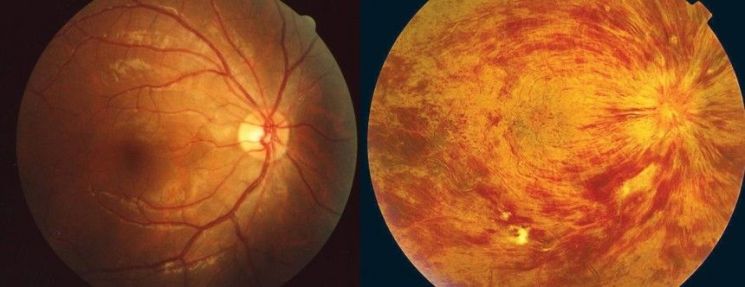 (Left) Normal fundus, (Right) Fundus of a patient with retinal vascular occlusion. Provided by Soonchunhyang University Bucheon Hospital
Professor Park Hyosong of the Department of Ophthalmology at Soonchunhyang University Bucheon Hospital stated on the 18th, "This disease occurs suddenly, and even if one eye has poor vision, many people tend to overlook the symptoms because the other eye functions. Since it shows various complications and rapid vision loss, prompt diagnosis and treatment are important."
The main symptoms of retinal vascular occlusion are sudden vision loss and visual field defects. In the case of retinal vein occlusion, delayed initial treatment can lead to complications such as macular edema, vitreous hemorrhage, and glaucoma, and in severe cases, permanent vision loss may occur.
Retinal vascular occlusion is diagnosed by confirming arterial and venous occlusion through fundus photography, optical coherence tomography, and fluorescein angiography. However, retinal artery occlusion may show almost no retinal changes in the very early stages of onset, so caution is required.
Treatment varies depending on which blood vessel is occluded. In retinal artery occlusion, treatment effects are often limited depending on the extent of the occlusion, but attempts are made to lower intraocular pressure to restore blood circulation. Recently, thrombolytic therapy has been attempted, and surgical treatment is also performed.
Retinal vein occlusion is treated for major accompanying complications such as macular edema and vitreous hemorrhage through intravitreal injections, laser therapy, and surgical treatment, while follow-up observation is conducted to prevent possible complications such as glaucoma.
Chronic diseases that cause blood circulation disorders can cause vascular occlusion not only in the eyes but also in other parts of the body. Therefore, if retinal vascular occlusion occurs, it is important to recognize the body's warning signs and evaluate and prevent life-threatening systemic diseases such as stroke and heart disease through examinations.
To prevent it, quitting smoking and drinking is necessary, and maintaining an appropriate body weight is important. Thorough management of risk factors related to cardiovascular and cerebrovascular diseases, such as regular exercise and eating less salty food, is essential.
Early detection and appropriate treatment of retinal vascular occlusion can minimize vision damage. Consistent management of chronic diseases such as hypertension and diabetes and regular ophthalmologic examinations are key to prevention and early treatment.
© The Asia Business Daily(www.asiae.co.kr). All rights reserved.

















