DeepSeek Released as Open Source
Applied to Generative AI, Robots, Devices, Cloud, and Data Centers
AI Ecosystem Formed Through Open Source
Competition Between the U.S. and China Expected to Intensify
South Korea Also Needs to Build Its Own Open Source AI Ecosystem
The emergence of China's generative artificial intelligence (AI) DeepSeek has led to predictions that the power struggle between the United States and China over AI will extend into the realm of 'open source.' On the morning of the 18th, Ha Jung-woo, head of the Naver Cloud AI Innovation Center, stated at the 'Discussion on Desirable AI Policy Responses after the Second Trump Administration' held in the small conference room of the National Assembly Library, "As DeepSeek rapidly spreads, an open source showdown between the U.S. and China will unfold."
Open source refers to the practice of making programming source code publicly available so that anyone can utilize it for new developments. The open source AI model DeepSeek has disclosed its operating principles, design methods, and algorithms entirely. Developers worldwide can now create similar generative AI models quickly and without huge investments by building on DeepSeek's open source.
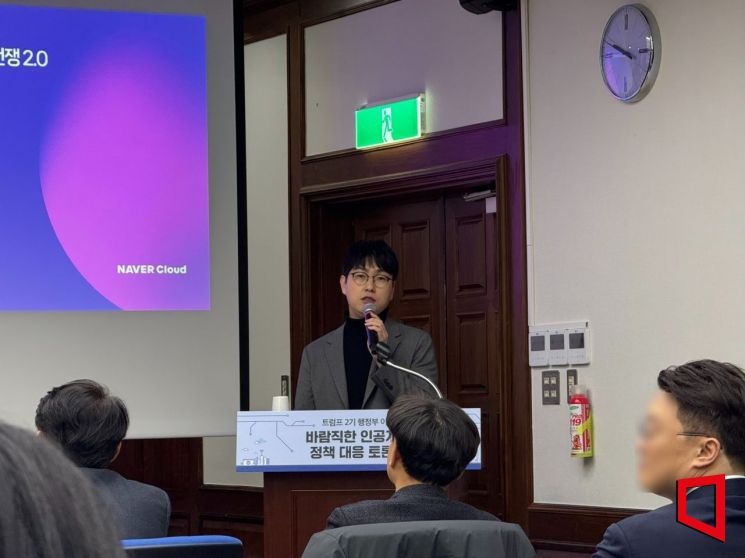 Ha Jung-woo, Head of Naver Cloud AI Innovation Center, is presenting at the "Discussion on Desirable AI Policy Responses After the Second Trump Administration" held on the morning of the 18th at the National Assembly Library Small Conference Room. Photo by Lee Myung-hwan
Ha explained, "Open source AI models will play a key role in building the ultimate 'AI ecosystem,' being utilized across various industries including generative AI services, robots, devices, AI agents, cloud, and data centers." He added, "Dominating the AI ecosystem means largely controlling the entire related supply chain (value chain)."
He also advised that South Korea should establish its own open source AI ecosystem. Ha said, "Rather than becoming completely dependent on the U.S. and China's open source ecosystems, South Korea should strengthen its own open source AI ecosystem." He assessed, "Since DeepSeek has disclosed a lot of information about generative AI, it is possible to enter the generative AI market without astronomical investments."
Measures to strengthen the AI ecosystem include 'investment in AI infrastructure such as graphics processing units (GPUs),' 'securing data centers and data,' 'expanding the distribution of AI agents,' and 'nurturing talent.' Ha emphasized, "An action plan is needed in terms of AI infrastructure, data, and talent development." He suggested, "There is also a way to support the digitization of data from ASEAN, Arab, and Latin American regions, which are relatively less competitive in IT, and use that as training data for AI."
Following Ha, Kim Yong-hee, professor at Kyung Hee University Graduate School of Media and Communication, who presented on the topic of 'The Necessity of AI Regulation Discussions,' stated, "(The core task is) finding a balance between regulation and innovation." He recommended, "For countries like South Korea that need to keep pace with AI development speed, promotion laws should take precedence over regulatory laws."
Meanwhile, the discussion was hosted by Democratic Party lawmaker Lee Hoon-ki and organized by the Korea Internet Corporations Association.
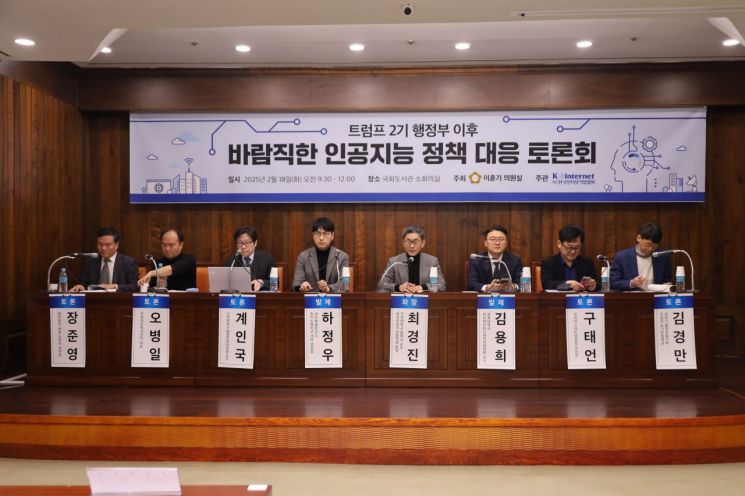 On the morning of the 18th, participants are discussing at the "Desirable AI Policy Response Discussion after the Second Trump Administration" held in the small conference room of the National Assembly Library. Provided by the office of Lee Hoon-ki, Democratic Party of Korea.
© The Asia Business Daily(www.asiae.co.kr). All rights reserved.


















