Temu Launches L2L Business, Recruiting Korean Sellers
Declares Direct Entry After Ali
SHEIN Completes Safety Tests... Intensified C-Commerce Invasion
The invasion of Chinese e-commerce (C-commerce) into the domestic distribution market is intensifying. Following AliExpress (Ali), Temu has also declared its direct entry into the Korean market. SHEIN has announced that it has completed product safety tests, a chronic issue in C-commerce.
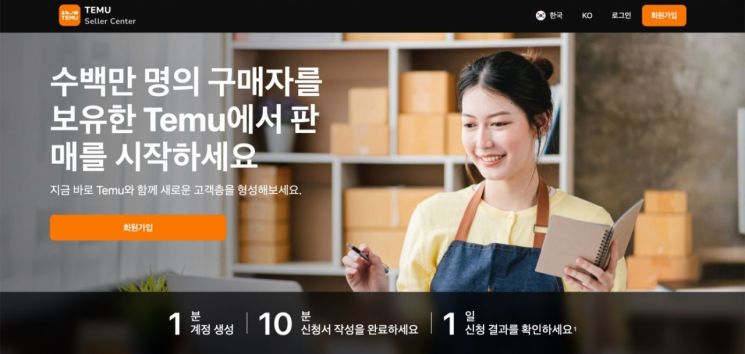
On the 18th, Temu announced that it is recruiting Korean sellers for its online marketplace. Through this move, Temu will expand its existing business model of selling Chinese products directly to overseas consumers via direct purchase, by launching a 'Local to Local (L2L)' business that directly distributes Korean products. Currently, Temu operates the L2L model in global markets including the U.S., Mexico, the U.K., Germany, and Japan.
This program targets sellers registered in Korea who hold local inventory and can handle their own order processing and delivery. Sellers wishing to join can search for 'Temu Seller Center' on Google and register through the Korean Temu Seller Center page.
A Temu representative stated, "We plan to offer domestic sellers the opportunity to connect directly with millions of new customers," adding, "With domestic sellers joining the platform, consumers will be able to easily purchase preferred local brand products on Temu."
With Temu deciding to start an open market business in Korea, it is expected to establish an office in Korea, dispatch a branch manager, and hire Korean staff. It is known that since the end of last year, Temu has been recruiting Korean employees in HR, general affairs, PR and marketing, and logistics while maintaining direct purchase sales.
Earlier, Ali launched the Korean product specialty section K-Venue in October 2023, recruiting Korean sellers until December last year by waiving entry fees and operating in an open market format.
On the same day, SHEIN announced that it had completed safety tests on over 2 million products last year in cooperation with international third-party testing agencies. This was to improve awareness of product quality and safety, which have been chronic issues in C-commerce. SHEIN also stated it will invest more than $15 million additionally this year for product quality and consumer safety. Last month, it appointed Mustan Lalani as the global sustainability officer and announced plans to lead innovation and technology development to address environmental and social issues across the global fashion supply chain.

The invasion of C-commerce companies such as Ali, Temu, and SHEIN is expected to intensify further.
According to Statistics Korea, last year, the estimated amount of direct purchases from China by domestic consumers was 4.7772 trillion KRW, accounting for 60% of the total direct purchases (7.9583 trillion KRW). Compared to about 1 trillion KRW in 2020, this represents nearly a fourfold growth over four years. According to WiseApp Retail, an app and retail analysis service that sampled payments made by Koreans aged 20 and over via credit card, debit card, and bank transfer, the estimated payment amounts for Ali and Temu last year were 3.6897 trillion KRW and 600.2 billion KRW respectively, with a combined estimated payment amount of 4.2899 trillion KRW, an 85% increase from the previous year.
Since the inauguration of the second Trump administration, Chinese companies are expected to perform poorly in the U.S. market and are likely to accelerate their focus on Korea. The direct entry of C-commerce companies into the domestic distribution market will intensify the low-price volume offensive, making competition in the domestic e-commerce market even fiercer.
© The Asia Business Daily(www.asiae.co.kr). All rights reserved.


















