Ministry of Strategy and Finance Raises Issue at National Assembly Subcommittee
on Allowing Conventional Tobacco Sales by Liquid E-cigarette Retailers
After Grace Period for Distance Restriction
On the 18th, the ruling and opposition parties again failed to pass the Tobacco Business Act amendment bill, which defines synthetic nicotine used as a raw material for liquid-type electronic cigarettes as tobacco and strengthens regulations, through the National Assembly's Planning and Finance Committee subcommittee.
The Economic and Fiscal Subcommittee of the National Assembly's Planning and Finance Committee held a meeting at the National Assembly that morning and discussed the amendment bill to expand the definition of tobacco raw materials from tobacco leaves to "tobacco and nicotine," but decided to postpone the resolution.
The day before, Park Soo-young, the ruling party's secretary of the Planning and Finance Committee from the People Power Party, and Jung Tae-ho, the opposition party's secretary from the Democratic Party of Korea, held a closed meeting and agreed to define synthetic nicotine as a raw material of tobacco along with tobacco leaves, and to process the amendment bill with a six-month grace period after the law's promulgation, a 50-meter distance restriction between retailers, and a 1 year and 6 months (2 years after the law's promulgation) suspension of application. This grace period is intended to allow time for the introduction of new regulations, preparation for enforcement, lease periods of retailers, and voluntary restructuring.
However, the Ministry of Strategy and Finance raised the issue of whether, after the grace period for the distance restriction between liquid electronic cigarette retailers, they would allow these retailers to sell heated tobacco products as well, necessitating further detailed discussions. If the definition under the Tobacco Business Act is expanded without separate licensing regulations for the liquid tobacco business, it implies that after the grace period for the distance restriction ends, business owners continuing liquid electronic cigarette retailing could also sell conventional tobacco products.
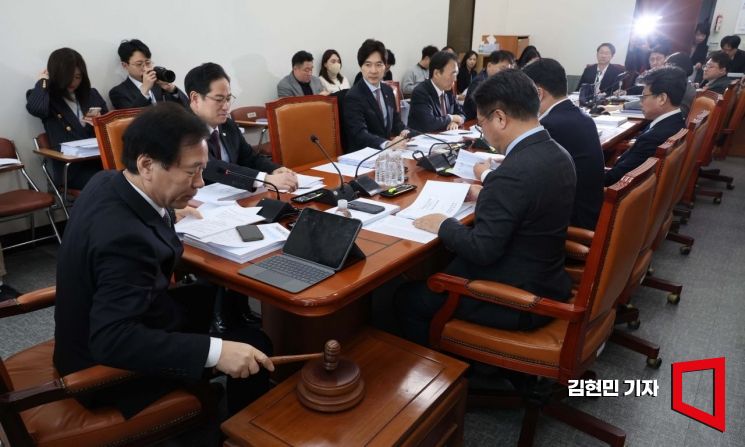 On the 10th, Jeong Tae-ho, the subcommittee chairman, is presiding over the 1st Economic and Fiscal Subcommittee of the Planning and Finance Committee held at the National Assembly. This meeting will review partial amendments to the Tobacco Business Act and the Foreign Exchange Transactions Act. 2025.2.10 Photo by Kim Hyun-min
The current Tobacco Business Act limits tobacco raw materials to tobacco leaves only, and to operate a general tobacco sales business, approval from authorities is required. However, in the case of liquid-type electronic cigarettes mainly using synthetic nicotine, sales are possible with just a business registration, and since they are not legally defined as tobacco, they are not subject to advertising restrictions, online and school zone sales regulations, or tobacco tax.
Jung Tae-ho, the opposition party secretary of the Planning and Finance Committee from the Democratic Party of Korea, told reporters after the subcommittee meeting, "The Planning and Finance Committee pointed out the problem that if tobacco business licenses are granted to new tobacco retailers under the new standards after two years, they would be able to sell existing tobacco products as well," adding, "We need to discuss this again."
The next discussion on the Tobacco Business Act amendment bill, including whether to grant permission to sell conventional tobacco products when liquid electronic cigarette retailers move locations after the grace period for the distance restriction, is expected to take place soon in a subcommittee meeting or during the Planning and Finance Committee's external agency business report scheduled for next week.
© The Asia Business Daily(www.asiae.co.kr). All rights reserved.
![Clutching a Stolen Dior Bag, Saying "I Hate Being Poor but Real"... The Grotesque Con of a "Human Knockoff" [Slate]](https://cwcontent.asiae.co.kr/asiaresize/183/2026021902243444107_1771435474.jpg)
















