Semiconductor Special Act Fails to Pass Subcommittee
Disagreement Over 52-Hour Workweek Exemption
National Council Meeting on the 20th Becomes a Turning Point
Choi Sang-mok Expresses Willingness to "Find a Solution"
The National Assembly's discussion on the Semiconductor Special Act to support the semiconductor industry has been stalled, making the upcoming National Council meeting on the 20th a critical turning point for bipartisan compromise. In particular, Choi Sang-mok, Acting Prime Minister and Minister of Economy and Finance, expressed his willingness to reach a grand compromise on the Semiconductor Special Act at the National Council meeting.
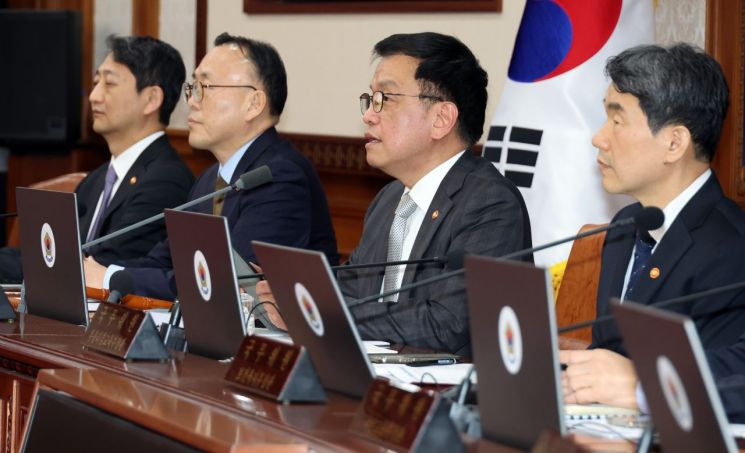
At the Cabinet meeting held at the Government Seoul Office on the 18th, Acting Prime Minister Choi stated, "Concerns that including a special exemption for the 52-hour workweek in the Semiconductor Special Act could encourage long working hours can be sufficiently resolved through sincere communication." He emphasized the necessity of including the 52-hour workweek exemption to revitalize the semiconductor industry and urged passing the bill with this provision.
Acting Prime Minister Choi stressed, "Since the National Council is being held with great difficulty, we must produce meaningful results regarding the handling of livelihood and economic bills and additional fiscal investment," adding, "The purpose of politics is the people's livelihood, and the method of politics is communication."
The National Council will be attended by Acting Prime Minister Choi, Speaker of the National Assembly Woo Won-shik, Emergency Committee Chairman of the People Power Party Kwon Young-se, and Leader of the Democratic Party Lee Jae-myung. This is a forum where the government, the National Assembly, and ruling and opposition parties come together to discuss policies in the fields of livelihood and economy amid the impeachment political turmoil.
Earlier, the Subcommittee on Legislation of the National Assembly's Industry, Trade, Small and Medium Enterprises, and Venture Businesses Committee failed to pass the much-anticipated Semiconductor Special Act. The People Power Party insisted that the Semiconductor Special Act must include an exemption from the 52-hour workweek system. On the other hand, the Democratic Party argued that it was important to pass the bill first based on agreed-upon measures such as tax benefits and subsidies, resulting in the bill not passing the subcommittee hurdle.
The problem is that the international trade environment is tense, with the United States, since President Donald Trump's inauguration, signaling tariffs on our key export items such as semiconductors and automobiles. The situation is not relaxed enough for the ruling and opposition parties to waste time in a tug-of-war amid the impeachment political turmoil.
Acting Prime Minister Choi said, "The government's trade response capabilities are now on a full-fledged test," adding, "From now on, it will be a 'total trade war'." He assessed, "The fate of countries will diverge depending on how they respond to the trade war initiated by the United States." Acting Prime Minister Choi announced, "We will hold an export strategy meeting to closely monitor related trends with relevant ministers and present a 'whole-government export plan,' including the largest-ever trade finance support plan of 360 trillion won plus alpha and measures to diversify export items and regions."
If Acting Prime Minister Choi and Speaker Woo Won-shik play the role of political lubricants to ease the confrontation between the ruling and opposition parties, meaningful outcomes could be produced at the National Council meeting. The issue is that the Semiconductor Special Act is emerging as a political issue beyond an economic matter. With the possibility of an early presidential election, both sides may try to check each other to prevent the Semiconductor Special Act from being arranged in a way favorable to the other side to secure political leadership.
In fact, on the day, the ruling and opposition parties clashed over responsibility for the failure to pass the bill in the subcommittee. Kwon Seong-dong, floor leader of the People Power Party, criticized at the floor strategy meeting, "(The Democratic Party) ignored the urgent request to strengthen the competitiveness of the domestic semiconductor industry," adding, "It's like putting shackles on a sprinter's ankles and cheering them to run hard." Kwon pointed out, "U.S. Nvidia is known for its intense work culture, and Taiwan's TSMC also works more than 70 hours a week. While competitors are running day and night, only the Korean semiconductor industry is tied to the 52-hour workweek system because of the Democratic Party."
On the other hand, Lee Jae-myung, leader of the Democratic Party, wrote on social media, "The failure to pass the Semiconductor Special Act was due to opposition from the People Power Party," and claimed, "The irresponsible stubbornness of the People Power Party, which insists that nothing can be agreed upon without a '52-hour workweek exemption clause,' has hampered the competitiveness of an industry critical to the nation's future." Lee emphasized, "The important part of the Semiconductor Special Act is the support provisions to revive the semiconductor industry facing a crisis, and both ruling and opposition parties have already agreed on this," adding, "It is appropriate to promptly handle the parts without disagreement to save the semiconductor industry and the national economy in crisis."
© The Asia Business Daily(www.asiae.co.kr). All rights reserved.
![Clutching a Stolen Dior Bag, Saying "I Hate Being Poor but Real"... The Grotesque Con of a "Human Knockoff" [Slate]](https://cwcontent.asiae.co.kr/asiaresize/183/2026021902243444107_1771435474.jpg)











