Can't Trust the Won... Surge in Dollar Deposits
Dollar-Denominated Balances Hit Highest Level in Over Two Years
Gold Banking Surpasses 900 Billion Won for the First Time
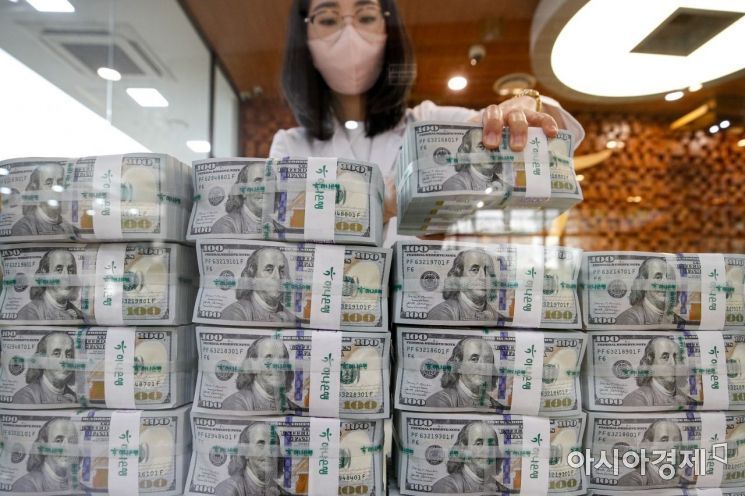 An employee is organizing US dollars at the Hana Bank Counterfeit Response Center in Jung-gu, Seoul. Photo by Kang Jin-hyung
Due to U.S. President Donald Trump's 'tariff bomb policy,' economic uncertainty has increased, leading to a rise in preference for gold, a representative safe-haven asset. Consequently, bank gold account balances have been hitting record highs day after day. Alongside this, dollar deposit balances are also continuing a steep upward trend. The shortage of gold bars appears to have driven market funds toward alternative investment products. Despite the sustained high exchange rate, demand for the safe-haven asset, the dollar, continues.
According to the financial sector on the 18th, the total dollar deposit balance at the five major banks (KB Kookmin, Shinhan, Hana, Woori, and NH Nonghyup) as of the 14th was $67.65207 billion. This is the highest figure in over two years since the end of January 2023, when the balance was $68.23181 billion.
Considering that the average KRW/USD exchange rate at the end of January 2023 was 1,247.2 won and the average exchange rate from the 1st to the 14th of this month reached 1,450.9 won, the balance in Korean won terms is nearly 15 trillion won larger than at that time. This indicates that many investors are aggressively buying more dollars rather than selling to realize profits, even amid the highest exchange rate levels since the financial crisis.
As of the 14th, the dollar deposit balance increased by 6.0% compared to the end of last year ($63.79719 billion) and by 6.5% compared to the end of last month ($63.52915 billion). Notably, the balance fluctuated between $63 billion and $64 billion until the 13th but surged to the $67 billion range on the 14th. In addition to the preference for safe assets, officials analyze that the dollar buying momentum strengthened ahead of the U.S. public holiday, Presidents' Day, on the 17th (local time).
Dollar deposits offer both exchange gains and interest income. Although income tax applies to the interest and currency exchange fees occur, the interest rate is higher than that of Korean won deposits at banks because it is based on the U.S. benchmark interest rate (annual 4.25?4.5%). However, experts advise cautious investment by monitoring exchange rate movements, as domestic and international uncertainties have not been fully resolved.

The balance of Gold Banking, a product that allows buying and selling gold through bank accounts, has also increased significantly. As of the 14th, the Gold Banking balance at KB Kookmin, Shinhan, and Woori banks totaled 901.9 billion won. Hana and NH Nonghyup banks do not offer Gold Banking. This is the first time the combined balance of these three banks has surpassed 900 billion won. Except for a decrease of 3 billion won on the 7th of this month, the Gold Banking balance has increased every day and, as of the 14th, rose by 15.3% compared to the end of last year (782.2 billion won) and by 8.0% compared to the end of last month (835.3 billion won).
Gold bar sales have somewhat slowed due to KB Kookmin and Woori banks suspending sales, but still remain at a high level. The five major banks sold a total of 50.21328 billion won worth of gold bars from the 1st to the 14th of this month, an unprecedented scale. KB Kookmin Bank resumed gold bar sales on the 17th for 1kg bars only, after suspending sales on the 12th, but halted sales again just one day later.
© The Asia Business Daily(www.asiae.co.kr). All rights reserved.


















