Stay-Type "Visit Gwangju Year" Boom through Culture and Sports Integration
Attracting Three National Institutions: Museum of Modern Art, History Museum, and National Assembly Library
Building a City of Humanities that Reads and Fostering AI-Converged Cultural Content Industry
Successful Hosting of Design Biennale and World Archery Championships
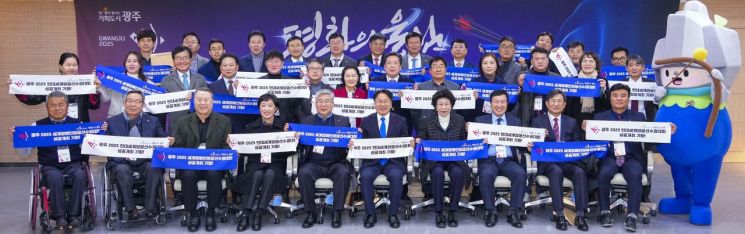 Gwangju Mayor Kang Gijeong attended the inaugural general meeting of the Gwangju 2025 Modern World Archery Championships and World Para Archery Championships Organizing Committee held on the afternoon of December 16 last year in the city hall's medium conference room. He shouted slogans with organizing committee members and archery officials, pledging the successful hosting of the World Archery Championships. Provided by Gwangju City
The city of Gwangju announced on the 17th that it will implement the "Seven Major Cultural Policies" this year to open up new avenues for the city's growth.
This year, the city plans to focus on expanding its cultural landscape by attracting three national institutions?the National Museum of Modern and Contemporary Art, the National Museum of Korean Contemporary History, and the National Assembly Library?creating a buzz for the "Visit Gwangju Year" by linking culture and sports, establishing a "City of Humanities that Reads," and fostering strategies for the AI-converged cultural content industry.
To mark the "2025 Visit Gwangju Year," the city will promote consumption by attracting stay-type visitors through various events that combine culture and sports. With the opening of the professional football team Gwangju FC's season in February and the professional baseball team KIA Tigers' season in March, the city will introduce experiential marketing targeting sports spectators visiting Gwangju.
Centered around Jeonil Building 245, a location featured in author Han Kang's novel "The Boy is Coming," the city will run humanities programs that revisit the spirit of that era, and in December, it will hold a commemorative event with citizens to celebrate the first anniversary of Han Kang's Nobel Prize in Literature.
In September, the city is planning a variety of cultural events by linking international events such as the "2025 Gwangju Design Biennale" and the "2025 Gwangju World (Para) Archery Championships" with the "10th Anniversary of the National Asia Culture Center." Additionally, it will introduce the "Art Pass" product, allowing visitors to enjoy local cultural hotspots such as Yangnim-dong, Daein Art Market, and Art Street.
The city aims to strengthen its role as a true cultural hub by connecting the Gwangju Biennale, the National Asia Culture Center, and the Nobel Prize in Literature. With growing public interest in the humanities following Han Kang's Nobel win, the city will accelerate efforts to create "Gwangju, a City of Humanities that Reads." Centered around the "Gwangju City of Humanities Committee," launched last year, the city will lay the groundwork for a "Reading City Gwangju" by developing themed trails based on humanities assets such as the novel "The Boy is Coming" and activation programs in collaboration with local bookstores.
The city will strategically foster the cultural content industry, including animation, webtoons, advanced video, and the gaming industry. To this end, it will strengthen customized support systems for each stage of the business lifecycle, from pre-startup and early-stage startups to growth and IPO.
Gwangju will maximize the value of local content intellectual property (IP) and foster "TOP companies" that possess global competitiveness by integrating advanced technology. The city plans to attract investment for promising companies within the Cultural Industry Investment Promotion District and operate the Asia Culture Hub City Development Fund to help technology-driven companies grow into unicorns, aiming to become a hub city for AI-converged cultural content industries.
The "GCC (Gwangju Realistic Content Cube) Academy" will strengthen company-customized projects to connect trainees to employment and entrepreneurship.
The 2025 Gwangju Design Biennale, marking its 20th anniversary, is accelerating preparations to present future-oriented agendas.
In preparation for the successful hosting of the Gwangju World (Para) Archery Championships in September, the city is thoroughly preparing 38 support tasks, including culture, tourism, promotion, and transportation. The city is planning a sustainable, eco-friendly event with the slogan "No! Plastic, Yes! 966," meaning that by reducing 8,795 kg of carbon dioxide, it will have the effect of planting 966 30-year-old pine trees.
To this end, athletes will be encouraged to bring personal tumblers to reduce the use of disposable plastic water bottles in the stadiums, reusable containers will be used for lunch, and paper promotional materials for the event will be replaced with QR codes.
The city will also operate the "Sports Culture Mashil" in collaboration with Gwangju FC, allowing citizens to enjoy both sports and culture, and will provide diverse cultural experiences through flagship cultural programs such as Daein Art Market, Art Street, Art Picnic, and Art Gwangju.
Kim Seongbae, Director of Culture and Sports, stated, "This year, Gwangju will focus on expanding the local cultural growth plate through the seven major cultural policies, including attracting three national cultural institutions, boosting the Visit Gwangju Year, establishing a city of humanities that reads, and fostering strategic cultural content industries. We will vigorously pursue key projects to create jobs through culture, ensure mutual prosperity between culture and livelihoods, and enable people to experience and enjoy culture."
© The Asia Business Daily(www.asiae.co.kr). All rights reserved.

















