Sharp Increase in Aircraft, Rockets, Drones, and Air Taxis
About One-Third More by 2034 Compared to Now
The airspace is expected to become congested with aircraft, rockets, drones, and air taxis, increasing the risk of accidents. Analysts suggest that new airspace management techniques will be necessary as a countermeasure.
On the 17th, Yonhap News reported this citing the British daily Financial Times (FT). According to data from management consulting firm Oliver Wyman, the number of passenger aircraft worldwide is projected to reach about 36,000 by 2034, approximately one-third more than now.
At the same time, the number of electric vertical takeoff and landing vehicles (eVTOLs), known as "air taxis," is expected to reach around 10,000. The number of rocket launches is also forecasted to be in the thousands annually.
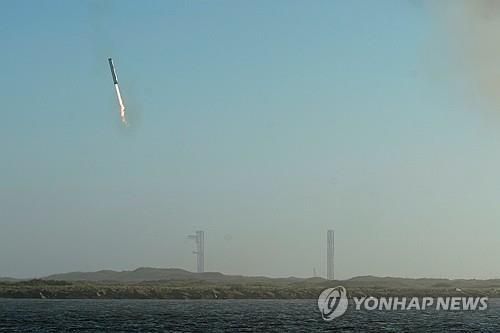 On January 16, 2025, the Super Heavy booster of SpaceX's Starship rocket attempts a ground landing. Photo by Reuters and Yonhap News.
Experts pointed out that the low-altitude airspace where aircraft take off and land will become congested, making changes in air traffic control techniques inevitable. Eduardo Garcia, who is in charge of future airspace management at the Civil Air Navigation Services Organisation (CANSO), told the media, "The way we provide services will probably have to change quite significantly. It is an important issue and will not be easy. Our industry (aviation industry) is one where safety is critical."
When the number of operating vehicles is small, humans can manage air traffic control as they do now, but as the number increases, it will eventually reach its limit. Ultimately, he said, "More automation and artificial intelligence (AI) will be needed."
Concerns about airspace congestion due to rocket launches have already become a reality. Last month, Qantas Airways delayed the departure of several flights on the Australia-South Africa route. This was because the U.S. government warned that parts of a SpaceX rocket posed a risk of re-entering the atmosphere over the southern Indian Ocean.
Chris Quilty, co-CEO of space business consulting firm Quilty Space, said, "This is something that can frequently happen as the space industry develops."
Besides rocket companies, several startups are designing launch vehicles that return to Earth after launch for reuse. They are developing manufacturing technologies that produce products such as medicines in zero gravity and then send them back to Earth, which also contributes to worsening airspace congestion.
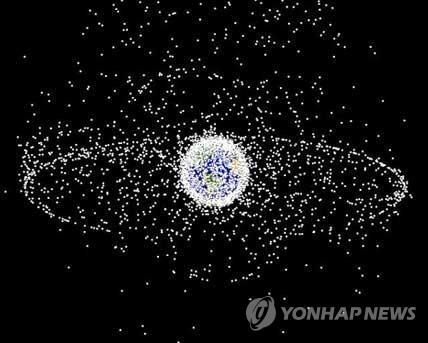
"Space debris" (such as satellite fragments after mission completion) orbiting the Earth and "uncontrolled re-entry" when falling back to Earth can pose even greater risks. In fact, in 2022, debris from a Chinese rocket caused partial closure of Spanish airspace due to concerns over uncontrolled re-entry, resulting in delays of hundreds of flights.
Last month, the scientific journal Scientific Reports published a paper stating that while the likelihood of aircraft colliding with space debris is not high at present, the possibility is increasing as both the aviation and spaceflight industries grow.
Aaron Bolli, associate professor at Columbia University and lead author of the paper, told the media, "It is estimated that there are about 50,000 pieces of space debris larger than a softball near Earth, and including smaller debris, the number reaches several million."
There is also the issue of drones in low-altitude airspace. In December 2019, after drones were spotted near London Gatwick Airport, the airport was closed for 36 hours, causing inconvenience to 140,000 passengers due to flight cancellations and delays.
© The Asia Business Daily(www.asiae.co.kr). All rights reserved.


















