Natural Gas Prices Hit Two-Year High
Cold Wave Drives Up Europe's Heating Demand... Impact of Russia-Ukraine War
FT Reports Some Politicians Advocate Resuming Gas Trade
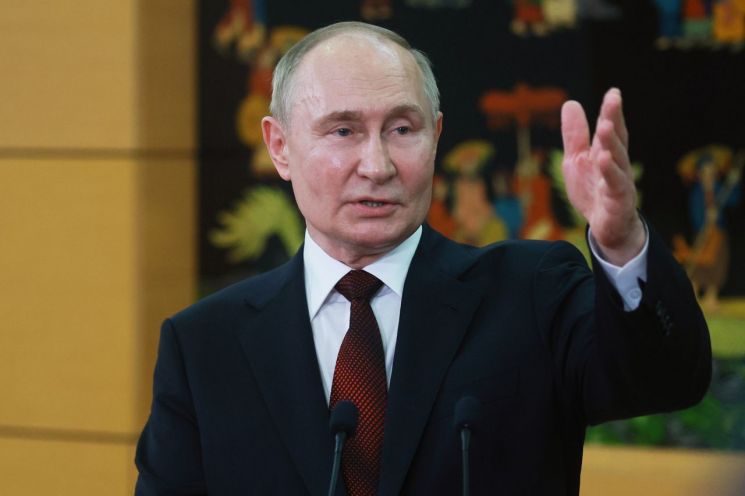 On June 21 last year (local time), Russian President Vladimir Putin, who was on a state visit to Vietnam, held a press conference in Hanoi. The Economist of the UK reported on the 16th (local time) that as natural gas prices have soared to their highest level in the past two years, some parts of Europe are calling for the resumption of natural gas trade with Russia. Yonhap News Agency
Will Europe resume its 'deal with the devil'? As natural gas prices have recently soared to their highest levels in two years, voices within Europe are calling for the resumption of natural gas trade with Russia, the British Economist reported on the 16th (local time).
According to the Dutch TTF futures exchange, natural gas was traded at 58 euros per MWh (megawatt-hour) on the 10th of this month (local time), up 4.1% from the previous day. This is the highest level in the past two years. The surge is due to increased heating demand across Europe amid cold weather and Ukraine's blockade of Russian gas pipelines passing through its territory.
The British Financial Times (FT) reported at the end of last month that some politicians within Europe are advocating for the resumption of Russian gas imports. Their argument is that Russian gas should be brought back into Europe to reduce energy costs.
This argument is not entirely unreasonable. Jari Stein, an economist at the global investment bank Goldman Sachs, forecasted, "When the war ends, Europe’s gross domestic product (GDP) will increase by 0.5%, most of which will be thanks to cheaper natural gas." Some proponents in countries like Hungary and Slovakia argue that if Russian gas supplies resume, Vladimir Putin might be encouraged to engage in peace negotiations and adhere to them.
The stance of Germany, the most influential country in the European Union (EU), is also important. As of 2023, Germany accounts for 24% of the total GDP of the EU. Friedrich Merz, the Christian Democratic Union (CDU) party leader and a leading candidate for Germany’s next chancellor, stated in a recent interview with The Economist, "There is currently no return to Russian gas," but he did not completely rule out the possibility.
Immediately after this news broke, Eastern European countries such as Estonia, a key ally of Ukraine, strongly opposed it. Kadri Eliaas-Hindoala, Deputy Foreign Minister of Estonia, said in a video interview with CNBC, "Historically, we have seen Russia use energy as a weapon," adding, "Russia has repeatedly proven this, and going back to the past is not a good solution."
In fact, in 2021, 45% of Europe’s imported natural gas was from Russia, but this has now dropped to around 10%. Russia has also been hit hard. In 2022, natural gas sales accounted for 13% of the Russian federal budget, but this has shrunk to 8%. Given that Russian President Vladimir Putin has wielded energy as a 'weapon' against European countries, this indicates a reduction in energy dependence on Russia.
According to The Economist, Ukraine has no intention of extending its gas contract with Russia, but Slovakia’s state-owned gas company is considering establishing a separate subsidiary in Ukraine to import Russian gas. Options under consideration also include restarting Nord Stream 1, which was suspended due to deteriorating Russia-Europe relations in 2022, and initially operating Nord Stream 2 at the same capacity.
© The Asia Business Daily(www.asiae.co.kr). All rights reserved.

















