Automatic Identification of Key Molecular Functional Groups
Accelerating New Drug Development
Catholic University announced on the 18th that Professor Oh Jun Lee from the Department of Artificial Intelligence and PhD candidate Hwang Ban-twi from the Network Science Laboratory have developed a new graph neural network pretraining method that automatically identifies key functional groups of molecules and predicts their properties.
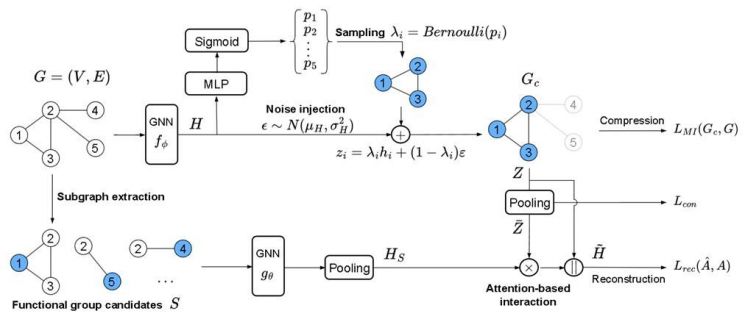 Overview of 'Subgraph Conditional Graph Information Bottleneck' developed by Professor Oh Jun Lee's team from the Department of Artificial Intelligence at Catholic University
 The research results are scheduled to be presented at the world’s most prestigious artificial intelligence conference, ‘AAAI 2025,’ recognizing their technical excellence.
As the role of artificial intelligence (AI) in new drug development grows, existing studies have faced the problem of relying on limited benchmark datasets. In response, the research team proposed a new graph neural network technique that overcomes data scarcity issues while improving the accuracy of molecular structure analysis and property prediction.
The ‘Subgraph-Conditioned Graph Information Bottleneck’ method developed by the team helps graph neural networks automatically identify key functional groups responsible for specific chemical reactions within molecules. Notably, it demonstrated performance surpassing existing technologies in ▲key functional group detection ▲property prediction of polymer materials ▲and enhanced model interpretability.
This research has significant potential applications not only in new drug development but also in new material development and chemical research across various industrial fields. The research team expects that applying the developed method will greatly improve the learning efficiency and prediction performance of graph neural networks, leading to more active use of AI models in the drug development process.
Professor Oh Jun Lee stated, “This research overcomes the limitations of existing graph neural network methods and presents new possibilities for molecular structure analysis. As the Department of Artificial Intelligence at Catholic University has been recognized globally by presenting research results at AAAI for two consecutive years, we will continue to pursue innovative research going forward.”
© The Asia Business Daily(www.asiae.co.kr). All rights reserved.
![Clutching a Stolen Dior Bag, Saying "I Hate Being Poor but Real"... The Grotesque Con of a "Human Knockoff" [Slate]](https://cwcontent.asiae.co.kr/asiaresize/183/2026021902243444107_1771435474.jpg)















