Loan Regulations, Political Instability, and Economic Downturn Concerns
Largest Drop in Sale Prices Seen in Seocho, Gangbuk, and Gwanak Districts
Last month, the apartment sale price per pyeong (3.3㎡) in Seoul fell below 40 million KRW. Concerns over an economic downturn and political turmoil combined to cause a 5.2% decrease compared to the previous month.
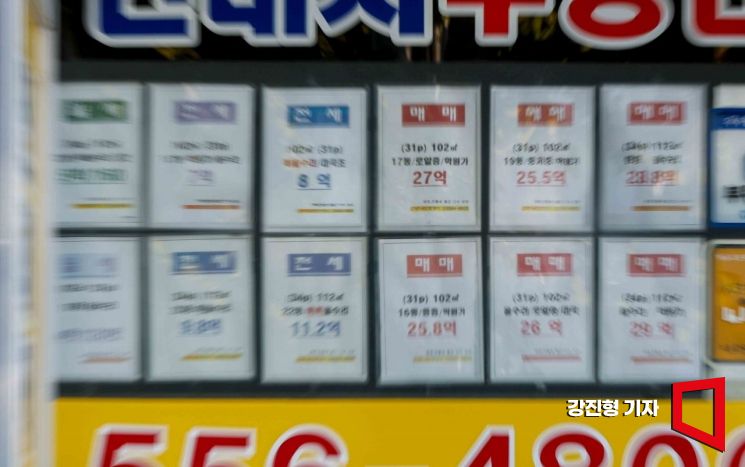 Due to the impact of loan regulations and other factors, apartment transactions have slowed down, causing listings to continue to accumulate. On the 24th, sale and jeonse (long-term lease) flyers were posted at a real estate office in Gangnam, Seoul. Photo by Kang Jin-hyung
According to Zigbang on the 17th, the apartment sale price per 3.3㎡ in Seoul in January was recorded at 39.96 million KRW. This is a 5.2% drop from the previous month (42.13 million KRW) and the lowest since August last year (40.11 million KRW). As of the 12th, the number of apartment transactions in Seoul in January was 2,343, the lowest level since December 2023 (1,789 transactions).
Since the fourth quarter of last year, loan regulations have been tightened, and with impeachment issues and external risk pressures at the beginning of this year, the domestic housing market atmosphere has rapidly cooled. As buying sentiment froze and transaction volume decreased, transactions focused on lower-priced properties, and the proportion of high-priced transactions declined, resulting in a lower average sale price.
The autonomous districts where the average sale price declined are △Seocho-gu -12.6%, △Gangbuk-gu -5.9%, △Gwanak-gu -5.6%, △Eunpyeong-gu -4.3%, and △Gangseo-gu -3.7%, in that order.
The average sale price per 3.3㎡ in Seocho-gu in January was 76.39 million KRW, down 12.6% from the previous month (87.42 million KRW). The number of transactions in Seocho-gu in January was 87, about 40% less than the previous month (146), influenced by a reduced share of transactions in landmark high-priced complexes such as Raemian One Bailey. Last month, the proportion of transactions exceeding 1.5 billion KRW in Seocho-gu was 74.7%, down 8.9 percentage points from December last year (83.6%).
In Gangbuk-gu, the average sale price per 3.3㎡ fell from 22.72 million KRW to 21.39 million KRW as transactions mainly involved low-priced properties in small complexes under 85㎡ exclusive area. In Gwanak-gu, the price decreased from 26.79 million KRW in December last year to 25.28 million KRW last month. Transactions were mainly of relatively inexpensive properties compared to market prices, such as a 113㎡ unit in Sillim-dong Samsung San Jugong sold for 670 million KRW and an 82㎡ unit in Gwanaksan Humansia 2 complex sold for 575 million KRW.
Areas where the average sale price increased last month include △Jongno-gu 31%, △Seodaemun-gu 10.7%, △Yeongdeungpo-gu 6.3%, △Yongsan-gu 5.8%, and △Dobong-gu 5.7%. Although transaction volume was not high in Jongno-gu, the 59㎡ unit in Gyeonghuigung Xi 3 complex set a new record price at 1.815 billion KRW. In Seodaemun-gu, units of 59㎡ in e-Pyeonhansesang Sinchon and Sinchon Prugio traded between 1.35 billion KRW and 1.545 billion KRW, raising the average sale price.
By area size, the price drop was largest in the segment exceeding 85㎡ exclusive area. The average sale price for units over 85㎡ in Seoul in January was 50.68 million KRW, down 6% from the previous month (53.89 million KRW). Due to liquidity concerns and the burden of purchase funds, transactions in medium to large-sized units decreased, resulting in a larger price drop compared to other size segments. Other segments showed changes of -2.8% for units 60㎡ or less and -4% for units between 60 and 85㎡.
Kim Eun-seon, head of the Big Data Lab at Zigbang, said, "With the third phase of the stress DSR (Debt Service Ratio) scheduled to be implemented in July, it is highly likely that the government's continued loan regulations will make it even more difficult for buying demand to recover. Some transactions are expected to occur in areas where land transaction permit zones have been lifted, which had previously been restricted, so there is a possibility that sale prices may rebound in February. However, the impact on the market will be limited."
© The Asia Business Daily(www.asiae.co.kr). All rights reserved.

















