Lowest in Four Years... Gap with Last Year's 1.5% Growth Rate
NYT: "Japan's Weak Yen Helps Exports,
But Causes Inflation and Weakens Consumer Purchasing Power"
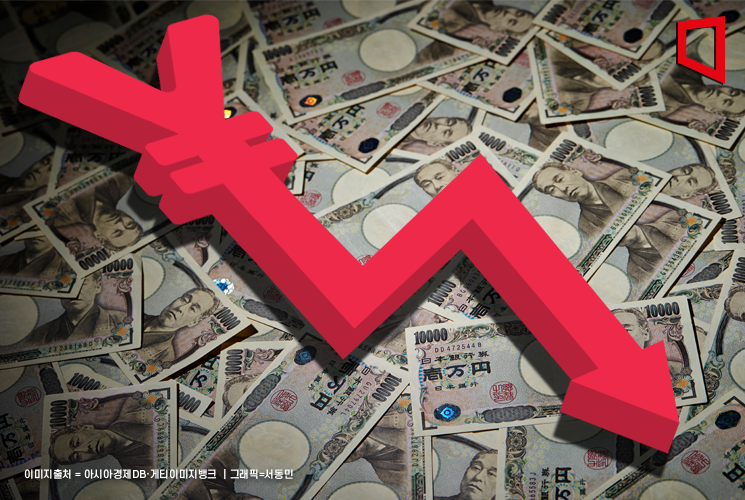
Japan's real gross domestic product (GDP) growth rate last year was recorded at 0.1%, the lowest in four years. As a result, Japan's economic growth rate, which surpassed Korea for the first time in 25 years in 2023, fell below Korea's again after just one year. Some critics argue that the intentional weak yen policy aimed at revitalizing export companies such as automakers has had the side effect of suppressing household consumption.
According to the preliminary GDP figures released by Japan's Cabinet Office on the 17th, the real GDP growth rate last year was only 0.1%. This is the lowest level since -4.2% in 2020. Japan's real growth rate showed a trend of negative growth in 2020, followed by 2.7% in 2021, 0.9% in 2022, and 1.5% in 2023.
Notably, in 2023, Japan's growth rate (1.5%) was higher than Korea's (1.4%), marking the first time in 25 years since the 1998 Asian financial crisis that Japan surpassed Korea. The Bank of Korea recently announced Korea's preliminary real GDP growth rate for last year as 2.0%. This means Korea has overtaken Japan once again.
Looking at Japan's quarterly real GDP growth rates last year (compared to the previous quarter, seasonally adjusted), the first quarter saw a contraction of -0.5%, followed by 0.7% in the second quarter, 0.4% in the third quarter, and 0.7% in the fourth quarter.
The contraction in Japan's economy in the first quarter is analyzed to have been caused by production halts at some automakers due to quality certification fraud issues. On the other hand, the fourth quarter exceeded market expectations due to increased exports. It surpassed Reuters' forecast of 0.3% and was also higher than the revised 0.4% GDP growth rate of the third quarter.
The New York Times (NYT) pointed to the weak yen policy aimed at promoting exports as the background for this low GDP growth rate. The weak yen policy led to inflation, which in turn negatively affected Japan's household consumption. Currently, the yen is valued at around 153 yen to the US dollar, the lowest level in 37 years.
NYT stated, "Maintaining a weak domestic currency to promote exports has long been used as an economic growth strategy. However, Japan's case shows that while a weak currency may help exports, it can worsen inflation and severely weaken consumers' purchasing power."
This argument is based on the declining indicators of Japanese household consumption. Household consumption in Japan slightly decreased in 2024, reversing the expansion trend of the previous three years. According to the '2024 Household Survey' released by Japan's Ministry of Internal Affairs and Communications, the average monthly consumption expenditure of households with two or more members last year was 300,243 yen (approximately 2.86 million won), a real decrease of 1.1% compared to the previous year. The average monthly spending per household reached 300,243 yen (about 2,865,730 won). The Engel index, which indicates the proportion of food expenditure in consumption spending for households with two or more members, was 28.3%, the highest level in 43 years since 1981.
NYT noted, "While increased consumer spending led the economic recovery after the COVID-19 pandemic in the United States, prolonged consumption stagnation in Japan has kept real GDP barely above pre-pandemic levels."
© The Asia Business Daily(www.asiae.co.kr). All rights reserved.

















