Outstanding Cost Competitiveness and Energy Efficiency:
New Facilities Scheduled for Completion in the First Half of 2026
Expected to Enhance Ulsan Petrochemical Downstream Competitiveness
and Contribute to Regional Economic Development
S-OIL (CEO: Anwar Al-Hujazi)'s Shahin Project is expected to contribute to fundamentally enhancing the competitiveness of the domestic petrochemical industry, which is currently facing difficulties due to the global demand growth slowdown, large-scale capacity expansions in China, and continued oversupply in the region.
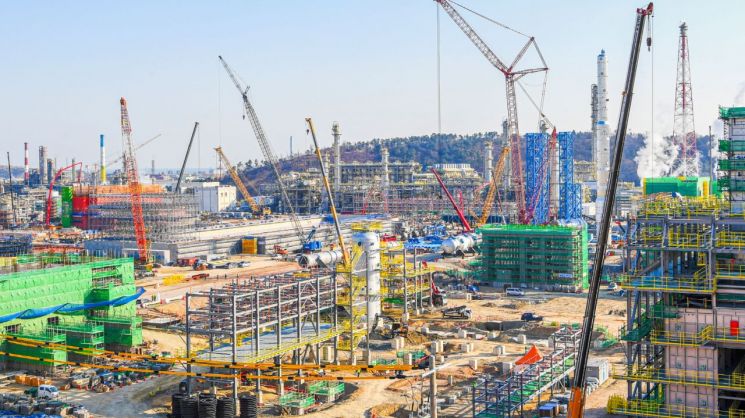 The S-OIL Shahin project is progressing smoothly with the goal of completion in the first half of next year at the Onsan National Industrial Complex in Ulsan. Photo by S-OIL
The Shahin Project, the largest investment in the history of the domestic petrochemical industry at KRW 9.258 trillion, has surpassed 55% completion in its EPC (Engineering, Procurement, and Construction) phase and is progressing smoothly toward completion in the first half of 2026.
After commercial operation begins in the second half of next year, it will produce basic feedstocks such as ethylene (1.8 million tons), propylene (770,000 tons), butadiene (200,000 tons), and benzene (280,000 tons). Among these, polyethylene (LLDPE 880,000 tons, HDPE 440,000 tons), used for producing various synthetic materials including plastics, will be produced in-house using ethylene as the raw material.
S-OIL plans to supply the basic feedstocks produced at the Shahin Project facilities?new petrochemical plants with excellent cost competitiveness and high energy efficiency?mainly through pipelines to domestic petrochemical downstream companies.
Construction of logistics-related infrastructure, including new pipeline networks, is underway simultaneously. Long-term agreements for stable raw material supply are being signed one after another between S-OIL and petrochemical companies located in the Ulsan and Onsan National Industrial Complexes, which is expected to serve as a catalyst for elevating the competitiveness of the domestic value chain to the next level.
Amid fierce competition due to large-scale new and expanded facilities in overseas markets, expectations are growing that the Shahin Project will contribute to strengthening the competitiveness of domestic petrochemical downstream sectors producing various derivatives. Furthermore, it is anticipated that this will have positive ripple effects on the new and expanded facilities of petrochemical companies and the regional economy.
An S-OIL official stated, “By supplying raw materials to downstream companies in a timely and stable manner, we not only provide cost savings in transportation within the value chain but also expect to create a competitive petrochemical industry cluster that will positively impact regional economic revitalization and the long-term strengthening of national industrial competitiveness.”
The Shahin Project is constructing facilities such as TC2C (a facility that directly converts crude oil into petrochemical feedstocks), steam crackers (ethylene production facilities), and storage facilities on approximately 480,000 square meters of land adjacent to the S-OIL Ulsan Complex in the Onsan National Industrial Complex.
Additionally, a polymer plant is being built on about 400,000 square meters of land in the Dangwol area of Ulju-gun to produce high value-added polymer products using ethylene produced from the steam cracker as raw material.
The Shahin Project plans to secure outstanding competitive advantages in cost competitiveness and energy efficiency by introducing the world’s first commercialized TC2C new technology.
The core facility, TC2C (Thermal Crude to Chemical), is an optimized process designed to increase the production of petrochemical raw materials such as naphtha and is expected to enable the production of petrochemical products with lower carbon intensity compared to traditional petrochemical industries.
TC2C was developed using proprietary technology from Saudi Aramco, S-OIL’s parent company, and is scheduled for the world’s first commercial operation through the Shahin Project. It refines crude oil and other raw materials using new separation and catalytic technologies rather than traditional methods, incorporating new technology that achieves 3 to 4 times higher yield of petrochemical feedstock fractions compared to existing facilities.
During the license process design package phase, the Shahin Project incorporated various cost-saving ideas to achieve the highest energy efficiency, reaching the first quartile (top 25% in the industry) in the energy intensity index, thereby reducing carbon emissions.
S-OIL plans to construct a 150MW-scale natural gas self-power generation facility to improve energy efficiency and reduce carbon emissions. All electricity produced by this power generation facility will be supplied to operate the Shahin Project facilities, enhancing operational stability. By replacing externally sourced electricity, it is expected to reduce costs and allow flexible operation depending on the plant’s electricity demand.
Furthermore, the high-temperature exhaust gas generated from the self-power generation facility will not be released directly into the atmosphere but will be recovered through a waste heat recovery boiler to produce high-pressure steam, which will be recycled for plant operations. This will reduce the operation of existing steam production boilers, thereby lowering both direct and indirect carbon dioxide emissions from the plant.
An S-OIL official said, “Considering the Shahin Project’s energy and carbon reduction new technologies and operational efficiency levels, it is expected to be an important turning point in fundamentally enhancing the competitiveness necessary for the sustained growth of the heavy chemical industry, which has played a central role in the national economy.”
© The Asia Business Daily(www.asiae.co.kr). All rights reserved.
![Clutching a Stolen Dior Bag, Saying "I Hate Being Poor but Real"... The Grotesque Con of a "Human Knockoff" [Slate]](https://cwcontent.asiae.co.kr/asiaresize/183/2026021902243444107_1771435474.jpg)
















