"Semiconductor Tariffs Will Be Passed on to Consumers... Even Nvidia Will Be Impacted"
As U.S. President Donald Trump is reportedly pushing for a renegotiation of the semiconductor law (Chips Act) subsidies, experts have pointed out that repealing the semiconductor law, renegotiating subsidies, or imposing semiconductor tariffs could become obstacles to the development of the U.S. artificial intelligence (AI) industry, AP News reported on the 16th (local time).
Experts warned that the Trump administration's approach could harm the U.S.'s ability to maintain a competitive edge in AI research. Saikat Chaudhuri, a professor at UC Berkeley Haas School of Business and an expert in corporate growth and innovation, evaluated that one of the biggest obstacles to AI advancement is semiconductor production, and it is surprising that President Trump is reconsidering the semiconductor law while most countries are promoting semiconductor production and encouraging low-cost semiconductor imports. He said, "We have seen how the shortage of semiconductors affects everything from AI to automobiles," adding, "During the COVID-19 pandemic, automakers had to use fewer semiconductors or less powerful semiconductors to address supply constraints."
The Biden administration enacted the semiconductor law to expand domestic semiconductor production and reduce Asia-dependent security vulnerabilities, providing a total of $52.7 billion over five years, including $39 billion in direct subsidies to semiconductor companies building factories in the U.S. and $13.2 billion in research and development (R&D) subsidies. According to the U.S. Department of Commerce, as of August last year, the semiconductor law created 115,000 manufacturing and construction jobs through 23 projects in 15 states. AP News reported that at the beginning of the Biden administration, the U.S. had a 0% share in the global advanced chip production sector, which has since risen to 30%.
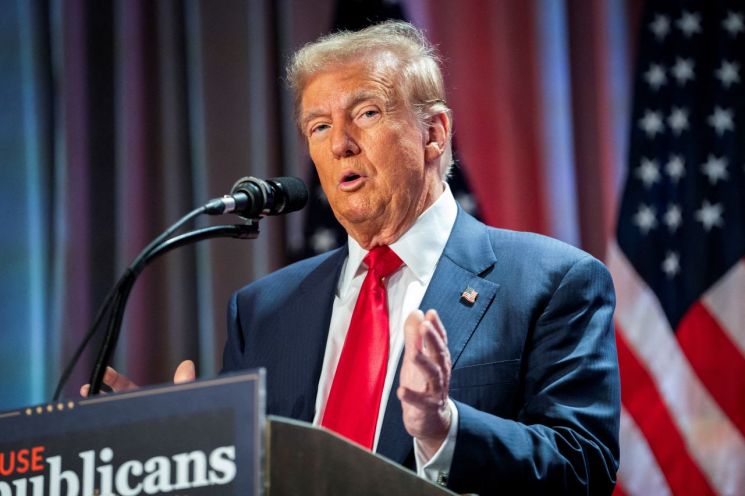
On the other hand, President Trump argues that subsidies are unnecessary to incentivize foreign companies like Taiwan's TSMC to produce semiconductors in the U.S. Instead, he believes companies should build factories in the U.S. without receiving subsidies if they want to avoid paying tariffs. On the 13th, President Trump said, "We must make semiconductors in the U.S.," adding, "Taiwan has taken away America's semiconductor industry. We want to get that business back."
Professor Chaudhuri pointed out that if the Trump administration imposes tariffs on semiconductors, the prices of products containing semiconductors will rise and be passed on to consumers. He also noted that although companies currently have high enough margins to absorb tariff costs, eventually even giants like Nvidia will suffer from the tariffs. He said, "Everyone will be negatively affected by this," adding, "Except for countries that competitively jump on the bandwagon and say they will introduce something like the semiconductor law, no one will benefit."
Brett House, a professor at Columbia Business School, pointed out that tariffs would not only increase costs for businesses and households overall but also significantly raise the cost of high-performance chips, one of the most critical elements of the U.S. AI sector. Professor House warned, "If broad tariffs are imposed on AI and other computer technology imports while the semiconductor law is halted, repealed, or threatened, it would seriously damage the industry." He predicted that tariffs would reduce domestic semiconductor manufacturing capacity, send signals of policy uncertainty to investors, dampen new capital allocation to the domestic industry, and increase the cost of semiconductor imports.
© The Asia Business Daily(www.asiae.co.kr). All rights reserved.

















